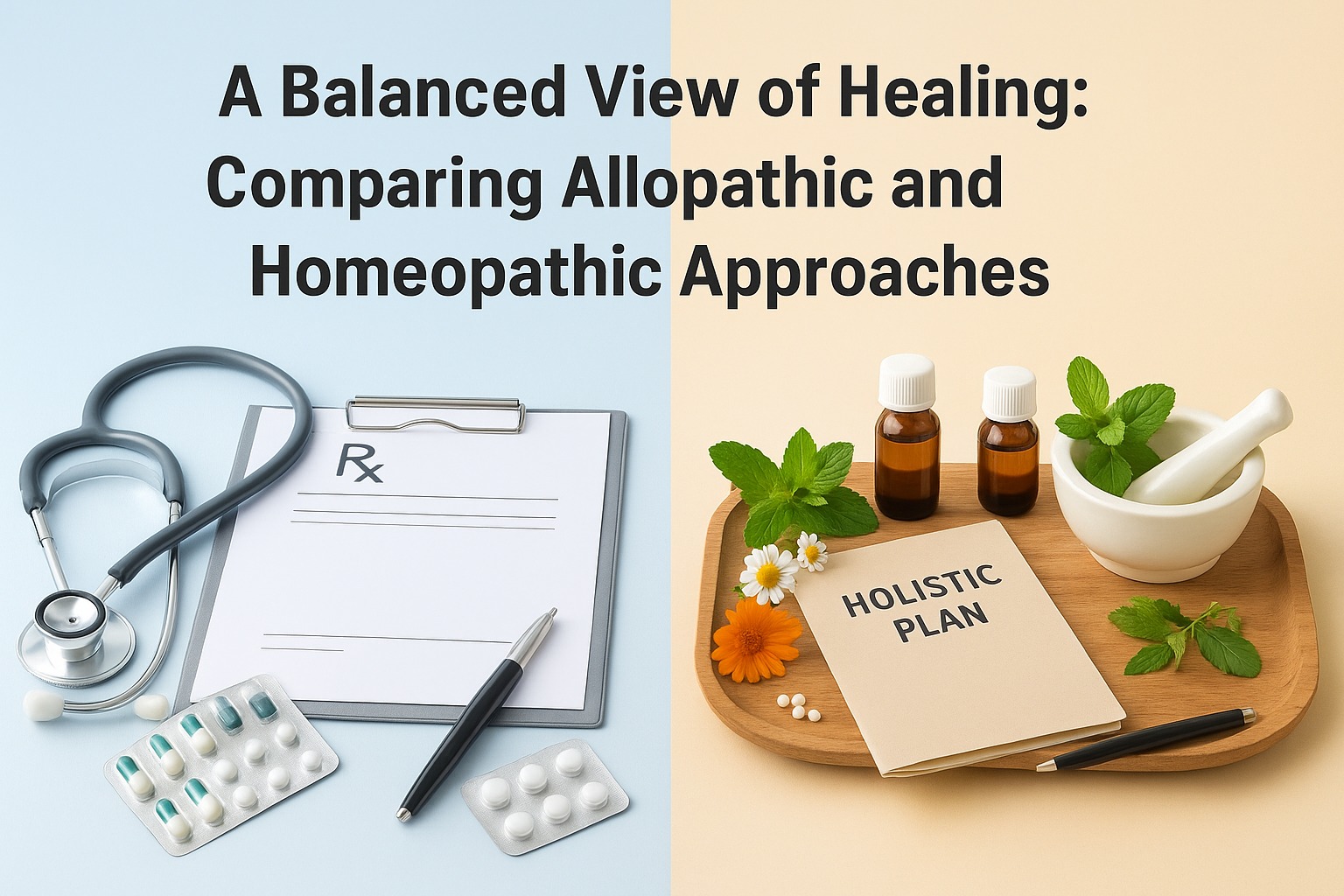
A balanced, evidence-aware guide to how conventional medicine and classical homeopathy each approach health — and where they meet
Patients today rarely choose just one system of medicine. Many take a prescribed medication for blood pressure while also seeing a homeopath for stress, or use surgery to fix a structural problem while turning to lifestyle and constitutional remedies to support long-term wellbeing. Understanding how Allopathy (conventional medicine) and Homeopathy actually differ — and where each genuinely excels — helps patients make informed, confident choices rather than relying on assumptions from either side.
This article offers a clear, respectful comparison of both systems: their philosophy, their evidence base, their safety profile, and how they can work together rather than in competition.
Two Different Philosophies of Healing
Conventional medicine is built on the scientific method. It identifies a disease mechanism — a bacterial infection, a blocked artery, an autoimmune process — and applies a targeted intervention: a drug, a procedure, or surgery. Its guiding idea is often summarized as “opposites treat opposites”: an anti-inflammatory reduces inflammation; an antihypertensive lowers blood pressure.
Classical homeopathy, founded by Dr. Samuel Hahnemann over two centuries ago, follows a different principle: “like cures like” (Similia Similibus Curentur). A substance that can produce certain symptoms in a healthy person is prepared, through a process of serial dilution and vigorous shaking called potentization, and given to a patient with similar symptoms. Homeopaths describe this as stimulating the body’s own regulatory and healing response, rather than directly correcting a biochemical pathway. The mechanism by which highly diluted preparations might act is still debated within mainstream science, and this is an honest, openly acknowledged point of difference between the two systems — one worth understanding rather than glossing over.
How Each System Approaches Illness
Conventional medicine excels at identifying what is wrong using laboratory tests, imaging, and structured clinical evaluation, then targeting that specific abnormality. This precision is why it remains unmatched in emergencies, trauma, infections requiring antibiotics, and conditions needing surgery.
Homeopathy instead asks who is unwell — taking into account a person’s emotional state, physical symptoms, personality, sleep, stress response, and overall life pattern before selecting a single, individualized remedy. Two patients with the same diagnosis may receive entirely different remedies, because homeopathy treats the whole person’s symptom picture, not the disease label alone.
Dosage, Evidence, and Honest Scientific Standing
Pharmaceutical drugs are prescribed in precisely measured doses, calculated by weight, age, and organ function, and their effects are studied extensively through randomized controlled trials and regulatory review by bodies such as the WHO, the US FDA, and the UK’s NICE. This rigorous evidence base is one of conventional medicine’s defining strengths.
Homeopathic remedies, by contrast, are used in extremely high dilutions. Regulatory treatment of homeopathic products varies by country and continues to evolve — for example, U.S. regulators have moved toward more active, risk-based oversight of products labelled as homeopathic, reflecting a broader global trend toward clearer manufacturing and safety standards even as scientific debate about mechanism continues. Clinical research on individualized homeopathy exists for a number of chronic and functional complaints, though the overall evidence base remains smaller and more mixed than that supporting conventional drugs. Readers are best served by an honest picture: homeopathy is widely used and reported as helpful by many patients, while rigorous, large-scale proof of mechanism is still developing.
Speed of Action and Best-Fit Situations
Conventional medicine is generally the right choice for situations requiring fast, decisive intervention — severe infections, heart attacks, fractures, acute pain, and surgical emergencies. For many chronic conditions, however, treatment often focuses on long-term symptom control rather than a complete cure.
Homeopathy tends to act more gradually and is commonly used for chronic, functional, and stress-related conditions — recurring digestive trouble, certain skin complaints, sleep difficulty, and emotional strain — where patients are often looking for a gentler, longer-term approach alongside their regular medical care.
Safety Considerations
Conventional medicines, particularly those used long-term, can carry real risks — gastrointestinal upset, strain on the liver or kidneys, hormonal effects, or allergic reactions — which is exactly why ongoing monitoring by a physician matters. Homeopathic remedies, due to their high dilution, are generally well tolerated and are often used by children, pregnant women, and people sensitive to standard medications. “Generally safe,” however, is not the same as “harmless if self-prescribed without guidance” — selecting the wrong remedy mainly wastes time rather than causing direct harm, but it is still not a substitute for proper diagnosis, especially for anything serious or unexplained.
Classical Homeopathy: Treating the Individual
A defining feature of classical homeopathy is that remedy selection is never based on a diagnosis alone — it is based on the total symptom picture of the individual. The following are commonly considered remedies for everyday chronic and stress-related complaints, intended here purely to illustrate this principle of individualisation rather than as a self-prescribing guide:
• Arsenicum album — for anxious, restless patients with a strong need for order and reassurance, often with digestive or skin sensitivity
• Nux vomica — for the overworked, irritable person with digestive complaints worsened by stress, coffee, or rich food
• Natrum muriaticum — for reserved individuals who internalise grief or disappointment, with a tendency toward headaches or dry skin
• Pulsatilla — for gentle, emotionally changeable patients whose symptoms shift with mood and who seek comfort and reassurance
• Sulphur — for chronic, recurring skin or digestive complaints in patients with a generally warm-blooded, untidy constitution
• Lycopodium — for digestive bloating and a lack of self-confidence masked by outward assertiveness
• Calcarea carbonica — for steady, hardworking but easily fatigued individuals prone to chronic colds or joint stiffness
• Ignatia amara — for acute grief, emotional shock, or suppressed sadness, often with sighing and oversensitivity
A qualified classical homeopath matches the remedy to a person’s complete picture — physical, emotional, and constitutional — which is why a proper consultation, rather than self-treatment from a list, gives the most reliable results.
Lifestyle Modification: A Shared Foundation for Both Systems
Regardless of which treatment path a patient follows, daily habits strongly influence health outcomes:
• Diet — regular meals, adequate hydration, and reduced ultra-processed food intake support both digestion and emotional stability
• Sleep — a consistent bedtime and wind-down routine improve hormonal balance and stress resilience
• Exercise — regular moderate activity benefits cardiovascular, metabolic, and mental health alike
• Stress management — breathing exercises, time outdoors, and reducing unnecessary screen time lower the physical toll of chronic stress
• Habits — moderating caffeine, alcohol, and smoking supports recovery from almost any chronic condition, whichever treatment is chosen
Lifestyle change is not a replacement for proper diagnosis or treatment, but it consistently improves outcomes alongside either system.
Mind | Body | Deen: Healing Beyond the Physical
Islam has long recognized that physical illness, emotional state, and spiritual condition are deeply connected. The Qur’an reminds believers: “And when I am ill, it is He who cures me” (Qur’an 26:80) — a verse that places ultimate healing in Allah’s hands while still encouraging the believer to seek treatment, exactly as the Prophet Muhammad (peace be upon him) instructed: “Make use of medical treatment, for Allah has not made a disease without appointing a remedy for it” (Sunan Abu Dawud).
This balance — seeking the best available treatment while trusting Allah as the ultimate source of healing — is the foundation of the Mind | Body | Deen approach. Whether a patient chooses conventional medicine, classical homeopathy, or both together, sincerity in seeking help, patience during recovery, and gratitude in health all remain acts of faith. Emotional burdens such as anxiety, grief, or unresolved fear often manifest physically; addressing them spiritually, through remembrance of Allah and trust in His plan, frequently supports the body’s own capacity to heal alongside whatever treatment is being followed.
Common Questions Patients Ask
Can I use homeopathy alongside my regular prescribed medication? Many patients do use both, but any change to a prescribed medication should only be made in consultation with the prescribing doctor — never stopped or adjusted independently.
Is homeopathy a substitute for emergency or surgical care? No. Conditions requiring urgent diagnosis, surgery, or emergency treatment should always be managed by conventional medicine first.
Which system should I choose? This depends on the condition. Acute, emergency, or structural problems are best managed conventionally; chronic, functional, and stress-related complaints are where many patients explore classical homeopathy as a complementary option, ideally with both their doctor and homeopath aware of the full picture.
Conclusion: Toward an Integrative Approach
Allopathy and homeopathy are built on different philosophies, but both aim to relieve suffering and restore health. Conventional medicine remains indispensable for emergencies, infections, and structural disease, supported by a strong evidence base. Classical homeopathy offers an individualized, gentle approach that many patients find valuable for chronic and stress-related conditions, alongside — not instead of — appropriate medical care. The most patient-centered path forward is often an integrative one: using each system where it is strongest, supported by sound lifestyle habits and spiritual grounding, with the patient’s safety and informed choice always placed first.
Dr. Benojir
Classical Homeopath & Islamic Life Coach
Mind | Body | Deen
“We Treat; Allah Heals”