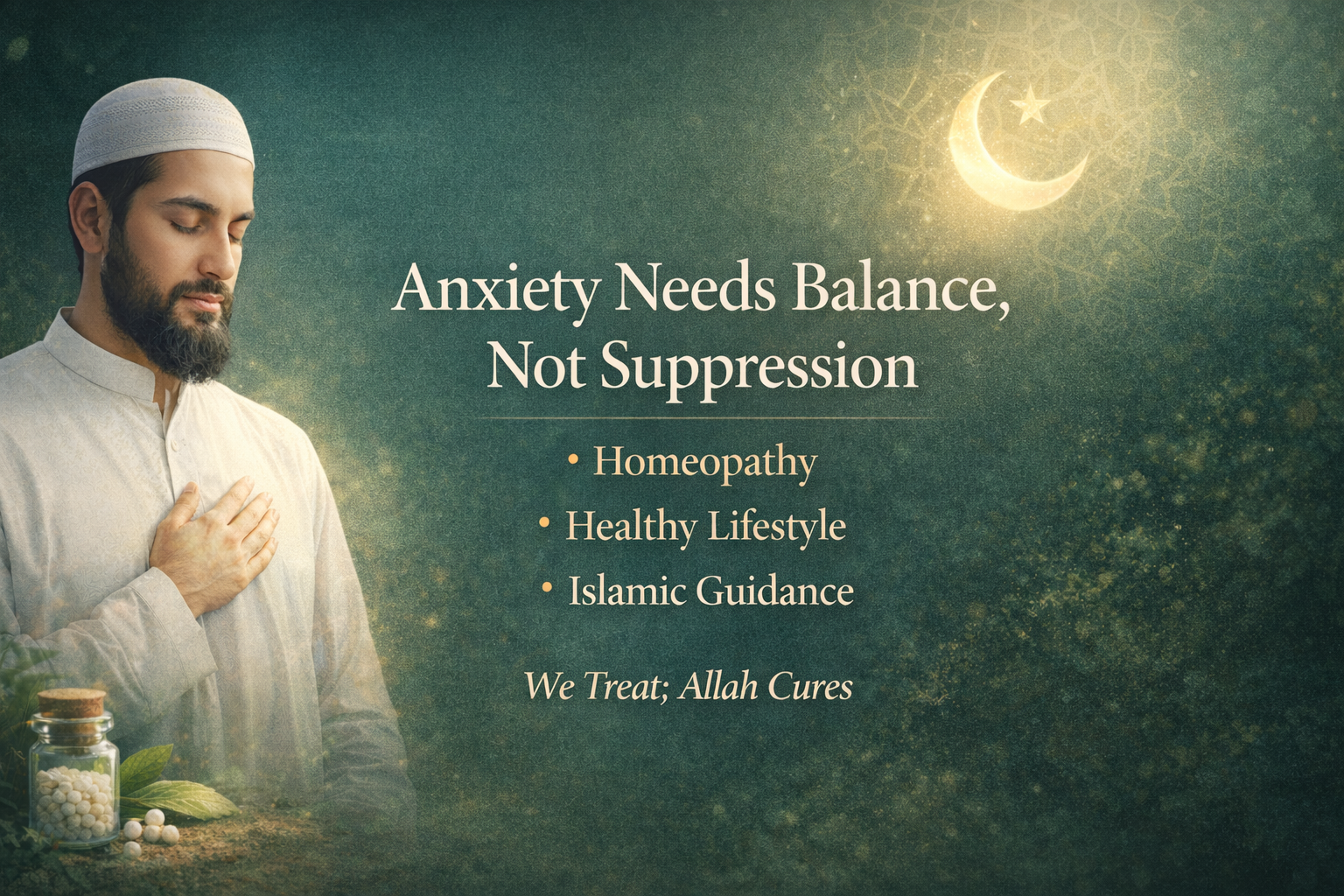
How Modern Medicine, Classical Homeopathy, Lifestyle Wisdom, and Faith Can Work Together for Lasting Calm
If your heart races before an ordinary meeting, if you replay tomorrow’s worries long after midnight, or if a tight, breathless feeling visits you without warning, you are far from alone. Recent global health research estimates that anxiety disorders affect close to 301 million people worldwide, making anxiety the most common mental health condition tracked by international health bodies today. The numbers are rising fastest among young people, with incidence among those aged 10 to 24 climbing by more than 50 percent between 1990 and 2021. Anxiety is not a personal failing or a sign of weak character. It is a deeply human signal, and understanding it is the first real step toward calm.
This article brings together four perspectives that, together, offer a complete picture of anxiety care: the established role of modern medicine, the individualised philosophy of classical homeopathy, the proven power of lifestyle medicine, and the grounding strength of faith. None competes with the other. Each has its place.
Understanding Anxiety: What Is Actually Happening
Anxiety is the body’s built-in alarm system. When the brain senses a threat, real or imagined, it releases stress hormones that prepare the body to react quickly. In short bursts, this response is useful; it sharpens focus and readies the body for action. Anxiety becomes a concern when this alarm refuses to switch off, firing repeatedly even when no real danger is present.
Doctors generally distinguish ordinary, situational nervousness from an anxiety disorder by looking at intensity, duration, and impact on daily life. If worry, fear, or physical tension persists for weeks, interferes with sleep, relationships, or work, and feels disproportionate to the actual situation, it may have crossed from a passing feeling into a pattern that benefits from professional evaluation and a clear diagnosis.
Common Symptoms and Risk Factors
Anxiety expresses itself differently in different people. Common signs include:
• Persistent, hard-to-control worry
• Restlessness or a constant sense of being on edge
• A racing heartbeat or palpitations
• Shortness of breath or a tight chest
• Digestive discomfort, nausea, or appetite changes
• Difficulty falling or staying asleep
• Muscle tension, trembling, or unexplained fatigue
• Irritability or difficulty concentrating
Several factors raise the risk of developing anxiety, including prolonged or unmanaged stress, irregular sleep, hormonal changes, a family history of anxiety, past trauma, chronic physical illness, excessive caffeine or stimulant use, and constant exposure to news and social media. Most people experience anxiety from a combination of these factors rather than a single cause.
Left unaddressed, anxiety can quietly affect sleep quality, digestion, blood pressure, relationships, and work performance, and it frequently overlaps with low mood. Severe or sudden panic attacks, anxiety that does not improve despite self-care, or any thoughts of self-harm deserve prompt medical or psychiatric attention rather than home management alone.
Modern Medicine: A Vital First Line of Care
For moderate to severe anxiety, structured talk therapies such as cognitive behavioural therapy, alongside medication when appropriate, remain well-established and often essential treatments. These approaches are respected throughout this article and should never be paused or replaced without a treating doctor’s guidance. For many people, the most realistic and effective path combines professional medical care with the lifestyle and supportive measures discussed below.
Classical Homeopathy: Treating the Person Behind the Anxiety
Classical homeopathy does not treat “anxiety” as a single, uniform diagnosis. It looks instead at how one particular person experiences it: what triggers it, what makes it better or worse, what physical sensations accompany it, and what kind of personality and life history surround it. Two people who both describe themselves as anxious may need entirely different remedies once their complete picture is taken into account. A qualified homeopath gathers this detailed history before selecting a remedy; the notes below are educational only and are not a substitute for individualised professional assessment.
Some remedies commonly studied in anxiety case-taking include:
• Argentum nitricum — for anticipatory anxiety before exams, performances, or travel, often with trembling, hurried movements, and a sudden urge to use the bathroom before the event.
• Arsenicum album — for anxiety about health and security, with restlessness despite physical exhaustion, symptoms worse after midnight, and a fastidious, detail-oriented temperament.
• Aurum metallicum — for anxiety bound up with a strong sense of duty and fear of failure, often with worry about heart health and deep sensitivity to criticism.
• Helleborus niger — for anxiety that has tipped into mental exhaustion, with slowed responses, dullness, indifference, and quiet weeping, often after a long period of stress or illness.
• Kali arsenicosum — for anxiety centred on health, particularly fear of heart disease, with restlessness, being easily startled, and disturbed, anxious dreams.
• Phosphorus — for sensitive, imaginative individuals with sudden, intense fears, especially of illness or being alone, who feel better quickly with company, reassurance, and gentle distraction.
• Nitricum acidum — for health-related anxiety mixed with fear of death, often alongside irritability, bitterness over past hurts, and harsh self-criticism over mistakes.
• Veratrum album — for anxiety with cold sweat and restlessness, pitiful or despairing complaints, and racing fearful thoughts that persist even amid company or distraction.
• Rhus toxicodendron — for anxiety with marked physical restlessness, an inability to stay in one position, symptoms worse at night and with inactivity, and relief through gentle movement.
• Bryonia alba — for anxiety about the future, work, or financial security, with irritability, a desire to be left entirely alone, and relief from stillness and quiet.
Lifestyle Modification: Building a Foundation for Calm
No remedy, conventional or homeopathic, works in isolation from daily habits. Several adjustable factors meaningfully influence anxiety.
Sleep. Irregular or insufficient sleep both worsens anxiety and is worsened by it. A consistent sleep and wake time, even on weekends, is one of the most effective free interventions available.
Diet. Excess caffeine, high sugar intake, and irregular meals can intensify nervous tension. Steady, balanced meals support more even energy and mood throughout the day.
Exercise. Regular movement, even brisk walking for twenty to thirty minutes most days, lowers circulating stress hormones and is associated with measurable reductions in anxious symptoms in research on mild to moderate cases.
Stress management. Simple daily practices such as slow breathing, brief mindfulness pauses, or journaling help interrupt the cycle of repetitive worry before it escalates.
Digital boundaries. Constant exposure to news and social media feeds comparison and overstimulation. Setting specific, limited windows for checking devices, especially before bed, noticeably reduces background mental noise.
These changes are not dramatic overhauls; they are small, sustainable daily commitments that compound over time.
Mind | Body | Deen: A Complete View of Anxiety
Anxiety is rarely only a medical or psychological event; it touches the heart as well. From an Islamic perspective, anxiety is part of the shared human experience, not a sign of weak faith. The Qur’an describes hearts finding true rest in the remembrance of Allah, reminding believers that comfort of the heart comes through conscious connection rather than control of every outcome (Qur’an 13:28).
This is paired with reassurance about limits: Allah does not place upon a person a burden heavier than they can bear (Qur’an 2:286), a verse many scholars highlight as a direct response to the perfectionistic, catastrophic thinking that often fuels anxiety. The Prophet Muhammad (peace be upon him) is reported to have taught that no fatigue, sorrow, or distress touches a believer, even something as small as a thorn’s prick, without spiritual benefit accompanying it (Sahih al-Bukhari, 5641). This teaching does not glorify suffering; it reframes it, removing shame from the experience of anxiety itself.
Three practical concepts support this mind-body-deen approach. Sabr, or patience, is active perseverance rather than passive endurance. Shukr, or gratitude, gently redirects attention from feared futures to present blessings. Tawakkul, or trust in Allah, means doing one’s genuine best in seeking treatment, whether medical, homeopathic, or lifestyle-based, while releasing the outcome. Together, these principles do not replace treatment; they support the person receiving it.
Common Questions Patients Ask
Is anxiety a sign of weak faith?
No. Anxiety is a recognised health condition with physical, emotional, and circumstantial causes; it affects devout and non-religious people alike.
Can homeopathy be combined with prescribed anxiety medication?
In many cases, yes, but both the prescribing doctor and the homeopath should be kept informed, and medication should never be stopped or adjusted without medical guidance.
How quickly does homeopathic treatment work?
This varies widely. Anxiety linked to a recent, specific trigger may respond within weeks; longer-standing patterns generally need months of consistent case-taking and follow-up with a qualified practitioner.
When should I see a doctor rather than trying home approaches alone?
If anxiety significantly disrupts daily life, includes panic attacks, or involves any thoughts of self-harm, prompt medical or psychiatric evaluation is essential.
A Balanced Path Forward
Homeopathy is not a substitute for emergency psychiatric care, and severe anxiety, panic disorder, or any thoughts of self-harm always warrant immediate professional attention. For many people experiencing mild to moderate anxiety linked to stress, lifestyle, or emotional strain, a person-centred approach that combines appropriate medical guidance, individualised homeopathic care, sustainable lifestyle change, and spiritual grounding offers a realistic and respectful path forward. Anxiety is a signal that something, rest, boundaries, emotional expression, or connection, needs attention; it is not proof that something is wrong with who you are. Healing unfolds gradually, through small, repeated choices, not overnight transformation.
Selected references
World Health Organization, Anxiety Disorders Fact Sheet (2025). • Global Burden of Disease Study 2021, published in Depression and Anxiety (2025). • Rising global burden of anxiety disorders among adolescents and young adults, 1990–2021. • Qur’an 13:28 and 2:286. • Sahih al-Bukhari, Hadith 5641.
Dr. Benojir
Classical Homeopath & Islamic Life Coach
Mind | Body | Deen
“We Treat; Allah Heals”