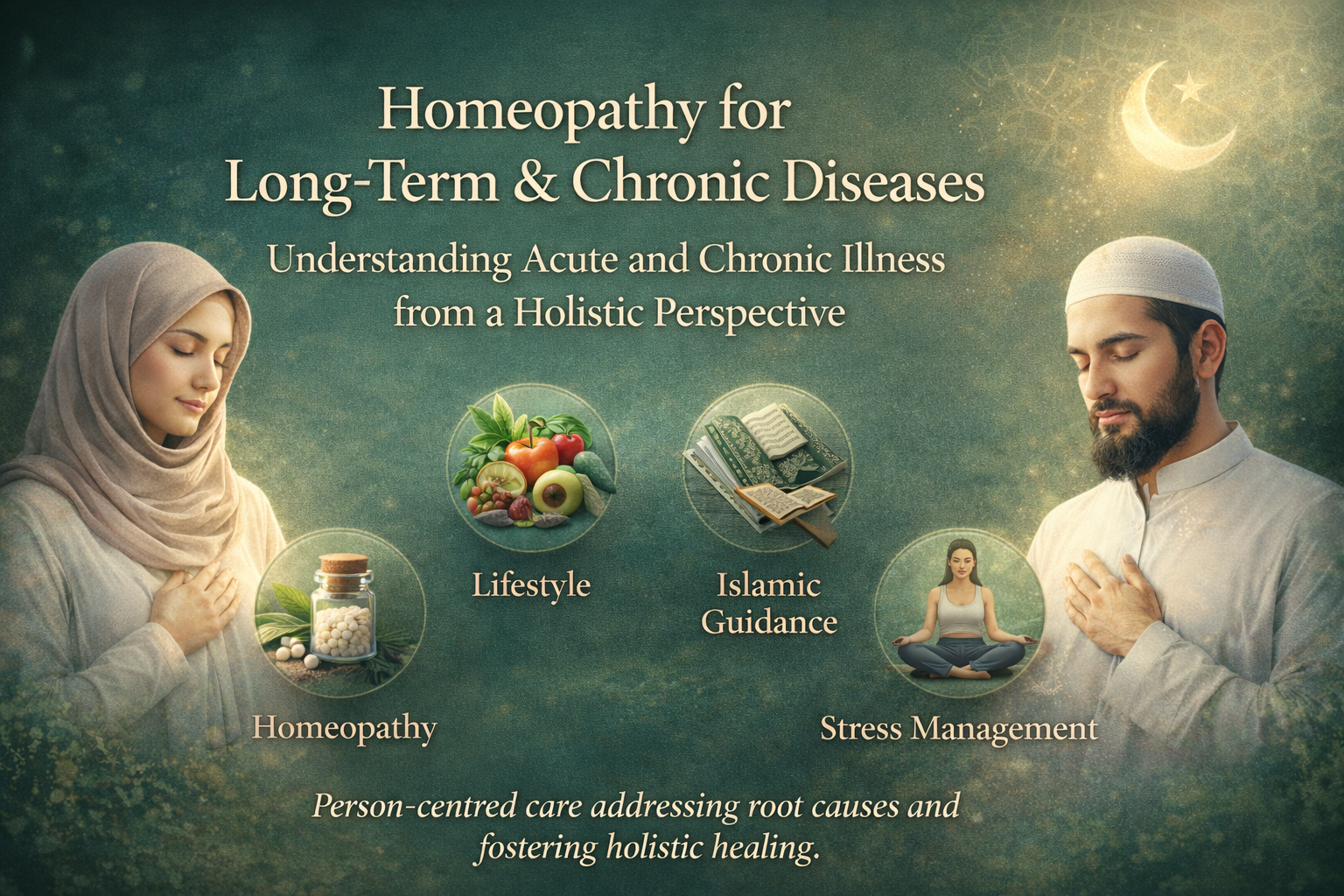
Understanding acute and chronic disease, and how classical homeopathy, lifestyle, and faith can support long-term wellbeing
Can Long-Term Illness Really Be Helped?
“Can homeopathy really help with a long-term or ‘incurable’ disease?” This is one of the most thoughtful questions patients ask, and it deserves an honest answer. To answer it responsibly, it helps to first understand the real difference between acute and chronic illness, and how different systems of medicine approach each one. Health, after all, is not only about quick relief; it is about long-term balance across the body, the emotions, and even the spirit.
Acute vs. Chronic Disease: What Is the Difference?
Acute conditions appear suddenly and usually resolve within days to a few weeks — fever, flu, diarrhoea, food poisoning, and minor infections are common examples. With proper care, the body typically recovers quickly, and homeopathy can sometimes offer gentle support for mild acute symptoms, though severe or life-threatening situations always require immediate medical attention.
Chronic conditions develop gradually and persist for months or years, often fluctuating between better and worse periods. The U.S. Centers for Disease Control and Prevention broadly defines a chronic disease as one that lasts a year or more and requires ongoing medical attention, limits daily activities, or both. Thyroid disorders, type 2 diabetes, hypertension, asthma, allergic conditions, eczema and psoriasis, PCOS, migraine, arthritis, irritable bowel syndrome, and anxiety all fall into this category. Many patients take long-term medication simply to keep lab values within a normal range — and it is exactly this experience that leads many people to explore complementary approaches like homeopathy.
What Does “Incurable” Actually Mean?
The word incurable can sound more final than it really is. In most cases, it does not mean the body is incapable of improving; it means that, by conventional medical standards, the condition needs long-term management rather than complete elimination. Blood sugar may be controlled, yet the underlying tendency toward diabetes remains. Blood pressure may stabilise, yet the stress pattern behind it can persist. Topical creams may calm a flare of eczema, yet flare-ups return.
Classical homeopathy does not claim to cure every chronic disease — that would be neither ethical nor honest. It is also worth noting that health agencies such as the U.S. National Center for Complementary and Integrative Health point out that scientific evidence for homeopathy's effectiveness in specific diseases remains limited and is still debated, even as the World Health Organization recognises such complementary systems as a widely used, often underutilised resource for lifestyle-related chronic disease support. With this balanced understanding, homeopathy's real focus is on why the imbalance developed in the first place, and how the body's own regulating capacity can be gently supported over time.
How Classical Homeopathy Approaches Chronic Disease
Classical homeopathy is person-centred and root-cause oriented. Rather than looking at lab reports alone, a homeopath typically asks: When did the symptoms begin, and what was happening in the person’s life at that time? What emotional patterns tend to repeat? How does the person react to weather, food, sleep, or stress? What is their overall vitality and resilience? Two people with an identical diagnosis can receive completely different remedies, because the goal is not to suppress a symptom but to gradually encourage the body’s internal balance to regulate itself.
Classical Homeopathy: Commonly Considered Remedies
A defining feature of classical homeopathy is individualization — remedy choice depends on the whole person, not the diagnosis alone. The remedies below are shared for educational purposes only and should never be self-prescribed without a full consultation with a qualified homeopath.
• Calcarea Carbonica — often considered for sluggish thyroid function or PCOS-related weight gain; suits individuals who feel chilly, tire easily, and crave sweets.
• Sepia — associated with hormonal exhaustion in PCOS or thyroid imbalance, especially with irritability, low energy, and indifference toward usual responsibilities.
• Pulsatilla — frequently indicated for allergic rhinitis with changeable, watery discharge; suits gentle, mild-tempered individuals whose symptoms ease in open air.
• Arsenicum Album — considered for asthma or eczema that worsens at night, marked by anxiety, restlessness, and a burning quality to symptoms.
• Natrum Sulphuricum — sometimes used for asthma that worsens in damp weather, alongside skin eruptions linked to sluggish digestion.
• Sulphur — associated with chronic, recurring skin conditions such as psoriasis, in individuals who feel overheated and tend to be untidy or intellectually curious.
• Ignatia Amara — considered for migraines that follow emotional shock or quietly suppressed grief.
• Lycopodium — often indicated in IBS with bloating and digestive discomfort that worsens in the late afternoon, in individuals who appear confident outwardly but feel insecure within.
As with any condition, remedy selection always depends on the complete clinical picture, not the diagnosis alone, and should be guided by a qualified homeopath.
Lifestyle Modification: Building Long-Term Stability
No chronic condition improves sustainably without supportive daily habits.
Sleep: irregular sleep disrupts both hormonal and metabolic balance, so a consistent schedule matters as much as total duration.
Nutrition: balanced, mindful meals that avoid extremes support digestive and metabolic stability, particularly in PCOS, IBS, and thyroid-related weight changes.
Physical activity: moderate, consistent movement improves circulation, reduces inflammation, and supports insulin sensitivity.
Stress management: chronic stress quietly weakens immune and hormonal balance, so protecting emotional boundaries is part of treatment, not an afterthought.
Homeopathy tends to work best when these lifestyle foundations are already in place, rather than as a substitute for them.
Mind | Body | Deen: Faith and the Long Road to Healing
Chronic illness tests more than the body; it tests hope, patience, and emotional resilience over time. Islamic tradition offers one of its most powerful examples of this in the story of Prophet Ayyub (Job), who endured prolonged illness for many years. When he finally turned to Allah, he prayed simply: “Indeed, adversity has touched me, and You are the Most Merciful of the merciful” (Surah Al-Anbiya, 21:83–84). His patience through a long illness, rather than complaint, is often cited as a model for facing chronic suffering with steadiness rather than despair.
This patience is not passive resignation. The Prophet Muhammad ﷺ taught that “there is no disease that Allah has created, except that He also has created its treatment” (Sahih al-Bukhari 5678), a clear instruction to keep seeking appropriate care rather than lose hope. The Quran also reassures that Allah does not burden a soul beyond what it can bear (2:286), an idea many patients find comforting during the slower, less linear stretches of chronic disease management.
Islamic life coaching brings these ideas into daily practice through four anchors: Taqwa, staying mindful of daily choices and habits; Sabr, steady patience without despair; Shukr, gratitude for small, incremental improvements rather than fixation on what remains unresolved; and Tawakkul, making consistent effort while trusting that the outcome ultimately belongs to Allah. This spiritual steadiness often eases anxiety and indirectly supports physical healing.
Integration, Not Opposition
It is neither responsible nor ethical to reject conventional medicine outright. Conditions such as diabetes, hypertension, asthma, and autoimmune disorders often require ongoing medical monitoring and, in many cases, lifelong medication. Classical homeopathy is best used as a complementary system under proper supervision, alongside — not instead of — essential treatment. Structural changes, such as advanced organ involvement, cannot always be fully reversed, but the intensity, frequency, and overall quality-of-life impact of many chronic conditions can genuinely improve when the whole person is supported.
What Patients Should Realistically Expect
Chronic disease responds gradually, not overnight. Lifestyle discipline and regular follow-up matter as much as the remedy itself. Not every condition can be fully reversed, but a meaningful improvement in symptoms, frequency of flare-ups, and day-to-day quality of life is a realistic and worthwhile goal. Responsible care stays honest about these limits rather than offering exaggerated promises.
Final Thoughts
Acute illness is a short-term disturbance; chronic illness is a long-standing imbalance that calls for patience rather than a quick fix. Classical homeopathy offers a person-centred way of looking beyond the lab report to the whole person — body, mind, and daily life — while conventional medicine continues its essential work of keeping core health markers safe. Paired with steady lifestyle habits and spiritual grounding, this combined approach often makes long-term stability more achievable, even when a complete cure is not realistic. Healing, in this sense, is rarely instant, but thoughtful, integrated care can meaningfully change how a person lives with chronic illness.
Dr. Benojir
Classical Homeopath & Islamic Life Coach
Mind | Body | Deen
“We Treat; Allah Heals”
References
Centers for Disease Control and Prevention (CDC). “About Chronic Diseases.” cdc.gov
National Center for Complementary and Integrative Health (NCCIH). “Homeopathy: What You Need to Know.” nccih.nih.gov
World Health Organization. “WHO Global Report on Traditional and Complementary Medicine 2019.” who.int
Sahih al-Bukhari, Hadith 5678, Book of Medicine. sunnah.com
The Holy Quran, Surah Al-Anbiya 21:83–84.
The Holy Quran, Surah Al-Baqarah 2:286.