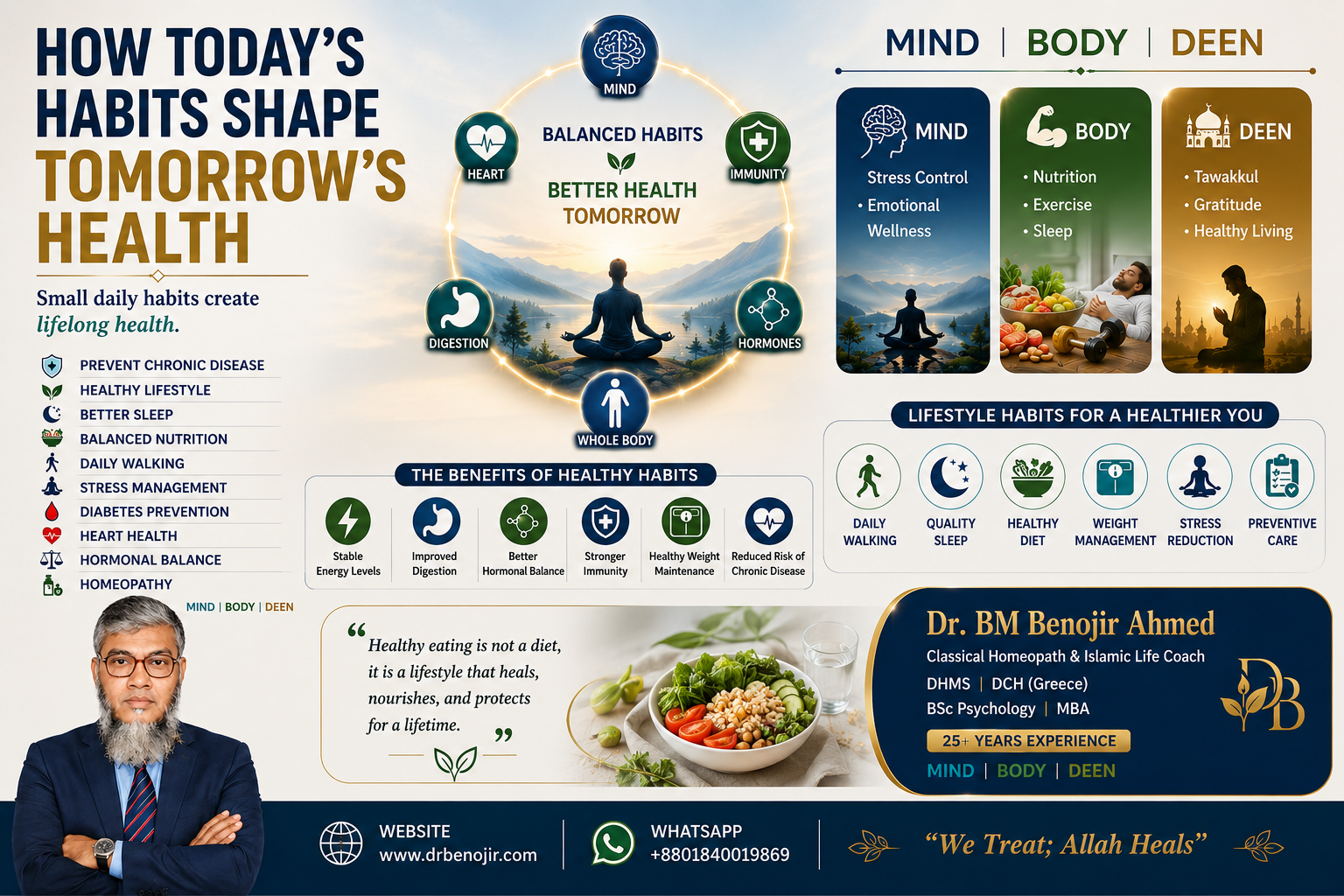
How Daily Habits Today Shape Your Risk of Chronic Disease Tomorrow
By Dr. Benojir — Classical Homeopath & Islamic Life Coach
An office worker in Dhaka sat across from me recently and said something I hear often: “Doctor, I don’t have any major disease right now. But I feel tired. I have acidity, poor sleep, and low energy. Will something serious happen in the future?”
It is one of the most important questions a patient can ask — because most chronic illness does not arrive overnight. It builds quietly, over years, through the accumulation of daily habits that seem too small to matter.
Across Bangladesh, the numbers reflect this shift clearly. National survey data show that diabetes prevalence among adults reached 13.2 percent in 2024, up sharply from previous decades, with nearly four in ten cases remaining undiagnosed until complications begin. Hypertension now affects close to one in four adults, often silently, until a routine check-up or a medical emergency reveals it. Thyroid disorders, obesity, PCOS, asthma, and heart disease are following similar trajectories.
The encouraging truth behind these statistics is this: a large proportion of these conditions are preventable, or at least significantly delayed, through awareness and timely lifestyle change. This article explains why chronic disease develops, what the research tells us about prevention, how classical homeopathy approaches early imbalance, and how faith-conscious living supports lifelong health.
What Is a Chronic Illness, and Why Does It Develop Slowly?
A chronic illness is a health condition that develops gradually and persists for months or years, rather than appearing suddenly like an infection or injury. Common examples include type 2 diabetes, high blood pressure, thyroid imbalance, obesity, heart disease, chronic gastritis or irritable bowel syndrome (IBS), and hormonal disorders such as PCOS.
These conditions rarely emerge from a single cause. They are the cumulative result of diet, sleep, physical activity, stress, and environmental exposure acting on the body over years. The body is remarkably good at compensating for imbalance — adjusting blood sugar, blood pressure, and hormone levels quietly behind the scenes long before any symptom appears. By the time lab reports turn abnormal, the underlying imbalance has often existed for years.
Why Chronic Disease Is Rising in Bangladesh
Bangladesh’s health profile has shifted rapidly alongside its economic growth. Researchers studying this transition point to rapid urbanization, increasingly sedentary work, poor dietary patterns, and an ageing population as the central drivers behind the rising burden of diabetes and hypertension nationwide.
In daily life, this shows up as long hours sitting at a desk, frequent consumption of fast food and processed snacks, heavy tea and coffee intake, late nights, chronic unmanaged stress, and little to no regular exercise. None of these habits feels dangerous in the moment. Their effect is cumulative — a slow erosion of the body’s natural regulatory capacity rather than a single dramatic event.
Why Prevention Matters More Than Treatment Alone
Once lab reports become abnormal, treatment begins — and modern medicine offers excellent tools for managing diabetes, hypertension, and related conditions. But research consistently shows that the earlier lifestyle correction begins, the greater the reduction in long-term risk and complications.
Prevention is not about fear or restriction. It is about awareness — recognising the early signals the body sends, and taking responsibility before a temporary imbalance becomes an established disease. This is a philosophy shared by modern preventive medicine and classical homeopathy alike.
The Foundation of Prevention: Lifestyle Modification
Balanced Nutrition
Traditional Bangladeshi staples — rice, lentils, fish, and vegetables — form a genuinely healthy foundation when portions are reasonable and meals are regular. The risk arises from the additions: excess sugar, deep-fried foods, sugary soft drinks, and frequent overeating, all of which are strongly linked to insulin resistance and metabolic disorders. Eating at consistent times each day also helps regulate appetite hormones and supports stable blood sugar.
Proper Sleep
Sleep is not downtime; it is when the body performs essential hormonal and metabolic repair. Regularly sleeping after midnight disrupts the natural circadian rhythm, impairing insulin sensitivity and increasing cortisol — a pattern strongly associated with weight gain and elevated blood sugar over time. Aiming for seven to eight hours of consistent, quality sleep is one of the simplest and most powerful preventive measures available.
Daily Walking or Exercise
At least 30 minutes of daily walking improves circulation, supports healthy blood pressure, and enhances the body’s ability to regulate blood sugar. Exercise does not need to be extreme or formal — brisk walking, climbing stairs, or cycling all count. Consistency matters far more than intensity; a daily 30-minute walk delivers more lasting benefit than an occasional intense workout.
Managing Stress
Stress itself is unavoidable, but how the body and mind respond to it determines long-term impact. Sustained emotional strain raises cortisol, which over time elevates blood pressure, disturbs blood sugar regulation, and aggravates digestive complaints such as acidity and bloating. Mental balance is, quite literally, a form of preventive medicine.
Classical Homeopathy: Individualized Support for Early Imbalance
A common misconception is that homeopathy is relevant only once a disease has fully developed. In classical homeopathic practice, however, the focus often falls on precisely the early-warning patterns that precede full-blown chronic illness — the person who catches every seasonal cold, the one with persistently weak digestion, the woman with irregular cycles, or the individual who lives in a near-constant state of anxiety.
These patterns are studied as a whole — not as isolated symptoms, but as an expression of the individual’s constitution and the way their Vital Force, the body’s inherent self-regulating capacity, is currently functioning. When such early imbalance is addressed through individualized homeopathic care alongside lifestyle correction, the long-term risk of deeper chronic disease may be meaningfully reduced. Below are remedies frequently considered in such early-stage, constitutional cases.
Nux Vomica
Suited to overworked, ambitious individuals who rely heavily on tea, coffee, or stimulants. Keynotes include irritability, acid reflux, constipation, and waking around 3–4 AM with a mind full of work-related thoughts. Symptoms are typically worse in the morning and improve with rest.
Lycopodium Clavatum
Often indicated in digestive weakness accompanied by underlying low self-confidence. Keynotes include bloating after even small meals, craving for sweets, and symptoms that worsen between 4 and 8 PM. Outwardly composed, these individuals frequently carry quiet anticipatory anxiety.
Natrum Muriaticum
Indicated in patients who internalise emotional stress rather than express it, often with a history of unresolved grief or disappointment. Keynotes include recurrent headaches, craving for salt, and a marked aversion to consolation or sympathy. Symptoms tend to worsen in heat.
Calcarea Carbonica
A constitutional remedy for individuals who feel chronically overwhelmed by responsibility, with a tendency toward weight gain, chilliness, and sluggish metabolism. Anxiety about health and security is a prominent feature, along with profuse sweating of the head during sleep.
Sepia
Commonly considered in women with hormonal imbalance — irregular cycles, premenstrual irritability, and pronounced fatigue. A characteristic emotional indifference toward family responsibilities is often present, alongside notable relief from vigorous exercise.
Arsenicum Album
Indicated in anxious, meticulous individuals who worry excessively about their health and future. Keynotes include burning sensations relieved by warmth, restlessness, and symptoms that intensify after midnight.
Argentum Nitricum
Suited to individuals with pronounced anticipatory anxiety — nervousness before exams, public speaking, or important events — often accompanied by digestive disturbance and a craving for sweets, with symptoms aggravated by warmth and crowds.
A note on safe practice: These descriptions are educational. Correct homeopathic prescribing always requires a full individual case history taken by a qualified practitioner; no remedy should be self-selected from a general description alone.
A Real Clinical Example
A patient came to the chamber with early signs of pre-diabetes. His laboratory values were elevated but not yet in a critical range. His history revealed irregular meal timing, late-night sleep, and significant work-related stress.
Through a structured combination of gradual dietary correction, a daily walking routine, conscious stress management, and individualized homeopathic support matched to his specific constitution, his blood sugar values stabilised over several months. Becoming aware before disease becomes fully established is, in every sense, true wisdom.
What Happens If We Ignore the Early Signs?
Left unaddressed, the trajectory tends to follow a predictable pattern:
• Blood sugar gradually rises, often without symptoms in the early stages
• Body weight increases, particularly around the abdomen
• Blood pressure climbs, frequently undiagnosed until a routine check-up
• Hormonal imbalance develops, affecting menstrual cycles, thyroid function, or mood
• A chronic illness becomes medically established, requiring ongoing management
Prevention, by comparison, is simple. Long-term disease management is complex, costly, and life-altering. The earlier the intervention, the smaller the effort required.
Mind │ Body │ Deen
Islam offers a remarkably complete framework for preventive living, built around concepts that align closely with modern health science.
The Mind: Taqwa and Sabr
Taqwa, conscious God-awareness, naturally encourages mindful living — paying attention to what we eat, how we spend our time, and how we treat our bodies. Sabr, patience and discipline, supports the consistency that prevention requires; lasting health is built through sustained small choices, not dramatic short-term effort.
The Body: A Trust to Be Protected
The Prophet Muhammad ❩ is reported to have said, “The son of Adam fills no vessel worse than his stomach. It is sufficient for him to eat a few morsels to keep his back straight. If he must eat more, then a third for food, a third for drink, and a third for breath.” (Sunan Ibn Majah). This guidance on moderation in eating mirrors what modern nutritional science has independently confirmed: overeating drives metabolic disease, while moderate, regular meals support long-term metabolic health.
The Quran similarly instructs in Surah Al-A’raf (7:31): “Eat and drink, but do not be excessive. Indeed, He likes not those who commit excess.” This principle of balance, wasatiyyah, extends naturally to sleep, work, exercise, and rest.
The Deen: Shukr and Tawakkul
Shukr, gratitude for the health one currently has, fosters a proactive rather than complacent relationship with one’s body. Tawakkul, trust in Allah, is not passive waiting — it is paired always with responsible effort. The Prophet ❩ advised a man who left his camel untied, trusting Allah to protect it, to “tie your camel, then trust in Allah” (Sunan al-Tirmidhi). Applied to health, this means taking every reasonable preventive step — nutrition, sleep, movement, stress management, medical check-ups — while trusting Allah with the outcome. Spiritual practice itself supports this effort: regular prayer, dhikr, and a sense of life’s meaning are associated in research with lower chronic stress and greater emotional resilience, both of which protect physical health.
Common Patient Questions
Q: I feel fine. Why should I worry about prevention now?
Because chronic illness typically develops silently for years before symptoms appear. Fatigue, mild acidity, and poor sleep are not “nothing” — they are often the body’s earliest signals of imbalance. Addressing them now is far easier than managing an established disease later.
Q: How do I know if my tiredness is a warning sign or just normal stress?
A simple medical check-up — blood sugar, blood pressure, thyroid function — combined with an honest look at your sleep, diet, and stress levels will usually clarify this. If symptoms persist despite reasonable rest, it is worth consulting both a physician and, if you wish, a classical homeopath for a fuller picture.
Q: Can homeopathy replace regular medical check-ups?
No, and it should not be used that way. Homeopathy works well alongside routine medical screening, not as a replacement for it. Blood tests and check-ups remain essential for catching measurable changes early; homeopathic care can support the body’s constitutional balance alongside this monitoring.
Q: How long does it take to see results from lifestyle changes?
Some markers, such as energy and sleep quality, often improve within two to four weeks of consistent change. Metabolic markers such as blood sugar and blood pressure typically take two to three months of sustained effort to show clear improvement. Long-standing imbalance generally requires longer, steadier commitment.
Final Thoughts: Health Is Cultivated, Not Accidental
Preventing chronic illness is not a one-day effort or a single dramatic decision. It is the quiet accumulation of balanced meals, consistent sleep, regular movement, emotional steadiness, and person-centred care, sustained over months and years.
The office worker who first asked whether something serious might happen in the future already holds the answer in his own hands. Awareness, today, is the most powerful preventive medicine available — stronger than any single remedy, and the necessary foundation beneath every other form of treatment.
We make our best effort. Healing ultimately comes from Allah.
Dr. Benojir
Classical Homeopath & Islamic Life Coach
Mind │ Body │ Deen
“We Treat; Allah Heals”