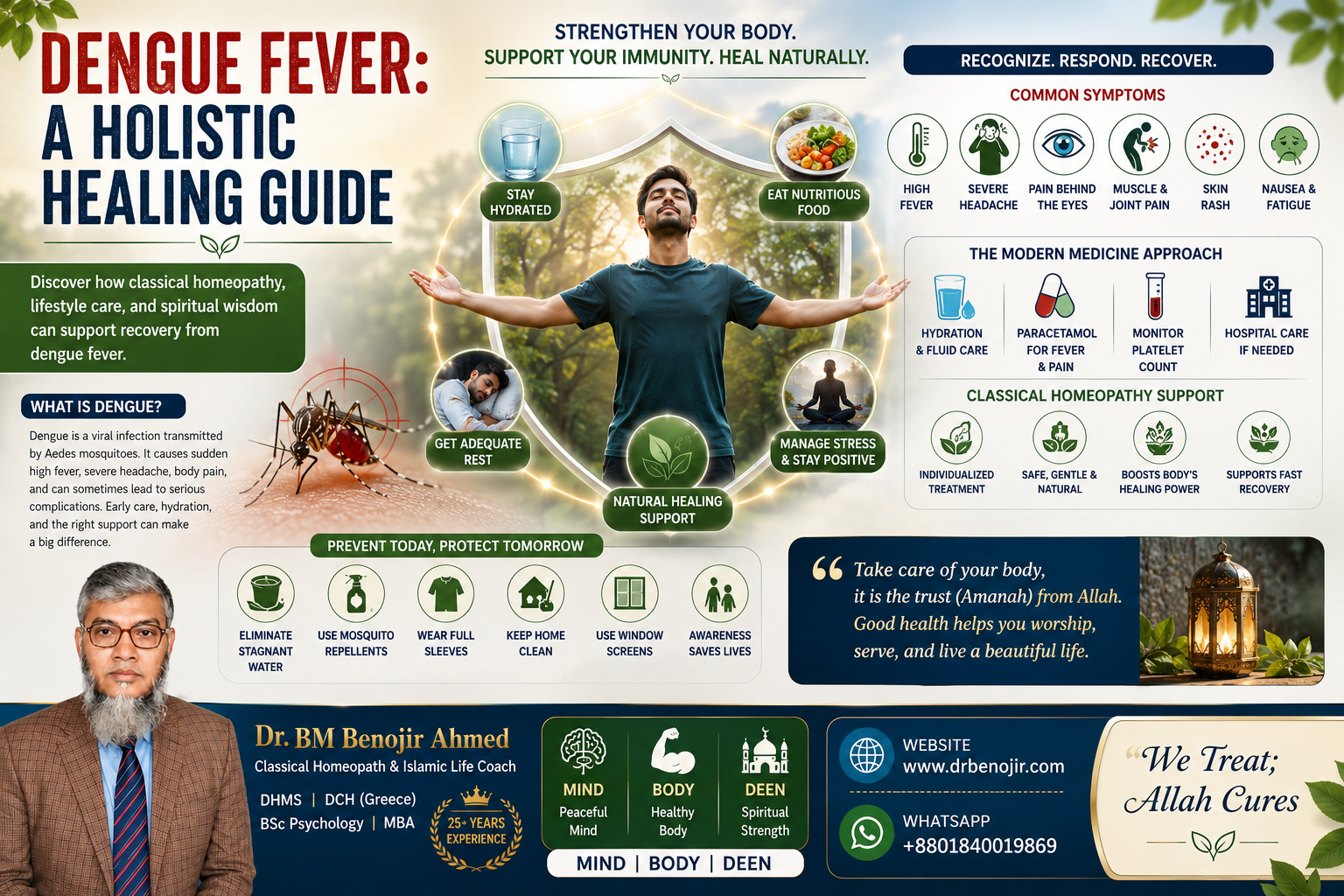
Discover how classical homeopathy, lifestyle care, and spiritual wisdom can support recovery from dengue fever.
When the Fever Won't Break
Imagine waking up with a sudden high fever, severe headache, and pain so intense behind your eyes that even light feels unbearable. Your muscles ache as if every bone in your body is being crushed. If you or someone you love has experienced this, it may have been dengue fever — one of the fastest-spreading mosquito-borne viral infections in the world. Each year, an estimated 390 million people are infected globally, and nearly half the world's population lives in areas at risk. Understanding dengue, and knowing how to support the body through it, is no longer optional — it is essential knowledge for every household.
What Is Dengue Fever?
Dengue fever is a viral illness caused by the dengue virus, which belongs to the Flaviviridae family. It is transmitted to humans through the bite of infected Aedes mosquitoes, primarily Aedes aegypti and, to a lesser extent, Aedes albopictus. There are four distinct serotypes of the dengue virus (DENV-1 through DENV-4), meaning a person can theoretically be infected up to four times in a lifetime. The disease is prevalent across tropical and subtropical regions, including South Asia, Southeast Asia, Latin America, and parts of Africa. Children, the elderly, and those with weakened immune systems are particularly vulnerable, though dengue can affect anyone regardless of age or health status.
Causes and Risk Factors
The primary cause of dengue is infection with the dengue virus following the bite of an infected female Aedes mosquito, which feeds during the day, particularly in the early morning and late afternoon. The mosquito becomes a carrier after biting a person already infected with the virus, and then transmits it to the next person it bites. Non-modifiable risk factors include living in or traveling to tropical regions, previous dengue infection (which raises the risk of severe disease upon reinfection), and genetic susceptibility.
Modifiable risk factors are those we can actively change. Living in areas with stagnant water or poor sanitation significantly increases mosquito breeding. Inadequate use of protective clothing, mosquito repellents, and window screens all raise the risk of exposure. Overcrowded urban environments, inconsistent waste management, and reduced community awareness further fuel the spread of the disease.
Signs, Symptoms, and Diagnosis
Dengue typically presents with a sudden onset of high fever (often reaching 104°F or 40°C), severe headache, pain behind the eyes (retro-orbital pain), and excruciating muscle and joint pain — which is why dengue is classically known as 'breakbone fever.' A skin rash may appear two to five days after the fever begins, often described as red patches with small islands of pale skin within them. Nausea, vomiting, and fatigue are also common.
Diagnosis is confirmed through blood tests, including the NS1 antigen test (which detects the virus early in the infection), along with PCR (polymerase chain reaction) testing and dengue IgM/IgG antibody tests. A falling platelet count — the number of blood cells that help the blood clot — is one of the key indicators monitored throughout the illness. Any dengue patient with a platelet count dropping below 100,000 per microliter of blood should be closely monitored by a healthcare professional.
Potential Complications
While the majority of dengue cases resolve within one to two weeks, a small percentage progress to dengue hemorrhagic fever (DHF) or dengue shock syndrome (DSS) — more severe forms of the disease that can be life-threatening. Warning signs include severe abdominal pain, persistent vomiting, rapid breathing, bleeding from the gums or nose, blood in urine or stool, and extreme fatigue or restlessness. These symptoms demand immediate medical attention. People who have been previously infected with one dengue serotype face a higher risk of developing severe disease upon infection with a different serotype, due to a process called antibody-dependent enhancement.
The Modern Medicine Approach
As of 2025, there is no specific antiviral drug approved for the treatment of dengue. The conventional approach focuses on supportive care: adequate hydration (either oral or intravenous), rest, and the use of acetaminophen (paracetamol) to manage fever and pain. Non-steroidal anti-inflammatory drugs (NSAIDs) such as ibuprofen and aspirin are strictly avoided, as they can increase the risk of bleeding. Severe cases may require hospitalization, blood transfusions, or platelet infusions when counts fall dangerously low. A dengue vaccine (Dengvaxia) is available in some countries but is recommended only for individuals with confirmed previous dengue infection, owing to risks in those not previously exposed. Monitoring platelet count, hematocrit, and fluid balance remains the cornerstone of dengue management in clinical settings.
Classical Homeopathy for Dengue Fever
Classical homeopathy offers a deeply individualized approach to dengue fever — one that looks beyond the label of the disease and asks: what is this particular person experiencing, in their own unique way? As Samuel Hahnemann, the founder of homeopathy, emphasized in the Organon of Medicine, the totality of symptoms — physical, emotional, and mental — guides remedy selection. In dengue, this means carefully observing the character of the fever, the precise location and quality of pain, the patient's thirst or thirst-lessness, position of comfort, emotional state, and modalities (what makes symptoms better or worse).
Eupatorium perfoliatum is perhaps the most frequently indicated remedy in dengue, known in classical texts as 'boneset.' William Boericke, in his Materia Medica, describes it as having intense pain in the bones that feels as if the bones are being broken — closely matching dengue's signature breakbone pain. The patient needing Eupatorium is restless despite exhaustion, feels a deep aching in the back and limbs, is thirsty for cold water, and may vomit bile along with the fever.
Bryonia alba is indicated when the patient is intensely irritable and wants to remain absolutely still — because any movement, even the slightest, worsens every symptom. The headache is bursting and splitting, worse with the slightest eye movement. Thirst for large quantities of cold water at long intervals is characteristic. This is a remedy that John Henry Clarke frequently highlighted for febrile conditions with dryness and aggravation from motion.
Rhus toxicodendron is called for in patients who are restless and find temporary relief from constant movement or changing position. The joints and muscles ache deeply, the tongue is coated with a red triangular tip, and the patient is often anxious and fearful at night. This contrasts directly with Bryonia, illustrating the central principle of individualization in classical prescribing.
Gelsemium sempervirens is suited to dengue presentations with profound weakness, dizziness, and drowsiness. The patient appears dull, heavy-lidded, and trembling, with little or no thirst. The fever feels like a wave of heat passing through the body, and the person simply wants to be left alone. James Tyler Kent, in his Lectures on Materia Medica, described this state as 'complete prostration of the vital force.'
Ipecacuanha is indicated when persistent nausea dominates the clinical picture — nausea that is not relieved even after vomiting. The tongue remains clean despite the nausea, and the patient may experience a hemorrhagic tendency with bright red bleeding. China officinalis (Cinchona), one of Hahnemann's foundational remedies, is deeply useful in the recovery phase when the patient suffers from weakness, debility, and sensitivity after fluid loss. Phosphorus may be called for in cases with bleeding tendencies, anxiety, and marked sensitivity. Crotalus horridus and Hamamelis are considered when hemorrhagic manifestations are prominent, with dark, passive bleeding requiring careful case management by an experienced classical homeopath.
It bears emphasis that no two dengue patients present identically, and the remedy that brings one patient through the crisis may be entirely wrong for another. Classical homeopathic prescribing is not disease-based — it is patient-based. Consultation with a qualified classical homeopath is strongly recommended for individualized care.
Lifestyle Support During and After Dengue
Hydration is the single most important lifestyle measure during dengue recovery. Oral rehydration salts (ORS), fresh coconut water, papaya leaf juice, and plain water should be consumed consistently throughout the day. Papaya leaf extract, in particular, has been the subject of increasing research interest for its potential role in supporting platelet recovery, and several studies have noted encouraging results. However, it should always be used alongside — not in place of — medical supervision.
Diet during dengue should be light, easily digestible, and nourishing. Warm broths, khichdi, steamed vegetables, bananas, and soft fruits are ideal. Fried, spicy, or heavily processed foods strain the digestive system and should be avoided completely. Guava juice and pomegranate juice are excellent sources of Vitamin C and antioxidants that support immune function during recovery.
Rest is non-negotiable. The body requires enormous energy to fight the dengue virus, and physical exertion during the acute phase — even mild activity — can worsen the clinical course. Sleep should be prioritized, and the patient should remain in a comfortable, cool, well-ventilated room, protected at all times from further mosquito exposure using nets and repellents. Screens, stress reduction, and avoidance of anxiety-inducing content all contribute meaningfully to recovery.
Mind | Body | Deen: Healing Through Faith
Illness has a dimension that medicine alone cannot always reach. When a person is struck by fever, exhausted, and frightened — the mind and the spirit are tested alongside the body. Anxiety, fear of complications, and emotional distress can genuinely impair the immune response and slow recovery. Addressing these inner dimensions is not a luxury in healing; it is a necessity.
In Islam, illness is not viewed as punishment but as purification — a means by which sins are forgiven and ranks are elevated. The Prophet Muhammad (peace be upon him) said: 'No fatigue, nor disease, nor sorrow, nor sadness, nor hurt, nor distress befalls a Muslim, even if it were the prick he receives from a thorn, but that Allah expiates some of his sins for that.' (Sahih al-Bukhari, narrated by Abu Said al-Khudri and Abu Hurairah). This hadith carries profound therapeutic value — it transforms suffering into meaning, and fear into trust.
“And when I am ill, it is He who cures me.”
— Surah Ash-Shuʼara (26:80)
This verse, spoken by Prophet Ibrahim (peace be upon him), is a timeless declaration of tawakkul — placing complete trust in Allah while taking every appropriate means of healing. The patient, the caregiver, and the physician are all instruments; the healing belongs to Allah alone. Reciting this verse with sincerity, maintaining prayer, practicing dhikr (remembrance of Allah), and asking for dua from loved ones are spiritual practices that calm the heart, reduce cortisol (the body's stress hormone), and create the inner conditions for healing.
The body, in Islamic understanding, is an amanah — a trust given to us by Allah. Caring for it with nutrition, rest, and treatment is not merely practical; it is an act of worship. Neglecting the body during illness — refusing treatment or rest out of stubbornness — is contrary to this sacred responsibility.
Prevention and Practical Tips
The most effective prevention against dengue is eliminating mosquito breeding sites. Stagnant water in flower pots, buckets, discarded tires, and drains should be emptied and cleaned at least once a week. Wearing full-sleeved clothing, using mosquito repellents containing DEET or picaridin, sleeping under insecticide-treated nets, and installing window and door screens are all highly effective individual measures.
Community-level action — clearing drains, reporting water logging, and participating in fogging programs during outbreaks — multiplies the impact of individual efforts. Immune-supportive habits year-round, including regular sleep, a wholesome diet, and management of chronic stress, help keep the body resilient and better able to recover if infection does occur.
Common Patient Questions
Can homeopathy treat dengue without conventional medicine? Homeopathy can provide meaningful support during dengue, particularly in managing fever, pain, restlessness, and fatigue. However, dengue requires careful clinical monitoring — especially of platelet count and signs of bleeding. A classical homeopath and a conventional physician working together provide the safest and most effective care. Please do not delay seeking conventional evaluation if warning signs appear.
How quickly does homeopathy work in dengue? Response time varies by the individual and the accuracy of remedy selection. When the correct remedy is prescribed based on the totality of symptoms, many patients report notable improvement within 12 to 24 hours. In homeopathy, a well-chosen remedy acts quickly because it aligns with the body's own healing response.
Is papaya leaf juice safe to use alongside homeopathic remedies? Yes, papaya leaf juice is generally safe as a supportive measure and does not interfere with homeopathic remedies. However, ensure it is freshly prepared, and always consult your practitioner before adding any supplement, particularly if the patient is already on prescribed medications.
A Path Through the Storm
Dengue fever is a serious illness — but the human body, when properly supported, has a remarkable capacity to heal. Whether you choose classical homeopathy, conventional medicine, or an integrative approach that honors the wisdom of both, the principles remain the same: nourish the body, rest the mind, trust in the process, and surrender the outcome to the One who heals. At drbenojir.com, we walk alongside you in that journey — as practitioners, guides, and fellow travelers on the path of wholeness.
References
1. World Health Organization (WHO). Dengue and Severe Dengue. Geneva: WHO; 2024. Available at: who.int
2. Boericke W. Pocket Manual of Homeopathic Materia Medica and Repertory. New Delhi: B. Jain Publishers; 2010.
3. Kent JT. Lectures on Homeopathic Materia Medica. New Delhi: B. Jain Publishers; reprint 2019.
4. Hahnemann S. Organon of Medicine. 6th ed. New Delhi: B. Jain Publishers; 2016.
5. Subenthiran S, et al. “Carica papaya leaves juice significantly accelerates the rate of increase in platelet count among patients with dengue fever and dengue haemorrhagic fever.” Evidence-Based Complementary and Alternative Medicine. 2013;2013:616010.
6. Sahih al-Bukhari. Hadith No. 5641–5642. Narrated by Abu Saʼid al-Khudri and Abu Hurairah.
Dr. Benojir
Classical Homeopath & Islamic Life Coach
Mind | Body | Deen
“We Treat; Allah Heals”