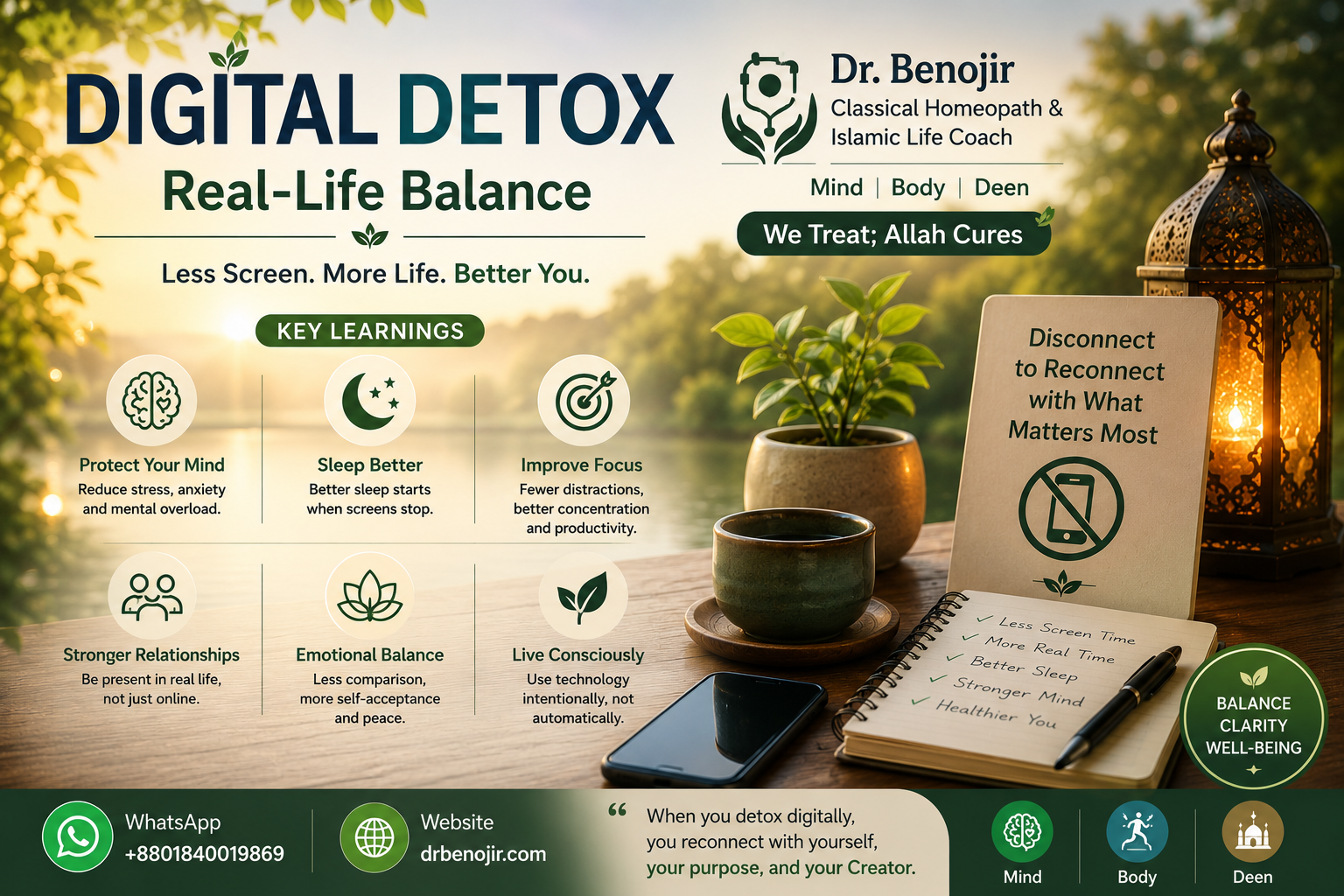
Reclaim Your Mind from the Screen
A Practical, Evidence-Based Guide to Digital Detox, Mental Health, and Balanced Living
Dr. Benojir | Classical Homeopath & Islamic Life Coach | drbenojir.com
Your alarm goes off. Before you are even fully awake, you reach for your phone. You check messages, scroll the news, browse social media. By the time you get out of bed, your mind is already racing — processing dozens of inputs before the day has actually begun. By evening, the pattern repeats: one last scroll before sleep. Perhaps another. Then another. An hour disappears. You feel tired, yet oddly restless. This is not a failure of willpower. It is the result of a technology environment specifically designed to capture and hold your attention — and it is taking a measurable toll on mental health, sleep, relationships, and overall well-being.
The concept of digital detox has emerged as a response to this challenge. Contrary to the name, it is not about rejecting technology or retreating to a simpler era. It is about reclaiming conscious control over how, when, and why you engage with digital devices — so that technology serves your life rather than consuming it.
The Scale of the Problem: Where We Are Now
According to data from the Global Web Index, the average adult worldwide now spends approximately six hours and thirty-seven minutes per day in front of screens — a figure that has roughly doubled in the past decade. Smartphone usage alone accounts for more than three and a half hours of that total, and social media platforms capture a significant portion of that time.
The World Health Organization (WHO) has formally acknowledged the relationship between excessive digital media use and deteriorating mental health outcomes, particularly among adolescents and young adults. A 2023 review published in JAMA Psychiatry analysed data from over forty studies and found consistent associations between heavy social media use and elevated rates of anxiety, depression, loneliness, and poor self-esteem across age groups.
This does not mean technology is inherently harmful. The problem is not the tool — it is the pattern of use. Specifically: overuse, unconscious use, and the chronic stimulation that comes from being perpetually connected without pause.
How Digital Overload Affects Your Mental Health
The human nervous system was not designed to process an uninterrupted stream of information. News cycles, social media feeds, email notifications, and messaging apps collectively create a state of chronic mental arousal — a background hum of stimulation that never quite switches off.
Research in cognitive neuroscience has shown that constant task switching — moving rapidly between notifications, apps, and messages — significantly increases mental fatigue while decreasing performance on tasks requiring sustained attention. A landmark study from the University of California, Irvine found that it takes an average of twenty-three minutes and fifteen seconds to fully regain focus after a single digital interruption. When notifications arrive every few minutes, the mind rarely returns to a state of deep focus at all.
Social comparison presents a separate and well-documented risk. Social media platforms predominantly display curated highlights: achievements, celebrations, holidays, promotions. Failures, setbacks, and everyday ordinariness remain hidden. When people — particularly young adults and teenagers — repeatedly compare their inner reality with others' outer presentation, feelings of inadequacy, anxiety, and low self-worth can follow. Studies have found that passive social media consumption (scrolling without interacting) produces worse mood outcomes than either active use or no use at all.
Over time, digital overload can manifest as irritability, emotional numbness, difficulty relaxing, reduced patience, and a pervasive sense of being busy while accomplishing little. These are not character flaws. They are recognised psychological responses to an overstimulated nervous system.
Screens, Sleep, and Your Brain
One of the most well-researched consequences of excessive screen use is its impact on sleep — and the downstream effects are far-reaching.
Blue light emitted by smartphones, tablets, and laptop screens suppresses melatonin, the hormone that signals to your brain that it is time to sleep. Research published in the Proceedings of the National Academy of Sciences found that individuals who used screens for four or more hours before bed experienced significantly delayed melatonin onset, fell asleep later, spent less time in REM sleep, and reported greater daytime sleepiness compared to those who did not use screens in the evening.
Beyond the biological effect of blue light, the content itself matters. Scrolling through emotionally stimulating content — news stories, social media debates, videos — activates the brain's alerting systems. The nervous system interprets this stimulation as a signal to remain awake and vigilant, making the transition to restorative sleep more difficult even after the device is put down.
Poor sleep, in turn, amplifies every other psychological vulnerability. Sleep deprivation impairs emotional regulation, increases irritability and anxiety, weakens immune function, and reduces cognitive performance. For many people struggling with mood or mental health, addressing screen use before bed is one of the most immediate and impactful changes they can make.
A Common Question from Patients
"I am on my phone for hours every evening, and I always feel tired but cannot switch off mentally before sleep. Could this be connected?"
Almost certainly, yes. Evening screen exposure — particularly social media and news — creates a cycle of stimulation that is difficult to break. The brain interprets the blue light and emotionally engaging content as signals to stay alert. Reducing screen use in the final sixty to ninety minutes before bed and replacing it with quiet reading, gentle movement, or spiritual practice typically produces noticeable improvements in sleep quality within one to two weeks.
The Productivity Paradox: More Connected, Less Effective
Technology promises to make us more productive. Yet for many people, the opposite is true. The research is striking: a 2022 study in the Journal of Experimental Psychology found that simply having a smartphone on a desk — even face down and silent — reduced available cognitive capacity on demanding tasks. The device does not need to be in use to create distraction. The mere awareness of its presence is enough.
Deep, sustained focus — the kind of concentration required for complex problem solving, creative work, and meaningful learning — requires mental quiet that is increasingly difficult to achieve in a notification-saturated environment. Microsoft Research has found that knowledge workers are interrupted or self-interrupt every three to five minutes on average, and that high interruption frequency correlates with significantly higher levels of self-reported stress.
Digital detox practices — including notification management, designated focus periods, and device-free hours — have been shown in workplace studies to improve output quality, reduce cognitive fatigue, and increase job satisfaction. Reclaiming time and attention from unnecessary digital noise is not a retreat from productivity; it is a prerequisite for it.
Classical Homeopathy and the Digital-Age Individual
Classical Homeopathy does not recognise "screen addiction" as a diagnosis in the conventional sense. However, it is exceptionally well suited to supporting individuals who are experiencing the physical, emotional, and mental consequences of digital overload — precisely because it treats the whole person rather than a labelled condition.
In a classical homeopathic assessment, the practitioner seeks to understand not only the presenting symptoms but the individual's constitution, emotional temperament, sensitivity, and particular way of experiencing stress. Two people with identical complaints of insomnia and anxiety may require entirely different remedies based on their deeper symptom picture. This individualized approach distinguishes classical homeopathy from symptomatic prescribing and makes it particularly valuable in complex, multi-layered presentations such as those arising from chronic stress and digital overload.
The following remedies are among those most commonly considered in individuals presenting with symptoms related to overstimulation, mental exhaustion, poor sleep, and emotional fatigue. They are offered here for educational purposes only. Homeopathic remedy selection requires professional assessment and should never be self-prescribed for ongoing or significant health concerns.
Nux Vomica
The classic remedy for the driven, overworked individual. Particularly indicated in professionals who work long hours, rely on stimulants such as coffee to sustain performance, and experience irritability, tension headaches, and poor-quality sleep despite exhaustion. Excessive screen time combined with a sedentary lifestyle, irregular eating, and high pressure fits this picture closely.
Coffea Cruda
Indicated when the mind is overactive and relentlessly busy — thoughts racing in all directions, making it impossible to fall asleep despite genuine tiredness. The individual may feel mentally stimulated well into the night. Particularly relevant for those whose evening screen use has trained the brain into a state of chronic hyperarousal.
Argentum Nitricum
A leading remedy for anticipatory anxiety and nervous excitement. Individuals needing this remedy often feel impulsive and hurried, experience digestive symptoms under stress, and are prone to catastrophic thinking. The compulsive quality of checking notifications and social media — and the anxiety that builds when they cannot — may resonate with this remedy's profile.
Gelsemium
Particularly suited to individuals who experience mental fatigue, heaviness, and a dull inability to concentrate. There may be a sense of being overwhelmed and unable to begin tasks. Chronic digital overload that has left the individual mentally depleted rather than agitated may call for this remedy.
Kali Phosphoricum
One of the most important tissue salts for nervous exhaustion and burnout. Indicated when mental overwork has led to genuine depletion — poor memory, difficulty concentrating, emotional flatness, and profound fatigue. Students and professionals who have pushed themselves beyond their limits, often with the aid of digital tools, frequently present with this picture.
Anacardium Orientale
A remedy associated with poor concentration, memory difficulties, and a divided sense of self — as if two conflicting impulses are operating simultaneously. May be relevant in individuals whose digital habits have fragmented their attention and eroded their ability to sustain focused thought.
Ignatia Amara
Often indicated after emotional disappointment, grief, or social stress. Social media-related experiences — public criticism, online conflict, the grief of social comparison — may leave individuals in a state of suppressed emotional pain that Ignatia addresses. Sighing, mood swings, and paradoxical symptoms characterise this remedy.
Phosphoric Acid
A remedy for profound emotional and mental exhaustion following prolonged stress, grief, or overwork. The individual appears apathetic, indifferent, and mentally blank — not irritable, but simply depleted. Digital burnout in its most advanced form may present this picture.
Natrum Muriaticum
Particularly relevant where social media has reinforced habits of comparison, withdrawal, and silent emotional suffering. The individual tends to dwell on disappointments, avoids emotional vulnerability, and may use digital environments to maintain connection while keeping real intimacy at arm's length.
Lycopodium
For individuals whose self-esteem fluctuates significantly, who use technology to project confidence they do not internally feel, or who experience significant performance anxiety. There may be a pattern of avoidance and procrastination masked by busy-seeming digital activity.
Lifestyle Modification: The Foundation of Digital Wellness
Homeopathy, counselling, and other therapeutic approaches work best when supported by consistent lifestyle habits. Digital wellness is inseparable from broader well-being. The following practices represent an evidence-informed foundation.
Sleep Hygiene
Sleep is the single most powerful recovery tool available to the human body and mind. The National Sleep Foundation recommends that adults aim for seven to nine hours of uninterrupted sleep per night. Practical steps that directly support this include switching off screens at least sixty to ninety minutes before bed, keeping the bedroom cool and dark, establishing a consistent sleep and wake schedule seven days a week (including weekends), and replacing evening screen use with reading, gentle stretching, or quiet reflection.
Physical Movement
Exercise is one of the most robustly evidenced interventions for mental health. A 2024 meta-analysis in The Lancet Psychiatry, drawing on data from over 1.2 million participants, found that regular physical activity was associated with 43% fewer days of poor mental health per month compared to a sedentary lifestyle. Exercise does not need to be intense to be beneficial — a brisk thirty-minute walk five times a week produces clinically meaningful reductions in anxiety and depression. Movement also counteracts the physical effects of prolonged sitting, which has been independently associated with increased risk of depression, cardiovascular disease, and metabolic disorders.
Nutrition and Gut Health
The gut-brain axis — the bidirectional communication network between the enteric nervous system in the digestive tract and the central nervous system — plays a crucial role in mood regulation. Approximately 95% of the body's serotonin is produced in the gut. Diets rich in diverse plant foods, fermented foods, fibre, and omega-3 fatty acids support a healthy gut microbiome and, by extension, more stable mood and cognition. High consumption of ultra-processed foods, refined sugar, and caffeine — patterns often associated with high-stress, screen-heavy lifestyles — is consistently linked to worsened anxiety and depressive symptoms.
Managing Notifications and Screen Time
Turning off non-essential notifications is one of the simplest and most effective digital wellness interventions available. Research suggests that reducing notification frequency alone — without reducing total screen time — measurably decreases interruption-related stress and improves focus. Additional strategies include using screen-time tracking tools to establish a factual baseline (most people significantly underestimate their usage), scheduling specific times to check email and social media rather than responding to every prompt, and designating certain physical spaces — the dining table, bedroom, prayer space — as phone-free zones.
Nature Exposure
A substantial body of research supports the psychological benefits of time spent outdoors. Spending time in natural environments reduces cortisol levels, lowers blood pressure, and improves mood — effects that are measurable within as little as twenty minutes. Even a daily walk in a local park provides meaningful benefit. For people whose working lives are heavily screen-dependent, time in nature offers the nervous system something the digital environment cannot: genuine, unprompted quiet.
Mind | Body | Deen: A Holistic Framework for Digital Well-Being
True digital wellness extends beyond managing screen time. It is about restoring balance across every dimension of the person.
Mind
Technology exerts its most immediate influence on attention, perception, and emotional experience. Practices that strengthen mental health in the digital age include mindfulness — the deliberate cultivation of present-moment awareness — journaling, reflective reading, and working with a counsellor or therapist when needed. Cognitive patterns such as comparison thinking, catastrophising, and the compulsive checking that reinforces digital dependence can all be addressed through awareness and, where appropriate, professional support.
Body
The body bears the physical cost of a screen-heavy lifestyle: disrupted sleep, sedentary posture, eye strain, tension headaches, disrupted appetite, and hormonal imbalance from chronic stress. Addressing these requires intentional investment in sleep, movement, nutrition, hydration, and regular rest from screens. These are not optional extras — they are the biological prerequisites for mental and emotional resilience.
Deen
For those who ground their lives in faith, spiritual practice offers something the digital world cannot replicate: a structured return to stillness, meaning, and connection with the Divine. The five daily prayers (Salah) create natural pauses in the day that interrupt the cycle of digital stimulation. Dhikr — the remembrance of Allah — trains the mind toward presence and gratitude. Recitation of the Qur'an calms the nervous system and focuses attention. Du'a opens space for reflection and surrender. In a world that constantly demands our attention and feeds us comparison, anxiety, and noise, faith teaches us where our attention truly belongs and reminds us of what genuinely matters.
Technology constantly asks for more of us. Deen gently restores us to ourselves.
Practical Digital Detox Strategies: Where to Begin
Digital detox does not require dramatic gestures. Sustainable change begins with small, consistent actions. The following evidence-informed strategies can be introduced gradually and built upon over time.
• Turn off all non-essential push notifications. Begin with social media apps, then expand to email and messaging.
• Set a screen-free period of sixty to ninety minutes before bed and protect it consistently.
• Keep your phone out of the bedroom entirely, or at minimum across the room and face down.
• Establish phone-free mealtimes — with family, housemates, or alone. Eating without screens improves digestion and mindful awareness of hunger and satiety.
• Use screen-time tracking features built into your smartphone to establish an honest baseline. Set weekly reduction targets of ten to fifteen percent rather than attempting sudden dramatic cuts.
• Schedule social media use to two or three defined periods per day rather than checking reactively.
• Replace one thirty-minute screen session per day with a walk, physical book, or face-to-face conversation.
• Create device-free physical spaces in the home: the bedroom, dining area, or prayer space.
• Observe one device-free hour each day — ideally in the morning before checking your phone — and build gradually toward a weekly half-day or full day offline.
None of these changes need to happen simultaneously. One small, consistent shift — maintained over weeks and months — compounds into meaningful transformation.
Conclusion: The Goal Is Not Less Technology — It Is More Life
Digital technology is one of the most extraordinary developments in human history. It has democratised access to knowledge, connected families across continents, enabled remote work and education, and opened doors that previous generations could never have imagined. None of that is worth abandoning.
But when technology begins to control our attention rather than serve it — when it disturbs our sleep, fragments our focus, amplifies our anxieties, and quietly displaces our relationships and presence — something important has been lost. Digital detox is the practice of recovering it.
The goal is not to live with less technology. The goal is to live more fully — with greater focus, deeper rest, more present relationships, and a quieter mind. Technology used consciously becomes a powerful tool. Technology used unconsciously becomes a quiet source of suffering.
The screen will always be there. The question is whether you are choosing to be with it, or whether it is simply taking you by default.
Choose consciously. Live fully. Balance the Mind, the Body, and the Deen.
Dr. Benojir
Classical Homeopath & Islamic Life Coach
Mind | Body | Deen
"We Treat; Allah Heals"