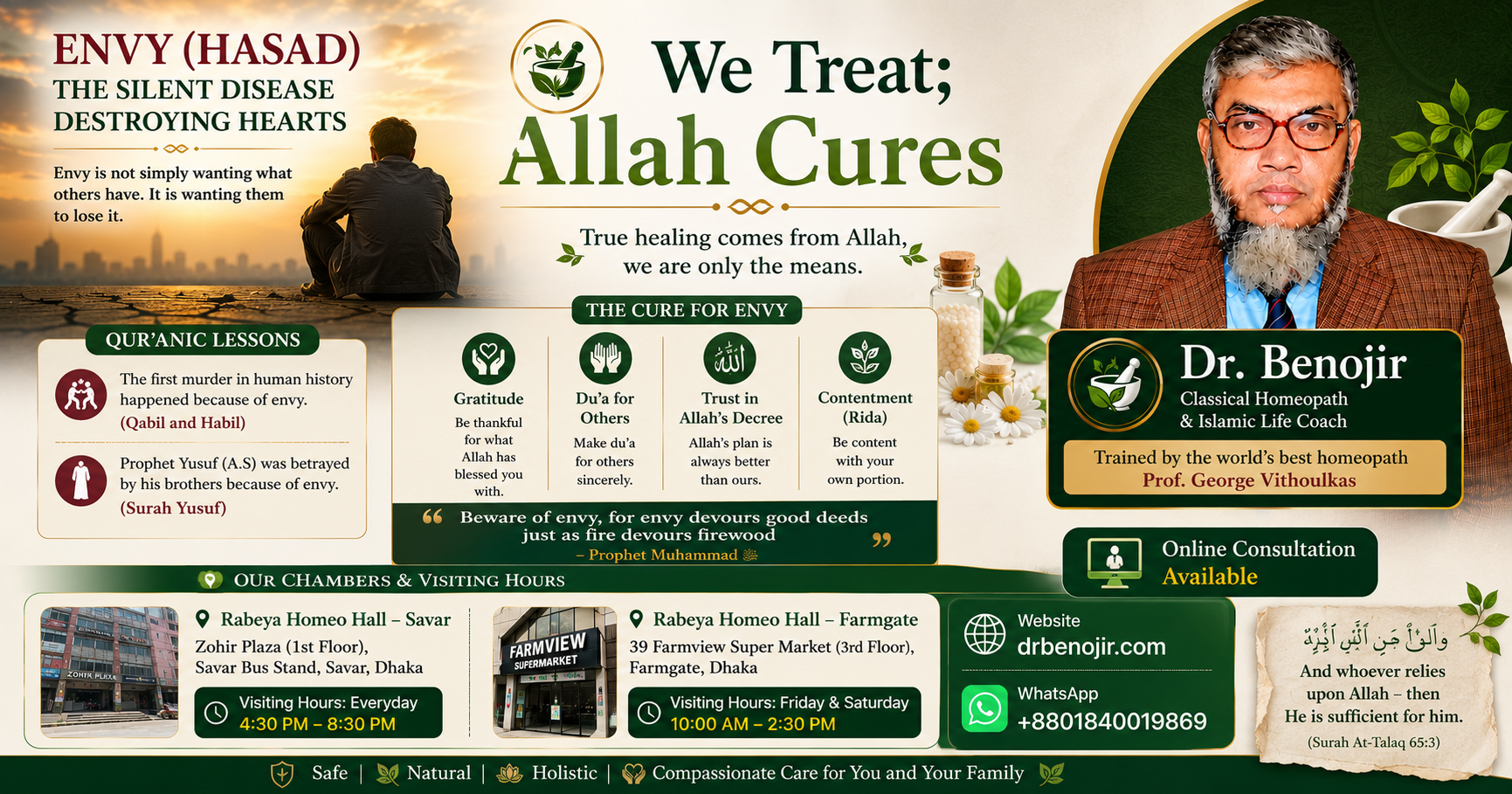
Envy (Hasad): A Hidden Disease of the Heart
Understanding the Spiritual, Emotional, and Constitutional Roots of Jealousy — and How Gratitude, Faith, and Holistic Care Can Heal It
Most of us have felt it at least once: a quiet sting in the chest when someone else receives a blessing we secretly wanted for ourselves. Islam calls this feeling Hasad, or envy, and identifies it as one of the most damaging — yet most common — diseases of the human heart. This article explores envy from a spiritual, psychological, and holistic health perspective, drawing on the Qur'an, the teachings of Prophet Muhammad ﷺ, and gentle constitutional insights from Classical Homeopathy, so that readers can recognize this hidden illness and begin healing it.
What Is Envy (Hasad)?
Envy is often misunderstood. It is not the same as simply wanting something good for yourself — that natural desire for progress is part of being human. True Hasad is different: it is the wish that a blessing be taken away from someone else. A person with envy does not merely want a similar house, marriage, or promotion; they feel uncomfortable that another person has it at all.
In Islamic teaching, envy is described as a disease that begins quietly in the heart and, left unattended, can grow into resentment, backbiting, broken relationships, and even open hostility. Because it so often hides behind a polite smile, envy is sometimes called a “hidden” illness — both the people around the envious person, and sometimes the person themselves, may not immediately recognize what is happening.
Causes: Why Envy Takes Root
Envy rarely appears out of nowhere. It tends to grow when certain conditions are present in a person's life and mindset:
• Constant comparison — measuring one's own life against the achievements of others
• Heavy social media use — seeing curated highlights of other people's lives, which can distort a sense of reality
• Low self-worth or insecurity — feeling that one's own value depends on having more than someone else
• Materialism — placing excessive importance on wealth, status, or appearance
• Weakened trust in Allah's wisdom — forgetting that every person's provision and trials are uniquely measured out
Recognizing these triggers is the first step toward addressing envy at its root, rather than only managing its symptoms.
Symptoms: How Envy Shows Itself
Envy can be emotional, behavioral, and even physical. Common signs include:
• A sinking or uncomfortable feeling upon hearing good news about someone else
• Persistent comparison and dissatisfaction with one's own blessings
• Irritability, restlessness, or low mood without an obvious cause
• Gossip or subtle criticism directed at successful people
• Difficulty offering genuine congratulations
• Withdrawal from people who appear to be doing well in life
Many patients who seek emotional or spiritual support describe these feelings without realizing that envy, rather than simple stress, may be quietly driving them.
Diagnosis: Recognizing Envy Within Ourselves
Unlike a physical illness, envy is not diagnosed with a blood test — it is diagnosed through honest self-reflection. Useful questions to ask yourself include:
• Do I feel uneasy, rather than happy, when someone close to me succeeds?
• Do I quietly hope a particular person's good fortune will not last?
• Do I find myself frequently comparing my life to others online or in person?
Answering these questions sincerely — ideally alongside dhikr (remembrance of Allah) and quiet reflection — is the starting point of self-diagnosis and, ultimately, healing.
Risk Factors and Complications
Certain life stages and circumstances make envy more likely: periods of financial difficulty, infertility or delayed marriage, career setbacks, or simply heavy daily exposure to other people's achievements through social media. If left unaddressed, envy can develop into more serious complications:
• Damaged family relationships, as seen in the story of Prophet Yusuf (AS) and his brothers
• Erosion of good deeds and spiritual reward, as the Prophet ﷺ warned
• Chronic anxiety, bitterness, and emotional exhaustion
• Social division, rivalry, and even, in extreme historical cases, violence — as with Qabil and Habil
The First Crime in Human History
The Qur'an records the very first murder as a direct result of envy. Allah recounts the story of the two sons of Prophet Adam (AS), Qabil and Habil, who each offered a sacrifice. Habil's offering was accepted because of his sincerity; Qabil's was not.
“And recite to them the story of Adam's two sons in truth...” (Surah Al-Ma'idah 5:27)
Rather than reflecting on his own shortcomings, Qabil allowed envy to grow until it led him to kill his brother. The lesson remains timeless: an unchecked envious heart can damage even the closest family bonds.
Prophet Yusuf (AS) and the Power of Forgiveness
Another timeless example is the story of Prophet Yusuf (AS). His brothers grew envious of the special affection their father, Prophet Ya'qub (AS), showed him.
“Indeed, Satan is to man a clear enemy.” (Surah Yusuf 12:5)
Their envy eventually led them to abandon Yusuf (AS) in a well. Yet years later, when he held power in Egypt and his brothers stood before him in need, Yusuf (AS) chose forgiveness over revenge — demonstrating that a pure heart is far stronger than an envious one.
What the Qur'an and Prophet Muhammad ﷺ Teach About Envy
“Or do they envy people for what Allah has given them of His bounty?” (Surah An-Nisa 4:54)
“And from the evil of an envier when he envies.” (Surah Al-Falaq 113:5)
That Allah specifically instructs believers to seek refuge from envy underlines how seriously this disease is regarded. The Prophet ﷺ reinforced this warning directly:
“Beware of envy, for envy consumes good deeds just as fire consumes firewood.” (Sunan Abi Dawud)
“The disease of nations before you has crept into you: envy and hatred.” (Jami’ at-Tirmidhi)
These teachings remind believers that years of prayer, charity, and good deeds can be quietly eroded by a heart consumed with resentment toward others.
Hasad vs. Ghibtah: A Healthy Alternative
Islam does not discourage ambition. It distinguishes clearly between Hasad (destructive envy) and Ghibtah (healthy aspiration).
• Hasad: wishing a blessing would be removed from someone else
• Ghibtah: admiring someone's blessing and asking Allah for something similar, without wishing them any harm
The Prophet ﷺ encouraged this second form — using another person's success as healthy inspiration toward one's own righteousness and effort, rather than as a source of bitterness.
Prevention and Spiritual Treatment
Islam offers practical, everyday remedies for envy:
• Seek refuge in Allah — recite Surah Al-Falaq regularly
• Practice gratitude — deliberately count and acknowledge your own blessings
• Make sincere du'a for the person you envy — this softens the heart remarkably
• Limit comparison — remember that every person's journey and provision is uniquely measured
• Offer genuine compliments and kindness, even when it feels difficult at first
• Remember the temporary nature of worldly success compared to the Hereafter
• Trust Allah's wisdom — He never errs in how He distributes blessings
Classical Homeopathy: An Individualized, Supportive Approach
Classical Homeopathy treats the whole person, not just a single emotion or symptom. It does not replace spiritual purification, but it can offer gentle constitutional support for the emotional patterns — insecurity, possessiveness, suspicion, or oversensitivity — that often accompany envy. A homeopath selects a remedy only after a detailed individual case-taking; the keynotes below are educational starting points, not self-prescription advice.
Arsenicum Album
Indicated for individuals who appear anxious about security and status, are possessive, and fear losing control over people or circumstances.
Hyoscyamus
Suited to marked jealousy with suspicion of betrayal, emotional instability, and attention-seeking behaviour.
Lachesis
Useful where jealousy is intense and competitive, accompanied by possessiveness and heightened sensitivity to perceived slights.
Pulsatilla
Fits an emotionally dependent picture, with sadness when feeling neglected and a strong need for affection and reassurance.
Sepia
Indicated when envy expresses as emotional withdrawal and quiet, hidden resentment rather than open confrontation.
Staphysagria
Suited to silent jealousy with suppressed anger, wounded feelings, and strong sensitivity to criticism.
Nux Vomica
Considered when envy combines with competitiveness, irritability, and a driven, perfectionistic temperament.
These constitutional pictures are general educational guides. A qualified Classical Homeopath always individualizes treatment based on a person's complete physical, emotional, and life history.
Lifestyle Modification: Supporting a Healthier Heart
Alongside spiritual and constitutional care, simple daily habits help reduce the emotional grip of envy:
• Diet: A balanced, whole-food diet supports stable mood and reduces irritability that can intensify negative emotions
• Sleep: Consistent, adequate sleep improves emotional regulation and reduces reactivity to comparison triggers
• Exercise: Regular physical activity is a well-documented mood stabilizer and outlet for restlessness
• Stress management: Practices such as deep breathing, journaling, or quiet reflection reduce the background tension that feeds envy
• Digital habits: Limiting time spent passively scrolling social media reduces unnecessary comparison
• Community: Spending time with supportive, sincere friends nurtures contentment rather than rivalry
Mind | Body | Deen: A Holistic Reflection
Mind: Envy is, at its core, a thought pattern — a habit of comparison that the mind can be retrained away from through gratitude practice and conscious redirection of attention toward one's own blessings.
Body: Left unmanaged, envy's emotional weight can manifest physically as tension, poor sleep, fatigue, or irritability, which is why lifestyle care and constitutional support both have a meaningful role.
Deen: Ultimately, the deepest healing for envy comes through faith. The Qur'an and Sunnah do not just name this disease; they provide its cure — gratitude, sincere du'a, humility, and trust in Allah's perfect wisdom.
“And recite to them the story of Adam's two sons in truth...” (Surah Al-Ma'idah 5:27)
“Beware of envy, for envy consumes good deeds just as fire consumes firewood.” (Sunan Abi Dawud)
Common Questions About Envy
Is it normal to feel envious sometimes?
Yes. Fleeting feelings of comparison are part of being human. Envy becomes spiritually and emotionally harmful when it lingers, intensifies, and turns into a wish for someone else's loss.
Can homeopathy alone cure envy?
Classical Homeopathy can gently support the emotional constitution underlying jealousy-related patterns, but it works best alongside spiritual practice and honest self-reflection — not as a replacement for either.
How can I stop comparing myself to others on social media?
Setting time limits, curating your feed mindfully, and replacing scrolling time with gratitude journaling or dhikr are practical, sustainable first steps.
The Beauty of Contentment (Qana'ah)
The opposite of envy is contentment — a heart that trusts Allah's wisdom, is grateful for its own blessings, and sincerely celebrates the success of others. The Prophet ﷺ taught believers to love for their brothers what they love for themselves. A heart purified of envy does not shrink at someone else's joy; it rejoices in it.
Final Reflection
Envy is among the most destructive hidden diseases of the heart, as the stories of Qabil and Habil, and of Yusuf (AS) and his brothers, vividly illustrate. Yet Islam offers a complete and accessible cure: gratitude, trust in Allah, sincere du'a, humility, and genuine love for fellow believers. May Allah purify our hearts from envy, hatred, arrogance, and resentment, and fill them instead with gratitude, mercy, contentment, and peace. Ameen.
“We Treat; Allah Heals”
Dr. Benojir
Classical Homeopath & Islamic Life Coach
Mind | Body | Deen