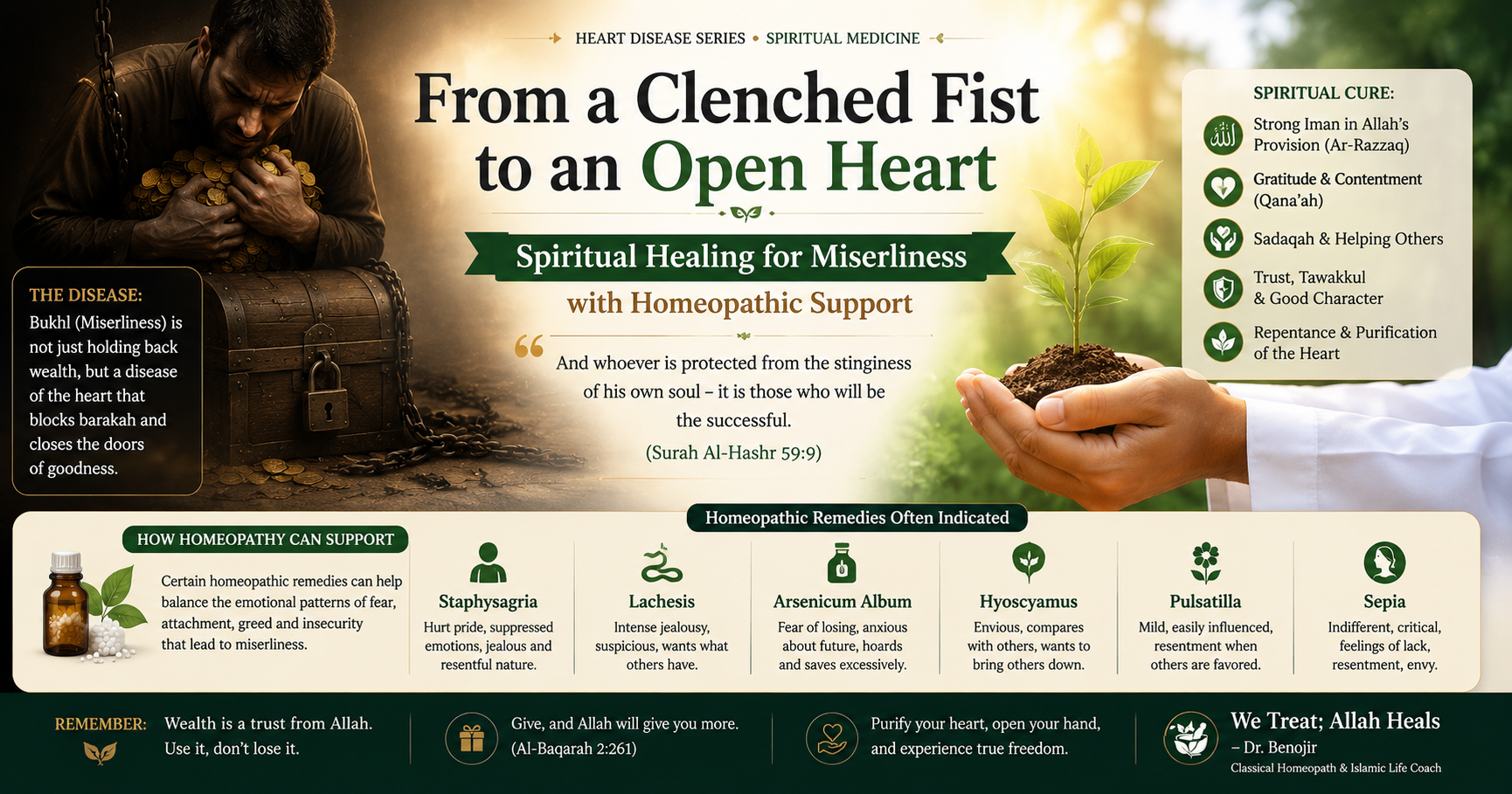
An Islamic and Holistic Guide to Overcoming Miserliness, Anxiety About Provision, and the Fear of Not Having Enough
By Dr. Benojir | Classical Homeopath & Islamic Life Coach
When a Full Hand Hides an Empty Heart
Picture a man whose cupboards are full, whose bank balance is healthy, and whose possessions are abundant — yet who lies awake at night gripped by a quiet dread of running out. He holds tightly to what he owns, convinced that giving any of it away will leave him exposed. Outwardly he looks secure. Inwardly, he is poor.
This is not simply a personality trait. In Islamic spiritual tradition it is recognised as a disease of the heart — Bukhl, or miserliness, and its deeper relative, Shuhh, a possessive, anxious greed that clings to wealth and resents what others have. Both are mentioned repeatedly in the Qur’an, not as minor character flaws but as conditions that, left untreated, corrode faith, relationships, and peace of mind.
Allah says:
And whoever is protected from the stinginess of his own soul — it is they who are the successful. — Surah Al-Hashr 59:9
Notice that this verse is not about how much a person owns. It is about what owns the person. The real struggle is rarely between rich and poor — it is between fear and trust, between a closed hand and an open heart. This article looks at Bukhl from three angles familiar to readers of this site: the spiritual diagnosis given in the Qur’an and Sunnah, the emotional and constitutional patterns that classical homeopathy has long observed in anxious, security-driven temperaments, and the practical, everyday steps that can help loosen greed’s grip.
Bukhl and Shuhh: Two Faces of the Same Disease
Although people often use “greed,” “stinginess,” and “miserliness” interchangeably, Islamic scholarship distinguishes between them.
Bukhl — The Outward Refusal to Give
Bukhl shows up in behaviour: withholding charity one can easily afford, neglecting the financial rights of family, refusing to help when capable, and hoarding wealth far beyond genuine need. It is visible chiefly through what a person fails to do.
Shuhh — The Deeper Root of Avarice
Shuhh runs deeper. It is not just refusing to give; it is an inner appetite that combines greed, covetousness, excessive attachment to possessions, and a nagging envy of what others have. Bukhl is the symptom; Shuhh is often the disease beneath it. This is why the Qur’an asks believers to seek refuge specifically from “the stinginess of their own souls” — the request is for inner healing, not merely better financial habits.
Why This Matters: A Warning from the Prophet ⻥
Beware of stinginess, for it destroyed those who came before you. It led them to shed blood and to make lawful what was unlawful. — Riyād as-Sāliḩīn, Hadith 562
Most people think of greed purely in terms of money. The Prophet ⻥ connected it to something far larger: injustice, conflict, and the breakdown of trust between people. History bears this out — unchecked attachment to wealth and status has repeatedly driven exploitation and conflict at every scale, from broken family ties over inheritance to large social injustices. What begins as a private fear in one heart can, multiplied across a community, fracture the bonds that hold people together.
The Qur’an’s Three-Layer Diagnosis
Surah An-Nisa offers an unusually precise description of how this disease progresses:
Those who are stingy and encourage others to be stingy and conceal what Allah has given them of His bounty — We have prepared for the disbelievers a humiliating punishment. — Surah An-Nisā’ 4:37
Three layers are named here. First, personal miserliness — neglecting the people and causes one is responsible for. Second, normalising stinginess in others, through comments like “keep your money to yourself” or “people will take advantage of you,” which quietly spread fear instead of generosity. Third, concealing one’s blessings altogether — understating what one has out of fear of being asked to share it. This last layer reflects a deeper confusion about ownership: wealth in Islam is understood as an Amanah, a trust from Allah, not an absolute personal possession.
The Closed Hand and the Closed Heart
Do not keep your hand chained to your neck, nor extend it completely, lest you become blameworthy and insolvent. — Surah Al-Isrā’ 17:29
Islam does not ask for recklessness, only balance. But the image is striking: the miser’s hand is, spiritually speaking, chained — unable to open, unable to give, unable to benefit anyone, including its owner. Over time, a closed hand tends to produce a closed heart, one that struggles to feel the relief of gratitude or the warmth of generosity even when circumstances are objectively comfortable.
Where Does Miserliness Come From?
The Qur’an and Sunnah point to several roots beneath the surface behaviour.
• Fear of poverty — the Qur’an names this directly: “Shaytan threatens you with poverty… while Allah promises you forgiveness and bounty” (Surah Al-Baqarah 2:268). Fear of future lack often prevents people from even enjoying what they currently have.
• Excessive love of this world (Hubb al-Dunya) — when wealth becomes the main source of identity and security, parting with any of it feels like losing a piece of oneself.
• Weak Tawakkul (trust in Allah) — many believe intellectually that Allah is Ar-Razzaq, the Provider, yet emotionally lean far more on savings and possessions.
• Ingratitude — forgetting that every blessing originates with Allah, and beginning to see it as a purely personal achievement, much like the owner of the two gardens in Surah Al-Kahf, who credited his harvest to himself and lost it soon after (Surah Al-Kahf 18:34–42).
None of these roots are unusual or shameful. They are simply patterns of the heart that, once named, become much easier to work on.
The Prophetic Approach to Healing Bukhl
Islam rarely names a disease of the heart without also offering a cure. Several practical steps are drawn directly from the Qur’an and Sunnah.
• Strengthen Tawakkul. Reminding oneself, in moments of financial anxiety, that provision ultimately comes from Allah weakens the grip of fear.
• Give consistently, even in small amounts. The Prophet ⻥ said, “Charity does not decrease wealth” (Sahih Muslim). Regularity softens the heart far more than occasional large gestures.
• Cultivate Shukr (gratitude). A grateful heart notices what it has; a greedy heart fixates on what it lacks.
• Remember the Hereafter. The Prophet ⻥ encouraged frequent remembrance of death, which puts the temporary nature of wealth into perspective.
• Choose generous company. The Ansar of Madinah — who, the Qur’an says, “give preference to others over themselves even though they themselves are in need” (Surah Al-Hashr 59:9) — remain history’s clearest example of how generosity is learned by proximity.
• Make sincere Du’a for a soft, generous, and contented heart.
On this last point, the Prophet ⻥ described a strikingly daily mechanism of reward and loss:
Every morning two angels descend. One says: ‘O Allah, give more to the one who spends.’ The other says: ‘O Allah, bring destruction upon the wealth of the miser.’ — Sahih al-Bukhārī & Sahih Muslim
Two prayers are offered every single day. The choice of which one a person lives under is, in large part, their own.
A Classical Homeopathy Perspective: Treating the Person, Not the Label
Classical homeopathy does not treat “greed” or “miserliness” as a diagnosis in the way conventional medicine treats a disease. Instead, it looks at the whole constitutional picture of a person — their fears, their physical tendencies, their stress responses, and their general temperament — and matches it to an individualised remedy. The patterns below are well-documented constitutional tendencies in classical materia medica that often appear alongside anxiety about security, possessiveness, or an excessive focus on material control. They are offered here for general education only; they are not a substitute for a full case-taking by a qualified classical homeopath, who selects a remedy based on the totality of a person’s symptoms, not a single trait.
Arsenicum Album: Marked anxiety about security and the future; restless, fastidious need for order and control; fear of poverty or loss despite material comfort; chilly and meticulous in nature.
Calcarea Carbonica: Cautious, security-seeking temperament; worries about finances even when objectively stable; slow but steady; sluggish constitution with a strong desire for predictability.
Lycopodium Clavatum: Preoccupied with status, reputation, and being seen as capable; underlying insecurity masked by outward confidence or controlling behaviour; digestive complaints linked to stress.
Nux Vomica: Driven, competitive, achievement- and work-centred; impatient and irritable under pressure to perform or provide; often linked to overwork and a results-at-all-costs mindset.
Natrum Muriaticum: Reserved and self-protective; keeps both emotions and resources guarded; difficulty trusting others enough to be open-handed; tends toward quiet grief or disappointment held inwardly.
Sepia: Emotionally withdrawn under chronic responsibility or fatigue; indifference can develop toward giving or connecting, often from sheer depletion rather than true selfishness.
Aurum Metallicum: Heavy sense of duty tied to wealth, status, or achievement; deep low mood if these feel threatened; perfectionistic and overly self-critical about “not doing enough.”
These constitutional pictures are not moral judgements — every temperament carries both strengths and challenges. A homeopath’s role is to understand the individual’s complete picture, physical and emotional, before recommending any remedy.
Lifestyle Steps That Support a Generous, Settled Heart
Spiritual and emotional healing is supported well by ordinary daily habits. None of these replace sincere worship or professional guidance, but together they create conditions in which a calmer relationship with money and giving can take root.
• Diet: Irregular eating and excess caffeine or sugar can heighten background anxiety, which often expresses itself as a tighter grip on control, including financial control. Regular, balanced meals support a steadier mood.
• Sleep: Poor sleep amplifies fear-based thinking. Aiming for consistent, adequate sleep helps the mind reason more calmly about provision and risk.
• Movement: Regular physical activity is one of the most consistent, well-supported ways to lower everyday anxiety, which is frequently the engine behind hoarding behaviour.
• Budgeting with intention: Setting a deliberate, written charity and family-support budget — even a modest one — turns generosity into a planned habit rather than an emotionally difficult decision made in the moment.
• Digital and social awareness: Constant exposure to others’ visible wealth on social media can quietly feed comparison and Shuhh. Limiting this exposure, or pairing it with conscious gratitude practice, helps.
• Journaling gratitude: A short daily note of three things one is grateful for is a simple, well-studied habit that measurably shifts focus away from scarcity thinking.
• Stress management: Deep breathing, a short daily walk, or simply pausing before a difficult financial decision allows the rational, faith-grounded mind to lead instead of fear.
Mind | Body | Deen: Three Dimensions of the Same Struggle
Mind
Psychologically, miserliness is frequently an anxiety response. The mind, anticipating future scarcity, tries to protect itself by tightly controlling present resources. Left unaddressed, this thinking pattern can generalise into broader rigidity, irritability, and difficulty trusting others — in relationships as much as in finances.
Body
Chronic financial anxiety does not stay confined to the mind. It frequently shows up physically as tense shoulders, disturbed sleep, digestive discomfort, or a persistently elevated stress response. The body, in effect, keeps the score of unresolved fear long after the original worry has passed.
Deen
Spiritually, the antidote begins with restoring the believer’s understanding of wealth as an Amanah — a trust, not an end in itself. The Qur’an’s repeated reminder that true success belongs to “whoever is protected from the stinginess of his own soul” (Surah Al-Hashr 59:9) reframes generosity not as loss, but as liberation. Combined with consistent Salah, sincere Du’a, and reflection on the temporary nature of this world, faith offers what willpower alone rarely achieves: a heart that gives because it trusts, not because it is told to.
Common Questions
Is wanting financial security the same as Bukhl?
No. Planning, saving, and providing responsibly for one’s family are encouraged in Islam. Bukhl begins where reasonable caution turns into fear-driven hoarding, refusal of due rights, or resentment of others’ blessings.
Can someone be generous with money but still suffer from Shuhh?
Yes. Shuhh is primarily a state of the heart — envy, comparison, and quiet attachment can persist even in someone who gives outwardly. This is why the Qur’an asks for protection from the soul’s stinginess, not merely better spending habits.
How does homeopathy fit alongside spiritual treatment?
Classical homeopathy works at the level of constitutional temperament — the anxious, controlling, or security-seeking patterns that often sit underneath miserly behaviour. It complements, rather than replaces, the spiritual and behavioural work of Tawbah, Shukr, and Tawakkul.
Final Reflection
Bukhl and Shuhh are not simply financial habits to be managed; they are conditions of the heart to be healed. The Qur’an, the Sunnah, and the timeless example of the Ansar all point in the same direction: true wealth is measured not by what is accumulated, but by what is given, trusted, and made peace with.
The miser spends a lifetime guarding what he has. The believer spends a lifetime investing in what remains. May Allah purify our hearts from greed, fear, and excessive attachment to this world, and fill them instead with gratitude, generosity, and trust.
Ameen.
Dr. Benojir
Classical Homeopath & Islamic Life Coach
Mind | Body | Deen
“We Treat; Allah Heals”