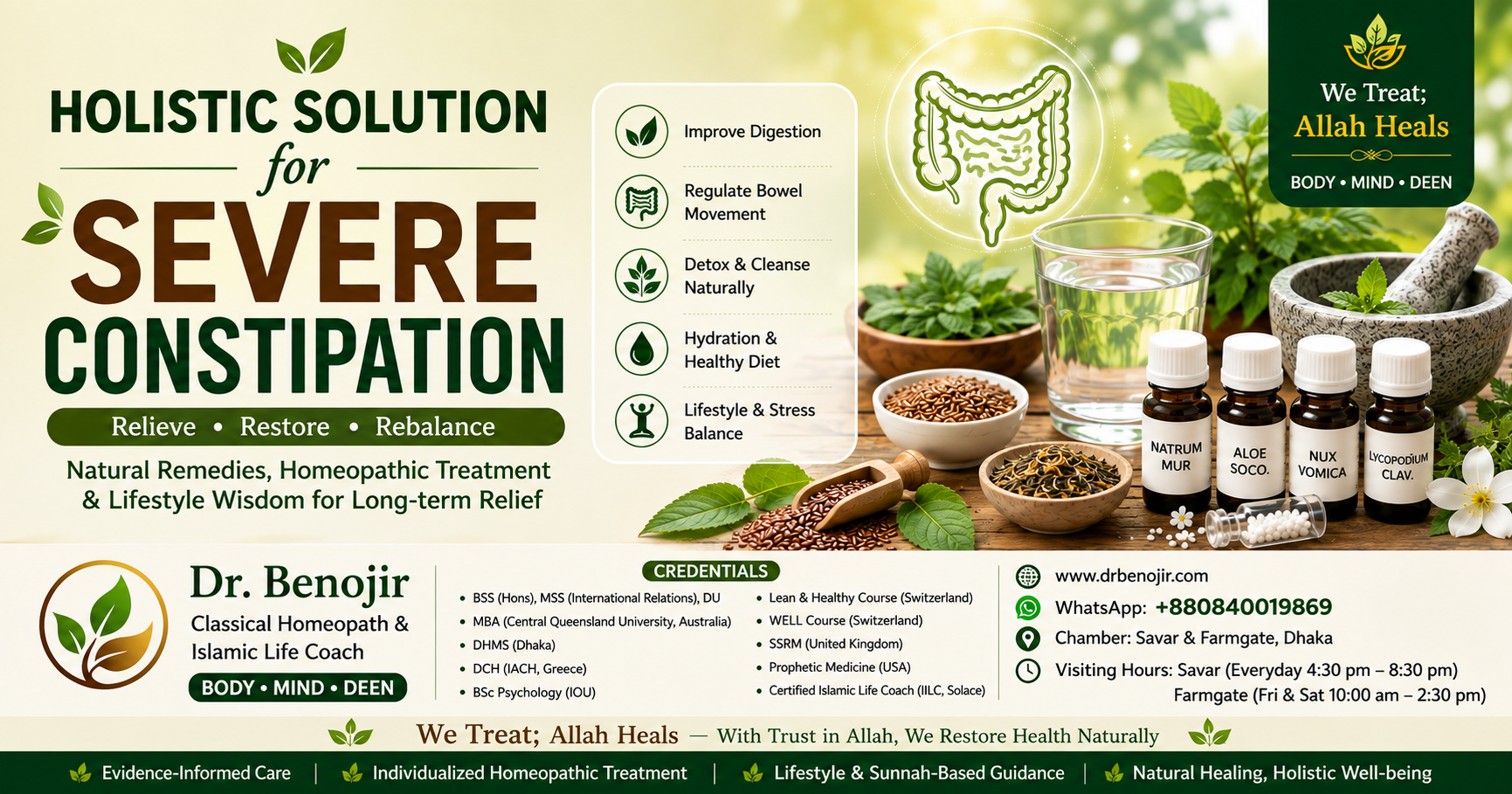
A practical, evidence-informed and holistic look at chronic constipation — its causes, its symptoms, natural remedies, homeopathic treatment, and time-tested lifestyle wisdom
What Is Constipation?
Constipation is one of the most common digestive complaints in the world, yet it is often dismissed as a minor inconvenience until it becomes severe. In simple terms, constipation means infrequent, incomplete, or difficult passage of stool. Medically, it is usually defined as having fewer than three bowel movements a week, along with stools that are hard, dry, or lumpy, and a bowel movement that requires excessive straining or feels incomplete.
Constipation is not a disease in itself — it is a symptom of an underlying imbalance. This imbalance can arise from a low-fiber diet, inadequate water intake, a sedentary lifestyle, ignoring the natural urge to pass stool, certain medications, hormonal changes, stress, or weakened muscle tone in the intestines, which is especially common as people age. In severe or chronic cases, constipation can also point to a slower-than-normal movement of the colon (often called slow-transit constipation) or to problems with the coordination of the pelvic floor muscles during defecation.
Common Symptoms of Constipation
Constipation can show up differently in different people, but the following are the most frequently reported symptoms:
• Passing stool fewer than three times a week
• Hard, dry, or lumpy stool that is difficult or painful to pass
• Straining excessively during a bowel movement
• A feeling that the bowels have not been completely emptied
• A sensation of blockage in the rectum
• Needing to use manual help, such as pressing on the abdomen, to pass stool
• Bloating, gas, and abdominal discomfort
• Loss of appetite, especially in long-standing cases
• Back pain or pelvic discomfort from repeated straining
• Small tears near the anus (fissures) that can cause bleeding and sharp pain
When constipation becomes chronic and severe, it can significantly affect a person's quality of life — disturbing sleep, mood, appetite, and even posture due to repeated strain on the lower back and pelvic muscles.
How Constipation Is Diagnosed
Diagnosis usually starts with a detailed history and physical examination. A doctor will typically ask about the frequency and consistency of stools, diet, fluid intake, physical activity, medication use, and any associated symptoms such as bleeding, pain, or weight loss.
Common diagnostic steps include:
• Physical and abdominal examination, and sometimes a digital rectal examination to check for fissures, hemorrhoids, or blockage
• Blood tests to rule out thyroid problems, diabetes, or electrolyte imbalance
• Stool tests to check for hidden blood or infection
• Colonoscopy or sigmoidoscopy, especially in people over 50 or when there are warning signs such as unexplained weight loss or rectal bleeding, to rule out structural problems
• Colonic transit studies or anorectal manometry in stubborn, long-standing cases, to check how well the colon and pelvic muscles are working together
A note of caution: any new or severe constipation in an older adult, especially with weight loss, bleeding, or a family history of bowel disease, should always be evaluated by a physician before starting any home or natural treatment, to rule out a serious underlying cause.
Natural Ways to Treat Severe Constipation
For most people, constipation — even fairly severe constipation — responds well to a combination of dietary change, hydration, movement, and better bowel habits. Below are natural approaches that are widely recommended:
1. Fiber, the Right Way
Both soluble fiber (found in oats, apples, flaxseed, and isabgol/psyllium husk) and insoluble fiber (found in whole wheat, vegetables, and bran) add bulk and softness to stool. Fiber should be increased gradually, because a sudden jump can worsen bloating and gas, particularly in someone whose gut is not used to it.
2. Hydration
Fiber without enough water can actually make constipation worse, since fiber absorbs water to form soft stool. Warm water first thing in the morning and steady fluid intake throughout the day are among the simplest and most effective natural remedies.
3. Healthy Fats
A spoon of olive oil, ghee (clarified butter), or soaked flaxseed can help lubricate the intestines naturally.
4. Movement and Exercise
Walking, especially after meals, along with gentle abdominal exercises and yoga poses that involve twisting or forward bending, stimulates intestinal motility.
5. Abdominal Massage
A gentle clockwise massage of the abdomen, following the direction of the colon, can help move stool along and ease cramping.
6. Never Suppress the Urge
Repeatedly ignoring the natural urge to pass stool — often due to a busy schedule or an unfamiliar toilet — trains the rectum to become less sensitive over time, which can itself lead to chronic constipation.
7. Correct Toilet Posture
Sitting with the knees higher than the hips (using a small footstool if sitting on a Western-style toilet, or squatting) straightens the anorectal angle and makes stool passage significantly easier and less strained.
8. Stress Management
The gut and the nervous system are closely connected. Chronic stress and anxiety can slow the gut down considerably, so breathing exercises, prayer, meditation, or a calm daily routine can meaningfully help bowel regularity.
An Illustrative Case: A 60-Year-Old with Severe Constipation
Consider the case of a 60-year-old patient with a long history of severe constipation. The stool is extremely hard, and there is no natural urge to pass it for several days at a stretch; the patient has to help it along mechanically, such as by pressing on the abdomen or using manual assistance. Because of the extreme straining, a fissure has developed, and there is now sharp pain during and after passing stool. The prolonged, forceful straining has also led to chronic lower back pain. The patient reports that milk and bread noticeably worsen the constipation and bring on gas and bloating. There is also marked, profuse sweating, especially on the head, even without exertion. In addition, the patient describes contraction and tightness of muscles and tendons, along with an unusual numbness in the feet, described as a sensation of needles entering through the toenails.
Clinical note: the numbness with a needle-like sensation in the feet, together with muscle and tendon contraction, are symptoms that deserve careful medical evaluation on their own — they can be seen in conditions such as peripheral neuropathy (for example, related to diabetes, vitamin B12 deficiency, or nerve compression) or electrolyte disturbance. These should be properly investigated by a physician alongside the treatment of constipation, rather than being treated as bowel symptoms alone.
Homeopathic Remedies for Constipation
Homeopathy treats constipation on the basis of the total picture of the person — not just the bowel symptom, but the accompanying sensations, food preferences and aversions, temperament, and modalities (what makes the complaint better or worse). Below are ten commonly indicated remedies, each with its key distinguishing features, as generally described in classical homeopathic materia medica.
1. Nux Vomica: For constipation from a sedentary lifestyle, overeating, alcohol, or overuse of laxatives. Frequent, ineffectual urging; feels as if the bowel has not finished emptying. Irritable, chilly, and impatient temperament.
2. Bryonia Alba: Stool is large, hard, and dry, as though burnt; there is little or no desire for days. Worse from any motion, better lying still. Often thirsty for large quantities of water at long intervals.
3. Alumina: One of the leading remedies for severe, obstinate constipation in the elderly. No urge to stool for days even though the stool may not be very hard; the rectum feels inactive and requires great straining, sometimes needing mechanical or manual help. Often accompanied by dryness of mucous membranes and a sensation of numbness, tingling, or 'pins and needles' in the limbs.
4. Silicea (Silica): Stool that is partly passed and then slips back ('bashful stool'); great straining; tendency to fissures and slow-healing wounds. Chilly patient with notably profuse sweating of the head and feet, and a general lack of vital reaction.
5. Sepia: Constipation with a sensation of a ball or plug in the rectum that moves up and down without being expelled. Common around menopause or hormonal change; irritability and indifference; worse from milk.
6. Natrum Muriaticum: Hard, dry stool, crumbling at the edges of the anus; constipation alternating with emotional stress; craves salt, averse to consolation, and often worse from sun and heat.
7. Opium: Complete inertia of the bowel; no urge whatsoever, sometimes for many days, with round, hard, black balls of stool. Often seen after a shock, fright, or in a person with a generally sluggish, torpid disposition.
8. Lycopodium: Constipation with much bloating and gas, worse in the afternoon and evening (roughly 4–8 p.m.); ineffectual urging; craves warm food and sweets; stool is often hard only in the first part, followed by soft stool.
9. Magnesia Muriatica: Constipation clearly aggravated by milk; stool crumbles as it passes, like dry, crumbled clay; liver sluggishness is common, along with a sensitive, easily hurt emotional nature.
10. Calcarea Carbonica: Constipation in a chilly, easily tired person; profuse sweating of the head, particularly during sleep; stool may be normal in consistency but simply not expelled without great effort; cravings for eggs and starchy food, with easy tiring on exertion.
Which Remedy Best Matches the Example Case?
Looking at the case above as a whole — hard stool, no natural urge for days requiring mechanical assistance, straining severe enough to cause a fissure and back pain, aggravation from milk and bread with flatulence, profuse head sweat, and numbness of the feet described as needles through the toenails — the picture points most strongly toward Alumina. Its hallmark is precisely this combination: a rectum that has essentially 'gone to sleep,' with no urging even after several days, requiring great and often mechanical effort to expel stool, together with the characteristic numbness and pins-and-needles sensation in the extremities. Silicea also deserves consideration in this case, particularly for the fissure and the profuse head sweat, and could be considered as an alternating or follow-up remedy if Alumina does not fully resolve the picture.
This matching is offered for educational understanding of homeopathic case-taking principles. Homeopathic remedies should be selected and prescribed by a qualified homeopathic practitioner after a full individual case-history, and this article is not a substitute for that consultation — particularly given the additional neurological symptoms described in this case.
Lifestyle Practices, Including Sunnah Food and Habits, That Help Fight Constipation
Alongside diet and homeopathic care, certain traditional lifestyle habits — including practices recommended in the Sunnah (the traditions and practices of Prophet Muhammad, peace be upon him) — are widely regarded as supportive for healthy digestion:
• Drinking a glass of warm water on an empty stomach in the morning to gently stimulate the bowel
• Eating dates (tamr) regularly — a Sunnah food that is naturally rich in fiber and helps soften stool
• Using olive oil in food or taking a small amount on its own, as olive oil was recommended in the Sunnah and is known to have a mild lubricating, laxative effect
• Eating in moderation and avoiding overeating, in line with the Sunnah guidance to fill the stomach with one-third food, one-third water, and one-third air
• Chewing food slowly and thoroughly rather than eating in haste
• Not delaying the answer to nature's call, and going to the toilet as soon as the urge is felt
• Regular, moderate physical activity such as walking, which was a natural part of daily life in the Sunnah tradition
• Consuming figs, raisins, and other dried fruits, which are traditionally used to ease bowel movements
• Practicing regular, unhurried sleep and waking early, which supports a stable digestive rhythm
• Using honey, particularly diluted in warm water, which is mentioned in the Sunnah as having general healing benefit and can gently aid digestion
• Reducing highly processed, refined foods (such as white bread) and heavy dairy in people who notice these foods worsen their constipation, as in the example case above
Taken together, these habits reflect a broader principle found in both traditional and modern medicine: constipation improves fastest when diet, movement, regular routine, and calm mental state are addressed together, rather than any single measure being relied upon alone.
References
The homeopathic principles discussed in this article draw on the foundational literature of classical homeopathy:
• Hahnemann, Samuel. The Organon of Medicine (6th edition) — for the foundational principles of individualized case-taking, the concept of the totality of symptoms, and the law of similars that underlie remedy selection.
• Kent, James Tyler. Lectures on Homoeopathic Materia Medica — for the detailed symptom pictures, keynotes, and clinical characteristics of remedies such as Alumina, Bryonia, Nux Vomica, Silicea, and Sepia.
• Vithoulkas, George. Materia Medica Viva and The Science of Homeopathy — for the modern clinical elaboration of remedy pictures, the concept of levels of health, and guidance on differentiating closely related remedies in chronic disease.
Disclaimer: This article is for general educational purposes only and is not a substitute for professional medical or homeopathic diagnosis and treatment. Anyone experiencing severe, persistent, or worsening constipation — particularly when accompanied by symptoms such as rectal bleeding, unexplained weight loss, fissures, numbness, or muscle contractions — should consult a qualified physician promptly for proper evaluation.