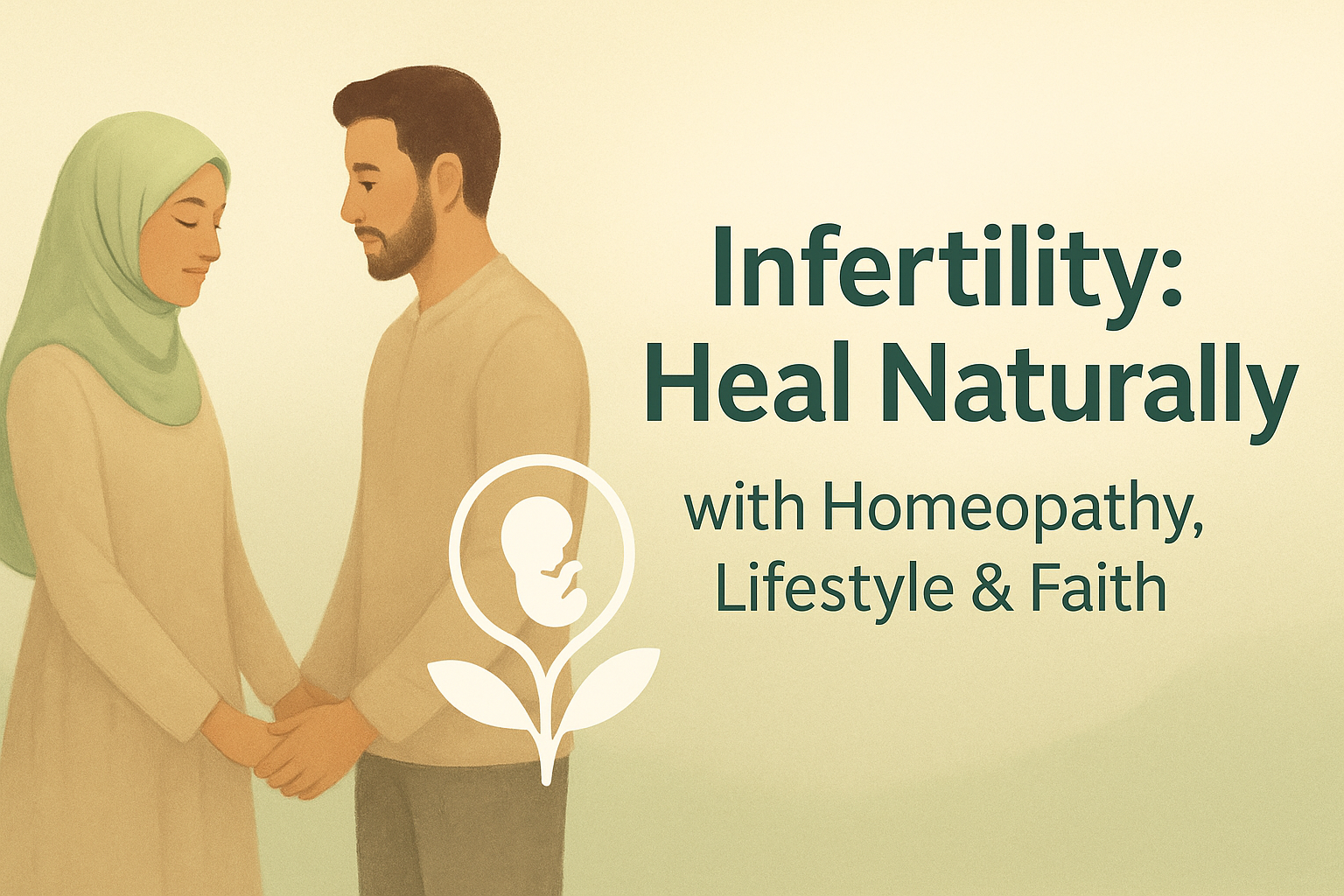
A Whole-Person Guide to Fertility, Lifestyle, and Emotional Well-Being
Dr. Benojir | Classical Homeopath & Islamic Life Coach
Trying to conceive a child and not succeeding can be one of the loneliest experiences a couple goes through. Yet it is far more common than most people realize. According to a major 2023 global report by the World Health Organization (WHO), roughly 1 in 6 people of reproductive age worldwide will experience infertility at some point in their lives — a rate that is remarkably similar across rich and poor countries alike.
This guide brings together the medical, lifestyle, and emotional dimensions of infertility, along with how Classical Homeopathy approaches fertility as part of whole-person health. The goal is simple: to help you understand what is happening in your body, what options exist, and how to move forward with informed hope rather than fear.
What Counts as Infertility?
Doctors generally define infertility as the inability to conceive after 12 months of regular, unprotected intercourse. For women over 35, evaluation is usually recommended after just six months, since fertility naturally declines more quickly with age.
It is important to know that infertility is never “just a woman’s problem.” Research consistently shows that male factors contribute to roughly 40–50% of cases, and in many couples, both partners contribute small factors that add up together.
Recognizing the Signs
Infertility itself often has no symptoms beyond the difficulty of conceiving. However, several underlying conditions can produce noticeable signs.
In women, watch for:
• Irregular, absent, or very painful periods
• Heavy menstrual bleeding
• Signs of PCOS, such as acne or excess hair growth
• Pelvic pain or known endometriosis
• Recurrent miscarriage
• Unexplained weight changes
In men, watch for:
• Low sexual desire or erectile difficulty
• Testicular pain, swelling, or change in size
• History of genital infection or surgery
• A semen analysis showing low count or poor motility
Common Causes in Women
Ovulation disorders — including PCOS, thyroid imbalance, and elevated prolactin — are among the leading causes, since pregnancy depends on regular release of a healthy egg.
Endometriosis, where tissue similar to the uterine lining grows outside the uterus, can cause inflammation and scarring that interfere with conception. Blocked or damaged fallopian tubes, often from past infections or pelvic surgery, prevent sperm and egg from meeting. Structural issues such as fibroids, polyps, or scar tissue inside the uterus can also affect implantation, and even subtle hormonal imbalances can disrupt the delicate timing pregnancy requires.
Common Causes in Men
Male fertility depends on having enough healthy, well-shaped sperm that can swim effectively. Low sperm count (oligospermia), poor motility (asthenozoospermia), and abnormal shape (morphology) are the most frequent laboratory findings. A varicocele — enlarged veins around the testes — is a common, often treatable contributor. Hormonal disorders affecting testosterone also play a role, and lifestyle factors such as smoking, heavy alcohol use, obesity, chronic stress, poor sleep, and exposure to environmental toxins can measurably reduce sperm quality.
When No Cause Is Found
In a meaningful number of couples, every standard test comes back normal. This is labeled unexplained infertility, and while it can feel especially frustrating, it is a reminder that fertility is influenced by many subtle factors — including stress, sleep, nutrition, and overall constitutional health — that don’t always show up on a lab report.
How Infertility Is Diagnosed
A thorough work-up usually involves both partners. For women, this may include a hormonal profile (FSH, LH, TSH, prolactin), pelvic ultrasound, ovarian reserve testing, and a hysterosalpingogram (HSG) to check the fallopian tubes. For men, semen analysis, hormonal testing, and a physical examination are standard. Evaluating both partners together, rather than focusing on just one, gives the clearest picture and the best chance of identifying treatable factors.
Classical Homeopathy: An Individualized Approach to Fertility
Classical Homeopathy does not treat “infertility” as one fixed disease with one fixed remedy. Instead, it looks at the person as a whole — physical symptoms, emotional state, sleep, stress levels, hormonal tendencies, and personal history — to find the remedy that best matches the individual’s overall pattern. Two women with PCOS, or two men with low sperm count, may need entirely different remedies because their underlying constitutional pictures differ. The aim is to gently support the body’s own regulatory and healing capacity alongside any conventional care a couple is pursuing.
Some commonly considered remedies in fertility-related homeopathic practice include:
• Sepia Officinalis — hormonal imbalance, bearing-down pelvic sensation, irregular cycles, emotional exhaustion, low libido
• Pulsatilla Nigricans — delayed or irregular periods, mild and emotionally sensitive temperament, changeable symptoms
• Natrum Muriaticum — unresolved grief, irregular cycles, vaginal dryness, emotional reserve
• Calcarea Carbonica — slow metabolism, weight gain, delayed menstruation, chilliness, fatigue
• Lycopodium Clavatum — low sperm count, erectile weakness, reduced confidence, digestive complaints
• Agnus Castus — sexual weakness, impotence, nervous exhaustion
• Medorrhinum — chronic, recurrent reproductive issues or repeated miscarriage in deep-seated cases
• Folliculinum — prominent hormonal imbalance or estrogen-related menstrual irregularity
These remedies are illustrative, not prescriptive — selecting the right one requires a detailed individual case-taking by a qualified homeopath, since the same remedy will not suit everyone with the same diagnosis.
Lifestyle Modification: Supporting Fertility Naturally
Growing scientific evidence shows that everyday habits meaningfully influence reproductive health, in both men and women.
• Maintain a healthy weight — both obesity and being underweight can disrupt hormonal balance and ovulation
• Eat a nutrient-dense diet — emphasize fruits, vegetables, whole grains, healthy fats, and lean protein; limit ultra-processed food and added sugar
• Move your body regularly — moderate exercise supports hormone regulation, though excessive intense training can sometimes backfire
• Protect your sleep — poor sleep disrupts the hormones that govern ovulation and sperm production
• Reduce toxin exposure — limit smoking, alcohol, recreational drugs, and unnecessary plastic/chemical exposure
• Manage stress actively — chronic stress can alter reproductive hormone signaling in both partners
Mind | Body | Deen: A Fuller Picture of the Fertility Journey
Infertility rarely stays confined to the reproductive system. It touches emotional well-being, self-worth, marital connection, and spiritual outlook all at once — which is why a fuller, three-dimensional perspective can be so helpful.
Mind: Learning to manage anxiety, fear, and the overthinking that often accompanies fertility treatment can itself improve quality of life and resilience during the process.
Body: Supporting hormonal balance through proper nutrition, sleep, physical activity, and appropriate medical or homeopathic care gives the body the best foundation to function well.
Deen: Islam frames every hardship as carrying wisdom and the possibility of reward. The Qur’an reminds believers that the gift of children rests entirely with Allah’s will:
“To Allah belongs the dominion of the heavens and the earth. He creates what He wills. He grants female offspring to whom He wills and male offspring to whom He wills.” — Surah Ash-Shura 42:49–50
The Prophet ẚallallahu ‘alayhi wa sallam taught that du’a (supplication), patience (sabr), and gratitude (shukr) are sources of strength in every trial. Many couples find that combining sincere du’a, tawakkul (trust in Allah), and dhikr (remembrance of Allah) with their medical and lifestyle efforts brings a sense of peace that numbers and test results alone cannot provide.
Common Questions Couples Ask
“Should we try homeopathy instead of IVF, or alongside it?” Many couples choose to pursue both approaches together, using homeopathy and lifestyle changes to support overall health while continuing recommended medical evaluation and treatment.
“How long should we try before seeking help?” Twelve months is the general guideline, but six months if the woman is over 35, or sooner if there are known risk factors such as irregular cycles or prior pelvic surgery.
“Is unexplained infertility hopeless?” Not at all — many couples with unexplained infertility eventually conceive, especially once contributing factors like stress, sleep, weight, and nutrition are addressed alongside professional care.
Final Thoughts
Infertility is rarely just a medical diagnosis — it is an experience that touches the body, the mind, and the spirit together. A balanced approach that combines proper medical evaluation, thoughtful lifestyle changes, individualized homeopathic support, and emotional and spiritual grounding offers couples the most complete path forward.
Classical Homeopathy does not promise to replace medical care, but it offers a way of seeing the whole person behind the diagnosis — and for many, that perspective itself becomes a source of renewed hope.
Dr. Benojir
Classical Homeopath & Islamic Life Coach
Mind | Body | Deen
“We Treat; Allah Heals”