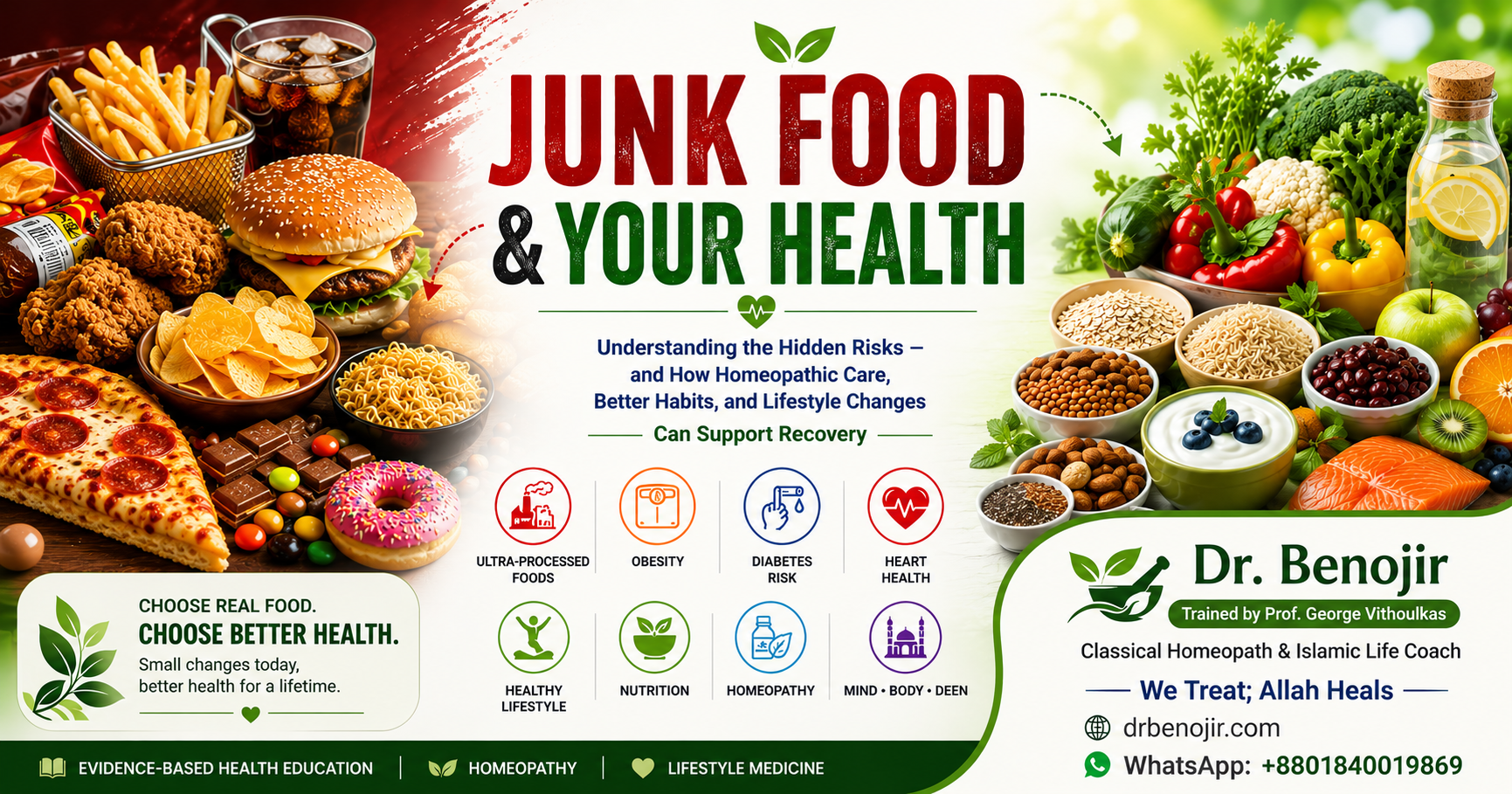
How everyday convenience foods quietly reshape your metabolism, mood, and long-term wellbeing — and what you can do about it, body and soul.
Introduction
Picture a typical evening: you're tired, dinner isn't ready, and a bag of chips or a plate of fried snacks is within arm's reach. It feels harmless. Yet that small, repeated choice, made thousands of times over months and years, is one of the most powerful forces shaping modern health.
Junk food, more precisely called ultra-processed food, has become so woven into daily life that many people no longer notice how much of it they eat. This article looks at what junk food actually is, how it affects the body, and how classical homeopathy, sensible lifestyle change, and spiritual grounding can work together to support lasting recovery.
Overview and Definition
"Junk food" is the everyday name for foods and drinks high in calories, added sugar, refined starch, salt, and unhealthy fats, while offering little of the fiber, vitamins, minerals, and protein the body genuinely needs. Nutritionists often use a more technical label: ultra-processed food (UPF), a term from the NOVA food classification system describing industrial formulations built mainly from refined ingredients and additives such as emulsifiers, flavorings, and preservatives, with little or no whole food remaining.
This is not a niche problem. Ultra-processed foods now make up a large share of daily calories in households worldwide, cutting across age, income, and geography, which is part of why this topic matters to nearly every family.
Causes and Risk Factors
The rise of junk food consumption reflects a mix of factors patients can and cannot control. Modifiable contributors include busy schedules favoring quick meals, limited cooking time, aggressive marketing of packaged snacks, and habits formed in childhood around sugary drinks and fried food.
Non-modifiable factors matter too. A genetic tendency toward stronger reward responses to sugar and fat, family history of obesity or metabolic disease, and limited access to fresh produce can all make junk food the easier option regardless of intentions. Recognizing which factors are within your control helps focus energy where change is actually possible.
Signs, Symptoms and When to Seek Help
A diet heavy in junk food rarely announces itself with one dramatic symptom. Patients often notice a cluster of complaints instead: sluggish digestion, bloating or acidity after meals, gradual weight gain, persistent low energy, skin breakouts, and strong cravings for sugar or salty snacks.
Diagnosis usually combines dietary history, physical examination, and basic blood work checking blood sugar, cholesterol, and liver function. See a doctor promptly if you notice unexplained weight change, persistent fatigue, high blood pressure readings, or blood sugar outside the normal range, since these can signal that dietary damage has progressed into a diagnosable condition.
Complications
Left unaddressed, a junk-food-dominated diet is linked to a wide range of conditions. A 2024 umbrella review summarized by Johns Hopkins researchers, drawing on 45 meta-analyses covering nearly 10 million people, connected high ultra-processed food intake with dozens of conditions, including obesity, type 2 diabetes, cardiometabolic disease, several cancers, digestive disorders, asthma, anxiety, and depression.
A multi-national cohort study linked to the International Agency for Research on Cancer found the highest ultra-processed food intake carried a meaningfully greater risk of becoming overweight or obese than the lowest intake. Patients may also experience insulin resistance and fatty liver from excess refined sugar, rising blood pressure and cholesterol from sodium and trans fats, and slowed gut motility from low fiber. An occasional treat is not dangerous; the real risk builds when junk food supplies a large share of daily calories over months and years.
Classical Homeopathy for Diet-Related Complaints
Classical homeopathy does not treat "junk food damage" as a single label. Following the principles Samuel Hahnemann set out and later homeopaths such as James Tyler Kent, William Boericke, John Henry Clarke, C. M. Boger, and George Vithoulkas refined, a homeopath selects a remedy based on each patient's complete symptom picture, including physical complaints, food cravings, emotional state, and general constitution. Two people with similar diets may therefore receive quite different remedies.
Several remedies are commonly discussed in relation to diet-related complaints, always chosen according to the individual's full picture rather than the food itself. Nux Vomica is often considered for irritable, driven people with acidity, bloating, and constipation after rich or spicy meals, especially with a history of overwork. Lycopodium is associated with bloating that worsens in the late afternoon and a strong craving for sweets alongside digestive weakness. Pulsatilla may suit gentle, changeable individuals whose digestion reacts poorly to fatty food and who feel better with comfort and company.
Antimonium Crudum is noted for a thickly coated white tongue and digestive upset after overeating fatty food or sweets. Carbo Vegetabilis is linked with sluggish digestion, excessive gas, and heaviness after meals, often with low vital energy. China (Cinchona) suits bloating and weakness following loss of fluids, with sensitivity to even light food. Natrum Phosphoricum is discussed for acidity tied to excess sugar, while Sulphur may suit someone with strong cravings, skin eruptions, and a warm, restless constitution.
These examples illustrate the individualized reasoning classical homeopathy uses; they are not a self-prescribing guide. A registered homeopathic physician takes a detailed case history before recommending any remedy, and homeopathy works best as a gentle complement alongside dietary change and medical care, particularly for anyone with a diagnosed condition such as diabetes, hypertension, or heart disease.
Lifestyle Modification
Diet change works best inside a broader shift in daily habits. Sleep deserves particular attention, since poor sleep raises hunger hormones and increases next-day cravings for sugar and refined carbohydrates; consistent, adequate sleep is one of the highest-leverage changes available. Regular movement, even a brisk daily walk, improves insulin sensitivity and mood, reducing the urge to reach for food as comfort.
Stress management through breathing exercises, prayer, or a short daily period of quiet reduces stress-driven "comfort eating," while staying hydrated prevents mild dehydration from being mistaken for hunger. Consistent meal timing avoids the extreme hunger that leads to impulsive choices, and eating slowly without screens allows fullness signals to register properly. Building meals around whole grains, legumes, fresh vegetables and fruit, nuts and seeds, lean protein, and fermented foods like yogurt gives genuine nourishment while naturally crowding out processed options. A simple guide is to favor foods you recognize as ingredients, such as an apple or a bowl of lentils, over anything that arrives in a wrapper with a long ingredient list.
Mind, Body, and Deen
Eating habits are rarely just physical; they are tied closely to mood, stress, and spiritual discipline. Islam offers guidance that speaks directly to this connection. In Surah Al-A'raf, Allah instructs, "Eat and drink, but do not be excessive. Indeed, He does not like those who commit excess" (Surah Al-A'raf, 7:31), a principle that applies naturally to modern overconsumption of rich, processed food.
The Prophet Muhammad (peace be upon him) is reported to have said that a human being fills no vessel worse than the stomach, and that a few bites are enough to keep the back upright; if more is needed, he advised dividing the stomach into thirds for food, drink, and breath, as narrated by al-Miqdam ibn Ma'dikarib and recorded in Sunan al-Tirmidhi. This teaching mirrors what nutrition science recommends today: moderation and gratitude at each meal, treating the body as a trust (amanah) rather than a vessel for indulgence.
Prevention and Practical Tips
Quitting junk food rarely succeeds as a single overnight decision; it works better as a series of small, repeatable habits. Begin by noticing patterns for a week or two: keep a brief food log, identify personal triggers such as stress or late nights, and read labels on the packaged foods you reach for most often.
From there, replace one item at a time with a whole-food alternative, keep healthy snacks visible and junk food out of easy reach, and plan meals a day ahead so hunger doesn't default to the nearest packaged option. A realistic rule such as limiting treats to twice a week tends to hold up better than an all-or-nothing ban, and pairing a new habit with an existing routine, such as fruit after lunch, helps it become automatic. Allow planned, occasional treats so the pattern feels sustainable, and revisit your plan every few months as routines and stress levels change.
Common Patient Questions
Is it really necessary to cut out junk food completely?
Not at all. Occasional treats aren't dangerous on their own; the concern is when ultra-processed food makes up a large share of daily calories over months and years. A sustainable, moderate pattern protects better than an all-or-nothing approach.
Can homeopathy reverse the damage from years of poor eating?
Homeopathy is best understood as a gentle, individualized support alongside dietary change, not a stand-alone cure. A qualified homeopath treats your unique symptom picture, and diagnosed conditions like diabetes or heart disease still need ongoing medical care.
My cravings feel almost impossible to control. Is that normal?
Yes, and it isn't just willpower. Ultra-processed foods are engineered with sugar, salt, and fat combinations that intensify cravings, so structured habit change, adequate sleep, and stress management genuinely help over time.
How soon can I expect to feel better after cutting back?
Many notice steadier energy, calmer digestion, and better sleep within a few weeks, though full metabolic recovery is gradual and builds over months as habits settle in.
Closing Thought
Junk food's appeal is built by design, and its health costs are well documented. Recovery is realistic, but it works best as a gradual process: understanding what you eat, replacing it step by step with real food, and supporting body and spirit through sleep, movement, stress management, and mindful gratitude. Classical homeopathy and Islamic wisdom together can be part of a supportive, individualized plan for lasting change.
References
1. Johns Hopkins Bloomberg School of Public Health. "What Are Ultra-Processed Foods?" (2025).
2. IARC / World Health Organization. "Consumption of ultra-processed foods associated with weight gain and obesity in adults: a multi-national cohort study." Clinical Nutrition, 2021.
3. Dicken, S.J. & Batterham, R.L. "Ultra-processed Food and Obesity: What Is the Evidence?" Current Nutrition Reports, 2024.
4. Monda, A. et al. "Ultra-processed food intake and increased risk of obesity: a narrative review." Foods, 2024.
5. World Health Organization. "Obesity and overweight" fact sheet, 2024.
6. National Center for Complementary and Integrative Health (NIH). "Homeopathy: What You Need To Know."
Dr. Benojir
Trained By Prof. George Vithoulkas | Classical Homeopath & Islamic Life Coach
Mind | Body | Deen
“We Treat; Allah Heals”