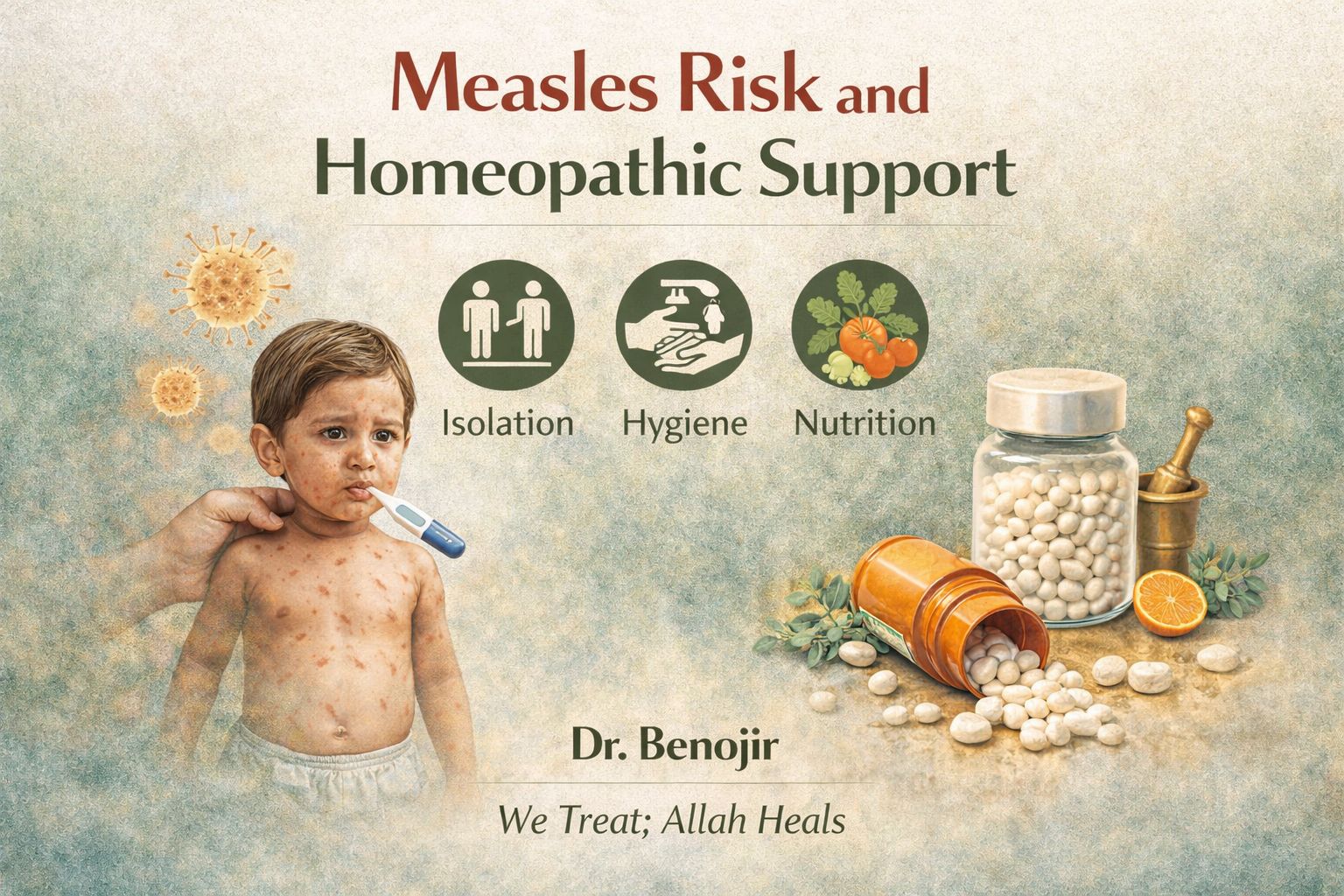
A Complete Guide to Measles Symptoms, Prevention, Home Care, and How Classical Homeopathy Supports Your Child’s Recovery
By Dr. Benojir | Classical Homeopath & Islamic Life Coach | drbenojir.com
When a child develops a high fever and a red rash spreading across their body, a parent’s first instinct is fear. In many cases, what they are witnessing is measles — one of the most contagious viral illnesses known to medicine, yet one that remains widely misunderstood. Too often, it is dismissed as “just a fever with spots.” Too rarely is it recognized for what it can become: a condition that, in the absence of proper care, can lead to serious and even life-threatening complications.
According to the World Health Organization, measles caused over 136,000 deaths globally in 2022 — the vast majority among unvaccinated children under the age of five (WHO, 2023). In South Asia, including Bangladesh, gaps in vaccination coverage and delayed recognition of the illness continue to put children at preventable risk. The encouraging truth is that measles is largely preventable, and when it does occur, it is highly manageable with timely awareness, proper care, and appropriate medical guidance.
This article is for every parent, caregiver, and family member who wants to understand measles: what it is, how to recognize it, how to protect against it, and how a holistic approach — including Classical Homeopathy and evidence-based lifestyle care — may support a child’s recovery.
What Is Measles?
Measles is a highly contagious acute viral infection caused by the Measles morbillivirus, belonging to the Paramyxoviridae family. It primarily affects children but can infect individuals of any age. Once a person is exposed to the virus, it typically takes 10 to 14 days before symptoms appear — the incubation period during which the child feels well but is already carrying the infection.
Measles is not a trivial illness. The virus attacks the respiratory tract, immune system, and in severe cases, the brain. The CDC and WHO both emphasize that measles-related immune suppression can leave a child vulnerable to other infections for months after recovery — phenomenon researchers have described as “immune amnesia” (Mina et al., Science, 2019).
Understanding measles means recognizing not just its rash, but the full pattern of illness it creates — and knowing when home care is sufficient and when professional help is urgently needed.
How Measles Spreads
Measles is one of the most contagious infections ever studied. A single infected person can transmit the virus to 12 to 18 susceptible individuals — a basic reproduction number (R0) that far exceeds that of influenza, COVID-19, and most other common viral diseases (CDC, 2024).
The virus spreads through respiratory droplets and airborne particles released when an infected person coughs, sneezes, or even breathes. The measles virus can remain suspended in the air and on surfaces for up to two hours after an infected person has left a room. A child entering that space can inhale the virus without ever having direct contact with the infected individual.
A child with measles is contagious from four days before the rash appears until four days after it emerges. This means they can unknowingly spread the infection during the period when they themselves — and their parents — may not yet realize they are ill. This characteristic makes early recognition and isolation particularly important.
Stages and Symptoms: Recognizing Measles in Your Child
Measles progresses through three distinct stages, each with recognizable features. Understanding these stages helps parents respond at the right time with the right care.
Stage 1: The Prodromal Stage (Days 1–4)
The illness begins with what appears to be a severe cold. The child develops a high fever — often 38.5°C to 40.5°C or higher — accompanied by a persistent dry cough, runny nose, and red, watery, and light-sensitive eyes (conjunctivitis). During this stage, a trained observer may notice Koplik’s spots — tiny white or bluish-white dots on a red background, appearing on the inner lining of the cheeks. These spots are virtually pathognomonic of measles, meaning they are a highly specific early diagnostic marker.
This stage is also the period of peak contagiousness. Many parents, understandably, treat these symptoms as a common cold and send their child to school, inadvertently facilitating spread.
Stage 2: The Rash Stage (Days 3–5)
After three to five days of prodromal symptoms, the characteristic measles rash appears. It begins as flat red or brownish-red spots on the face and behind the ears, then spreads downward over the next two to three days — to the neck, trunk, arms, legs, and feet. As the rash spreads downward, the fever typically reaches its peak. The rash spots may merge into larger blotches on the face and upper body.
By the time the rash reaches the feet, the child has usually been unwell for five to six days. The combination of high fever, rash, cough, red eyes, and runny nose is the classic presentation of measles.
Stage 3: The Recovery Stage (Days 6 onwards)
Gradually, the rash begins to fade — often in the same order it appeared, starting at the face. The fever subsides, the cough softens, and appetite slowly returns. However, the child may remain weak and fatigued for one to two weeks beyond the acute phase. This recovery period requires continued care, rest, and nutritional support.
Risk Factors and Vulnerable Groups
While any unvaccinated individual can contract measles, certain groups face significantly higher risk of severe illness and complications:
• Children under five years of age, particularly infants under 12 months who are too young for the vaccine
• Unvaccinated or incompletely vaccinated children
• Children with malnutrition — particularly those deficient in vitamin A, which plays a critical role in immune defense and mucosal integrity
• Children with weakened immune systems, including those with HIV, leukemia, or on immunosuppressive therapy
• Pregnant women, for whom measles poses serious risks including preterm birth and miscarriage
• Adults who were never vaccinated or have waning immunity
In Bangladesh and comparable settings, overcrowded living conditions, limited vaccination access in rural areas, and nutritional deficiencies all amplify risk. Awareness is the first line of protection.
Possible Complications: Why Measles Must Be Taken Seriously
Measles is not simply a childhood rash that passes. Complications are more common than many parents realize, and they can be severe. According to the CDC, approximately one in five unvaccinated people in the United States who contract measles requires hospitalization.
The most significant complications include:
• Pneumonia — the most common cause of measles-related death in young children, occurring in approximately one in 20 cases
• Ear infections (otitis media) — occurring in approximately one in ten cases, which can lead to permanent hearing loss
• Diarrhea and severe dehydration — particularly dangerous in young children
• Encephalitis (brain inflammation) — occurring in approximately one in 1,000 cases, sometimes causing permanent neurological damage or death
• Subacute sclerosing panencephalitis (SSPE) — a rare but uniformly fatal progressive neurological condition that can develop seven to ten years after measles infection, particularly when measles occurs before age two
• Corneal scarring and blindness — particularly in vitamin A-deficient children
These complications are not theoretical. They are the reason measles vaccines were developed, and why the WHO recommends universal vaccination as a public health priority.
Prevention: The Role of Vaccination and Vitamin A
Vaccination
The measles-mumps-rubella (MMR) vaccine is the most effective prevention available, with a two-dose schedule conferring approximately 97 per cent protection. In Bangladesh, the measles-rubella (MR) vaccine is provided free of charge through the Expanded Program on Immunization (EPI), with doses typically given at nine months and fifteen months of age. Ensuring your child receives both doses on schedule is the single most important step you can take to protect them.
Herd immunity against measles requires that at least 95 per cent of a community be vaccinated. When coverage falls below this threshold, outbreaks occur. Every unvaccinated child represents both an individual risk and a community risk.
Vitamin A Supplementation
The WHO recommends vitamin A supplementation for all children diagnosed with measles in areas where vitamin A deficiency is prevalent. Evidence consistently shows that vitamin A reduces measles-related mortality and the severity of complications, including the risk of blindness and pneumonia (WHO, 2023). In Bangladesh, vitamin A supplementation is part of national measles management guidelines.
Supportive Care at Home: What Parents Can Do
For uncomplicated measles in otherwise healthy, vaccinated, or mildly affected children, supportive care at home plays a central role in recovery. The goal is to keep the child comfortable, well-hydrated, and protected from secondary complications.
• Rest — the child’s immune system is working intensely; adequate rest is essential and non-negotiable
• Hydration — offer water, diluted fruit juice, oral rehydration solution, or warm soup regularly to prevent dehydration, especially during fever
• Light-sensitive eyes — dim the room lights and avoid screens to reduce discomfort from photophobia
• Eye hygiene — gently clean eye discharge with a clean, damp cloth to prevent secondary infection
• Fever management — use age-appropriate fever-reducing medication as advised by your doctor; do not use aspirin in children
• Nutritious food — offer soft, easily digestible, nourishing foods; continue breastfeeding infants
• Isolation — keep the child away from school, siblings, and unvaccinated contacts for at least four days after the rash appears
• Ventilation — ensure fresh air circulation in the room while keeping the child warm and comfortable
Monitor your child closely. Seek immediate medical attention if they develop difficulty breathing, severe ear pain, inability to eat or drink, extreme weakness, seizures, or any change in consciousness.
Classical Homeopathy and Measles: An Individualized Approach
Classical Homeopathy does not prescribe a fixed remedy for measles as a diagnosis. It evaluates the individual child — their unique symptom picture, their emotional state, their sensitivity, their response to temperature and environment, and the specific pattern of how their illness is expressing itself. Two children with measles may receive entirely different remedies based on how their bodies are responding.
The homeopathic approach in measles aims to support the body’s natural immune response, ease discomfort, and assist the healing process without suppressing symptoms that are part of the body’s own recovery mechanism. It is used alongside appropriate medical care, not as a replacement for it.
The following remedies are among those most frequently discussed in classical homeopathic literature for measles-like presentations. All remedy selection must be made by a qualified practitioner following individual consultation.
1. Aconitum Napellus
Indicated in the earliest hours of illness when symptoms arrive suddenly and intensely — high fever, great restlessness and anxiety, dry burning heat, and a frightened or agitated disposition. Often considered when illness appears to follow exposure to cold, wind, or a frightening experience.
2. Belladonna
Classic remedy for the peak-fever phase: bright red face, hot dry skin, throbbing head, dilated pupils, and intense sensitivity to light and noise. The child may be semi-delirious with the fever and wants to be left alone. Symptoms come on rapidly and intensely.
3. Pulsatilla
Often indicated for the gentle, affectionate, clingy child who wants constant comfort and reassurance. Symptoms are changeable; there is little or no thirst despite the fever; the child feels worse in a warm, stuffy room and better in fresh air and open windows. Weepiness and emotional sensitivity are prominent.
4. Bryonia Alba
For the child who wants complete stillness — any movement worsens their headache, cough, or body ache. They are irritable when disturbed, want to be at home, drink large amounts of water infrequently, and have a hard, dry cough that is painful to produce. Lips and mouth are dry.
5. Gelsemium
Suits the picture of profound weakness and heaviness — drooping eyelids, aching muscles, trembling, and a desire to be still and undisturbed. The child appears drowsy and dull, with little thirst and a slow, gradual onset of symptoms. Anticipatory anxiety before the illness may have been present.
6. Euphrasia
Specifically indicated when eye symptoms are pronounced and distressing — profuse burning, acrid discharge from the eyes, marked photophobia, and persistent watering. The nasal discharge, by contrast, is bland and non-irritating. This opposite pattern (acrid eyes, bland nose) helps distinguish Euphrasia from similar remedies.
7. Morbillinum (Measles Nosode)
A homeopathic preparation traditionally derived from the measles disease product. Used in classical practice for prolonged or complicated cases where the typical illness pattern persists beyond the expected duration, or where symptoms linger after the acute phase has resolved.
8. Rhus Toxicodendron
Indicated when the child is intensely restless — unable to remain in one position for more than a few minutes, constantly turning and moving. The rash may be intensely itchy. Symptoms improve with warmth and gentle movement and worsen with rest and cold, damp conditions.
9. Antimonium Tartaricum
Considered when respiratory involvement is prominent — chest congestion with a wet, rattling cough that the child cannot bring up effectively, pallor, and prostration. There may be a coated tongue and significant weakness. Often considered in young children or infants where bronchopneumonia threatens.
10. Sulphur
Often indicated when the rash is slow to develop or slow to resolve, when there is heat and burning of the skin, or when recovery is prolonged. The child may be warm-blooded, untidy, and prone to skin conditions. Symptoms tend to worsen with heat and bathing.
A note of emphasis: in any child with measles presenting with breathing difficulty, severe dehydration, persistent high fever beyond five days, or neurological symptoms, conventional medical evaluation and treatment must take precedence. Homeopathy is best used as a complementary support within an integrated care framework, under the guidance of a qualified practitioner.
Lifestyle and Supportive Measures During Recovery
The recovery phase of measles is as important as the acute phase, and the choices made during this period significantly influence how quickly and completely a child regains their strength and immunity.
Nutrition: Rebuilding from the Inside
Measles places enormous demands on the body’s nutritional reserves, particularly vitamin A, zinc, and protein. Prioritize nourishing, easily digestible foods: dal, khichuri, soft cooked vegetables, eggs, chicken soup, and fresh fruit. Vitamin A-rich foods such as papaya, sweet potato, carrot, and dark leafy greens support mucosal healing and immune recovery. Continue breastfeeding exclusively for infants — breast milk provides immune factors and hydration simultaneously.
Sleep and Rest
The immune system performs its most intensive repair work during sleep. During measles recovery, children require more sleep than usual. Create a calm, dimly lit, well-ventilated room and allow the child to rest as much as they need. Avoid screens, stimulating activities, and premature return to school.
Hydration
Fever and increased respiratory rate cause significant fluid loss. Ensure consistent hydration with water, coconut water, diluted fruit juice, warm soups, and oral rehydration solution when needed. Watch for signs of dehydration: dry mouth, reduced urination, sunken eyes, and unusual drowsiness.
Eye Care
Measles frequently affects the eyes. Keep the eyes clean, reduce light exposure, and if there is significant discharge or worsening redness, consult a healthcare provider promptly. In vitamin A-deficient children, measles can rapidly progress to corneal ulceration and permanent vision loss.
Emotional Support
A sick child is not only physically unwell — they are frightened, uncomfortable, and dependent on their caregivers. Your calm, consistent, reassuring presence is itself therapeutic. Hold the child, speak softly, and maintain familiar routines as much as possible. Parental anxiety is transmitted to children; your steadiness supports their healing.
Mind | Body | Deen: Caring for the Whole Child
When a child is ill, the instinct of every parent is to act — to find a cure, administer a remedy, eliminate the problem. Islam gently invites us into a deeper understanding: that illness itself can be a mercy, a purification, and an opportunity to draw nearer to Allah.
Mind
Anxiety is natural when a child is unwell. But chronic parental anxiety can impair decision-making, magnify the child’s distress, and disrupt the calm environment that promotes healing. Knowledge is the antidote to fear: understanding what measles is, what to expect, and when to seek help transforms a frightened parent into an empowered one.
Body
The body’s immune response to measles is extraordinary — a fever, a rash, inflammation are not failures of the body but signs of its vigorous self-defense. Supporting the body means supporting that process: rest, nourishment, hydration, cleanliness, and professional guidance when needed. Suppressing symptoms reflexively, without understanding their role, is rarely the wisest response.
Deen
The Prophet Muhammad ⅟ said:
“There is no disease that Allah has created, except that He also has created its treatment.” (Bukhari, 5678)
This hadith is a call to seek healing with confidence — knowing that every illness has a remedy and that the search for that remedy is itself an act of trust in Allah’s wisdom. The Prophet ⅟ also said:
“Make use of medical treatment, for Allah has not made a disease without appointing a remedy for it.” (Abu Dawud, 3855)
Caring for a sick child with knowledge, gentleness, consistency, and duʻa is a profound act of ʻibaadah. The Quran reminds us:
“And when I am ill, it is He who cures me.” (Surah Ash-Shuʻara, 26:80)
These words, spoken by Prophet Ibrahim (AS), are an acknowledgement that all cures ultimately come from Allah. Our role — as parents, practitioners, and caregivers — is to act with knowledge, care, and sincerity, and then to place our trust entirely in Him.
Common Questions from Parents
My child has been vaccinated. Can they still get measles?
Yes, but rarely. The two-dose MMR vaccine is approximately 97 per cent effective. A small number of vaccinated individuals can still contract measles, but the illness is almost always significantly milder, shorter, and less likely to lead to complications. Vaccination remains the most important protection available.
How long should I keep my child at home?
A child with measles should be kept away from school, playgroups, and public spaces from the onset of symptoms until at least four days after the rash first appeared. If the child is immunocompromised, the isolation period may need to be extended — discuss with your healthcare provider.
When should I go to the hospital?
Seek immediate medical attention if your child develops difficulty breathing or rapid breathing, persistent high fever beyond five days, inability to eat or drink, severe ear pain, fits or convulsions, unusual drowsiness or unresponsiveness, or any sudden change in behaviour or consciousness. These are warning signs of complications that require urgent professional care.
Is it safe to use Homeopathy alongside conventional treatment?
Classical Homeopathic remedies are generally considered safe alongside conventional medications and do not typically interact pharmacologically. They are best used as a complementary support within an integrated care framework. Any treatment decisions — conventional or complementary — should be discussed with qualified professionals. Never delay seeking conventional medical care in favor of any alternative approach when a child’s safety is at risk.
Final Thoughts
Measles is a serious illness — but it is also one of the most preventable. With timely vaccination, nutritional support, informed home care, and access to appropriate medical guidance, the vast majority of children recover fully and go on to develop lifelong immunity to the disease.
As a parent, your most powerful tools are knowledge, observation, and presence. Know the stages of measles. Know the warning signs that require immediate medical attention. Know that your calm, consistent, loving care is itself medicine. And know that every effort you make — every remedy, every warm bowl of soup, every gentle word in the night — is part of a covenant of care between you, your child, and your Creator.
References
World Health Organization (2023). Measles. Geneva: WHO. Retrieved from who.int/news-room/fact-sheets/detail/measles
Centers for Disease Control and Prevention (2024). Measles (Rubeola). Atlanta: CDC. Retrieved from cdc.gov/measles
Mina MJ, et al. (2019). Measles virus infection diminishes preexisting antibodies that offer protection from other pathogens. Science, 366(6465), 599–606.
World Health Organization (2023). Vitamin A Supplementation in Infants and Children 6–59 Months of Age. Geneva: WHO.
Expanded Program on Immunization, Bangladesh (2023). National EPI Schedule. Dhaka: Ministry of Health and Family Welfare.
Sahih al-Bukhari, Hadith 5678. Translation referenced from USC-MSA Compendium of Muslim Texts.
Sunan Abu Dawud, Hadith 3855. Referenced from Dar-us-Salam Publications.
Quran, Surah Ash-Shuʻara (26:80). Translation referenced from Saheeh International.
Dr. Benojir
Classical Homeopath & Islamic Life Coach
Mind | Body | Deen
“We Treat; Allah Heals”