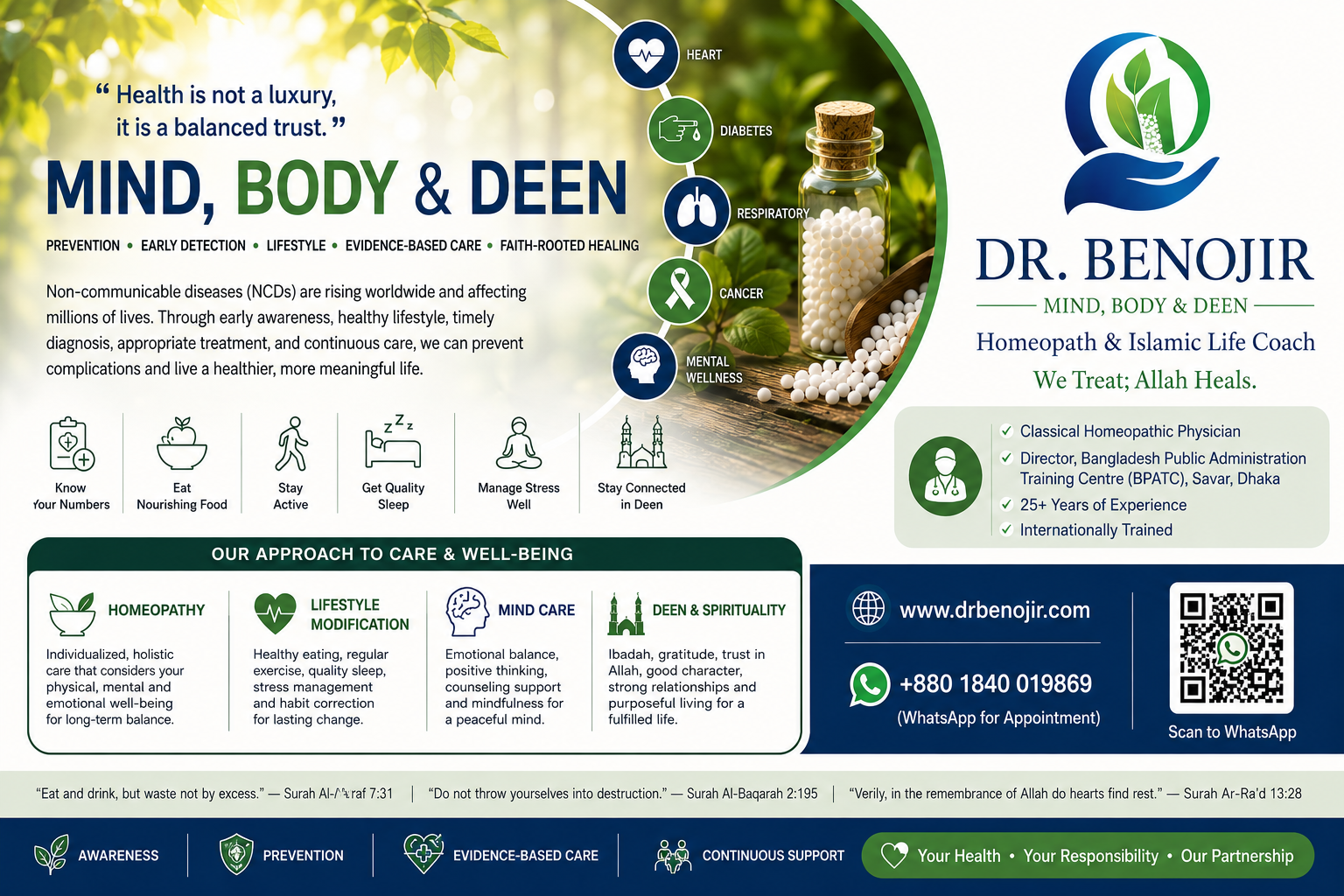
Non-Communicable Diseases and Their Management
Non-Communicable Diseases and Their Management
A Whole-Person Approach Through Prevention, Evidence-Based Care, Lifestyle and Mind–Body–Deen
Non-communicable diseases (NCDs) are the defining health challenge of the twenty-first century. Unlike infections, NCDs cannot be caught from another person. They develop slowly, over years or decades, through an interaction of genes, environment, and everyday behaviour — and by the time symptoms appear, the underlying disease process may already be well advanced. The practical message from modern NCD medicine is simple to state and harder to practise: recognize the risk early, act before damage accumulates, and manage the disease for life rather than treating it as a single episode. Prevention does not stop at diagnosis; once an NCD is present, the task shifts to diagnosis, treatment, monitoring, adherence, review and adjustment, repeated in a continuous cycle for as long as the person lives.
This article updates and expands an earlier presentation on NCDs with current global data, the latest clinical guidelines, and a look at where NCD care is heading — while keeping the original document's whole-person framing, including its Mind–Body–Deen model of care.
The Scale of the Problem
According to the World Health Organization (WHO), NCDs killed at least 43 million people in 2021 — about 75% of all deaths not related to a pandemic event. Roughly 18 million of these deaths occurred before age 70, and 82% of these premature deaths occurred in low- and middle-income countries [1]. Cardiovascular disease is the largest single contributor, causing more than 19 million deaths a year, followed by cancer (10 million), chronic respiratory disease (about 4 million) and diabetes (over 1.6 million, including diabetes-related kidney failure) [2].
Hypertension alone affects an estimated 1.28 billion adults worldwide, yet nearly half do not know they have it, and only about one in five have their blood pressure adequately controlled [2]. Almost every step in that chain — undiagnosed, untreated, poorly controlled — represents a preventable stroke, heart attack or case of kidney failure. WHO's global NCD investment case argues that comparatively low-cost measures — tobacco and alcohol taxation, hypertension management programmes, and cervical cancer screening — could avert millions of these deaths while saving health systems money [3].
The pattern holds across Bangladesh and South Asia, where NCDs already account for the majority of deaths and are rising as populations age and urbanize. The exact national percentage depends on the survey year and methodology used, but the direction of travel is unambiguous: NCD prevention and early management are now core public-health priorities, not niche concerns.
What Counts as an NCD?
WHO defines four major disease groups that together cause roughly 80% of all premature NCD deaths [1]:
1. Cardiovascular diseases (CVD) — hypertension, coronary artery disease, heart attack, heart failure and stroke.
2. Cancers — including lung, breast, cervical, colorectal and many others.
3. Chronic respiratory diseases — chiefly chronic obstructive pulmonary disease (COPD) and asthma.
4. Diabetes — mainly type 2 diabetes, along with its vascular, eye, nerve and kidney complications.
Mental-health conditions such as depression, anxiety and dementia are increasingly discussed alongside these four groups, since they share risk factors and often coexist with them, though WHO's core NCD statistics are built around the four groups above [1,4].
Four behaviours drive most of the global NCD burden: tobacco use, unhealthy diet, physical inactivity, and harmful alcohol use. Air pollution is a major environmental risk factor operating largely outside individual control. These behaviours in turn produce a shared set of metabolic risks — raised blood pressure, excess body weight, high blood glucose, and abnormal blood lipids — now understood as an interconnected "cardiometabolic" risk continuum rather than separate problems [1,4].
From Risk to Disease: Why Symptoms Come Late
Long before a person feels unwell, measurable changes are already occurring: low-grade chronic inflammation, stiffening of blood vessels, expanding fat stores (especially visceral fat around the abdominal organs), and insulin resistance. Everyday habits — poor food choices, prolonged sitting, heavy screen use, irregular sleep and chronic stress — reinforce one another and accelerate this hidden progression.
Because of this silent phase, prevention cannot wait for symptoms. The single most useful habit is to "know your numbers": blood pressure, blood glucose, blood lipids (cholesterol), body weight, and waist circumference. These five simple measurements, repeated periodically, can reveal risks that would otherwise stay invisible for years.
How Are the Major NCDs Diagnosed?
Diagnosis should always rest on validated clinical criteria and investigations, not on symptoms alone.
Hypertension
Hypertension is called a "silent" condition because most people with it feel nothing. WHO's operational definition remains a systolic blood pressure of 140 mmHg or higher and/or a diastolic pressure of 90 mmHg or higher, confirmed on two separate days [5].
Clinical guidance has moved further in recent years. The 2024 European Society of Cardiology (ESC) guideline introduced a new "elevated blood pressure" category (120–139/70–89 mmHg) that triggers lifestyle treatment and, in higher-risk people, medication — even before the traditional 140/90 mmHg threshold is reached, because cardiovascular risk rises continuously with blood pressure rather than jumping at a fixed cut-off [6]. The 2025 American College of Cardiology/American Heart Association (ACC/AHA) guideline kept the 130/80 mmHg diagnostic threshold introduced in 2017, and now uses a dedicated risk calculator (PREVENT) to decide who with mildly elevated pressure needs medication rather than lifestyle measures alone [7,8]. In practice, both guidelines agree on the essentials: confirm the diagnosis properly, assess overall cardiovascular risk rather than blood pressure in isolation, treat confirmed hypertension (≥140/90 mmHg) in almost everyone, and individualize decisions for borderline readings based on a person's broader risk profile.
Diabetes
Diabetes is diagnosed through blood glucose testing. WHO's diagnostic thresholds are a fasting plasma glucose of 7.0 mmol/L (126 mg/dL) or higher, a 2-hour plasma glucose of 11.1 mmol/L (200 mg/dL) or higher during an oral glucose tolerance test, or an HbA1c of 6.5% or higher on validated laboratory testing. A random plasma glucose of 11.1 mmol/L or higher in someone with classic symptoms (excess thirst, frequent urination, unexplained weight loss) is also diagnostic [9]. HbA1c is especially useful because it reflects average blood glucose over roughly the preceding two to three months, smoothing out day-to-day fluctuations.
An emerging tool worth knowing about is continuous glucose monitoring (CGM) — a small skin sensor that tracks glucose trends throughout the day. CGM is well established for people already living with diabetes, and is now being studied in people without diabetes as a way to visualize how specific meals, activity and sleep patterns affect glucose trends, potentially guiding earlier lifestyle correction — though this remains an evolving area of evidence rather than a routine screening tool for the general population [10].
Cardiovascular Disease
Assessment can include a detailed history, blood pressure measurement, physical examination, blood glucose and lipid testing, and an electrocardiogram (ECG), with echocardiography, exercise stress testing or coronary imaging added when indicated. Chest pain, sudden breathlessness, fainting, new weakness on one side of the body, or sudden difficulty speaking are medical emergencies that need immediate evaluation, not self-treatment or a "wait and see" approach.
Cancer
Cancer is not a single disease and has no single diagnostic test. Depending on the type, evaluation may involve age- and risk-appropriate screening, physical examination, imaging, laboratory tests and tissue biopsy. An abnormal screening result is a prompt for further diagnostic work-up — it is not, by itself, a diagnosis.
Chronic Respiratory Disease
Asthma and COPD both require clinical assessment, but lung-function testing (spirometry) is central to confirming and classifying disease severity in most cases. Tobacco use — including secondhand smoke — occupational exposures, air pollution, and a pattern of recurring symptoms are all important parts of the history.
Treatment: Usually Multidimensional, Rarely "One Thing"
Modern NCD management typically combines several elements depending on the disease and its severity:
• Lifestyle intervention — nutrition, physical activity, healthy weight, sleep, stress management, and avoiding tobacco.
• Medicines — for example, antihypertensive drugs, glucose-lowering medicines and lipid-lowering therapy (such as statins) when clinically indicated.
• Procedures or surgery — for selected cardiovascular conditions and cancers.
• Rehabilitation — cardiac, pulmonary, neurological or other rehabilitation programmes.
• Psychological and social support.
• Screening and management of complications.
• Palliative care — when disease is advanced and comfort becomes the priority.
WHO frames detection, screening, treatment and palliative care as equally essential components of the NCD response, not as a strict sequence [1]. A useful mental model for ongoing care is the cycle: diagnose, treat, monitor, adhere, review, adjust — repeated indefinitely as the disease and the person's circumstances change.
A Rapidly Evolving Area: Metabolic and Cardioprotective Medicines
Diabetes and obesity treatment has changed substantially in the past few years with the rise of GLP-1 receptor agonists (such as semaglutide) and newer dual GLP-1/GIP agonists (such as tirzepatide). Originally developed to lower blood glucose, these medicines also produce clinically significant weight loss and have been shown in large cardiovascular outcome trials to reduce heart attacks, stroke and cardiovascular death in people with type 2 diabetes or obesity and existing cardiovascular disease [11,12]. They are prescription medicines with real costs, supply constraints and side effects, and are not a substitute for lifestyle change — but they illustrate how far pharmacological options for cardiometabolic disease have advanced beyond blood-pressure pills and insulin alone.
Lifestyle Modification: The Foundation, Not an Add-On
For most NCDs, lifestyle change is not a soft complement to "real" treatment — it is core therapy in its own right.
Nutrition
A healthy dietary pattern emphasizes vegetables, fruit, whole grains, pulses, nuts and other minimally processed foods, while limiting excess salt, added sugar, unhealthy fats and ultra-processed foods. Meal timing may matter too: eating on a fairly regular schedule, avoiding very late meals, and keeping a consistent daily eating window (commonly discussed as roughly 10–12 hours) are reasonable, low-risk habits — though they should be individualized, particularly for people on glucose-lowering medicines, pregnant women, older adults, or anyone with a condition that requires specific nutritional management.
Physical Activity
Regular movement improves cardiovascular fitness, helps muscles use glucose more efficiently, and supports a healthy body weight. WHO recommends that adults aim for at least 150–300 minutes of moderate-intensity aerobic activity per week (or an equivalent mix with vigorous activity), plus muscle-strengthening activity on two or more days a week [5]. Breaking up long periods of sitting — standing, stretching or walking briefly every 30–60 minutes — appears to provide metabolic benefits independent of total exercise time.
Sleep and Digital Boundaries
Sleep is part of health management, not "lost" time. Adults generally need 7–9 hours of reasonably consistent sleep. A wind-down period free of bright screens before bed can help, since evening light exposure can delay the body's natural sleep signal. Individual needs vary, but persistent insomnia, loud snoring, witnessed pauses in breathing, or excessive daytime sleepiness deserve medical assessment rather than being dismissed as ordinary tiredness.
Stress and Emotional Health
Chronic stress makes healthy behaviour harder to sustain and often travels together with poor sleep, inactivity and emotional eating. Structured relaxation, breathing exercises, social connection, meaningful activity, counselling when needed, and predictable daily routines are practical, evidence-supported ways to build resilience.
How Far Can Homeopathy Help?
This deserves an honest answer, especially for people with chronic disease who are exploring complementary options.
Homeopathy is a traditional system of complementary medicine based on principles such as "like cures like" and the use of highly diluted preparations. Some people are drawn to it for the individualized consultation and whole-person conversation it offers about symptoms, emotions and lifestyle.
Homeopathy should therefore never replace evidence-based care: insulin in type 1 diabetes, antihypertensive therapy when indicated, cancer treatment, inhaled therapy for asthma or COPD, or emergency care. For someone who chooses to use homeopathy anyway, the safest approach is to treat it strictly as complementary — alongside, never instead of, prescribed treatment — with open communication with the treating clinician. Prescribed medicines should never be reduced or stopped simply because symptoms feel better after starting a complementary therapy; objective markers such as blood pressure, glucose, lipids, weight and lung function should guide any treatment decision, not subjective impressions alone. By comparison, the evidence supporting structured lifestyle modification is far stronger than the evidence for homeopathy.
What Can a Mind–Body–Deen Approach Add?
A Mind–Body–Deen approach is best understood as a whole-person framework that sits alongside medical care, not a replacement for it. "Mind" covers emotional wellbeing, habits, stress and meaning. "Body" covers nutrition, movement, sleep, screening and physical health. "Deen" (faith) adds worship, moral responsibility, gratitude, moderation, community and trust in Allah.
Islamic teaching offers a strong frame for health-promoting behaviour. The Qur'an instructs moderation directly:
"Eat and drink, but do not be excessive." — Qur'an 7:31
a principle with obvious relevance in an age of overeating, ultra-processed food and sedentary living. Elsewhere the Qur'an warns:
"Do not throw yourselves into destruction." — Qur'an 2:195
Not a clinical guideline, but an ethical principle that can encourage avoiding knowingly harmful behaviour and taking reasonable care of one's body.
The Qur'an also speaks to emotional wellbeing:
"Surely in the remembrance of Allah do hearts find comfort." — Qur'an 13:28
Practices such as salah, dhikr, dua, reflection and gratitude may support emotional resilience and a sense of meaning — though they should never be marketed as cures for hypertension, diabetes, cancer or any other NCD.
The Prophetic tradition reinforces balance. In one hadith (Sahih al-Bukhari 5199), the Prophet Muhammad ﷺ reminded a companion that his own body has a right over him, alongside his other obligations [15] — a strikingly modern message that worship and work should not become excuses to neglect sleep, nutrition, recovery and physical health. Another well-known teaching supports an attitude of responsible action rather than passive resignation in the face of illness:
"Seek treatment, O servants of Allah." — Sunan Abi Dawud 3855; Jami' al-Tirmidhi 2038 [16]
A Practical Mind–Body–Deen Model
A person living with, or at risk of, an NCD can translate this philosophy into five daily commitments:
1. Know — track blood pressure, glucose, lipids, weight and other relevant indicators.
2. Nourish — eat mindfully, moderately, and predominantly from wholesome foods.
3. Move — reduce sitting and build regular activity into the day.
4. Restore — protect sleep, recovery and emotional balance.
5. Connect — maintain salah, dhikr, dua, gratitude, family ties and supportive community, alongside continued medical care.
Conclusion
NCDs are not simply diseases to be treated once symptoms appear — they are long-term conditions that emerge gradually from the interaction of biology, environment and daily behaviour. The most effective response is neither "medicine alone" nor "lifestyle alone," but appropriate diagnosis, evidence-based treatment, continuous monitoring, and sustainable lifestyle change, updated as guidelines and medicines evolve.
For people already living with an NCD, the goal is to manage the disease well, reduce complications, and preserve quality of life. For people at risk, the goal is to identify that risk early and change course before disease becomes established. A Mind–Body–Deen approach adds a human and spiritual dimension to this process — encouraging self-awareness, moderation, discipline, gratitude and responsibility toward the body — while respecting the boundaries of medical evidence.
The central message remains simple: recognize the risks, screen early, treat appropriately, move more, eat wisely, sleep well, protect your mind, nurture your faith, monitor your numbers, and review your progress regularly. Allah is the ultimate Healer, but responsible care includes taking the means available to us.
Important medical note: This article is educational and does not diagnose or treat any individual. Anyone with a suspected or established NCD should be assessed by a qualified healthcare professional. Complementary approaches should never delay emergency care or replace evidence-based treatment.
References
1. World Health Organization (WHO). Noncommunicable diseases. Fact sheet, 25 September 2025. who.int/news-room/fact-sheets/detail/noncommunicable-diseases
2. World Health Organization. Universal Health Coverage and Noncommunicable Diseases Data Portal / Global Health Observatory: NCD mortality and hypertension estimates, 2025.
3. World Health Organization. Saving lives, spending less: the global investment case for noncommunicable diseases, 2025.
4. World Health Organization. Noncommunicable diseases: risk factors and major disease groups.
5. World Health Organization. Hypertension. Fact sheet, 25 September 2025. who.int/news-room/fact-sheets/detail/hypertension
6. European Society of Cardiology. 2024 ESC Guidelines for the management of elevated blood pressure and hypertension. European Heart Journal, 2024.
7. American College of Cardiology/American Heart Association. 2025 Guideline for the Prevention, Detection, Evaluation, and Management of High Blood Pressure in Adults. Hypertension/Circulation, 2025.
8. Reflections on the 2025 AHA/ACC statement on risk-based blood pressure management. Hypertension, 2025.
9. World Health Organization. Diabetes: diagnostic criteria and management guidance. who.int/news-room/fact-sheets/detail/diabetes
10. Systematic review: Use of continuous glucose monitoring in non-diabetic individuals for cardiovascular prevention, 2025 (PMC12612783).
11. Westermeier F, Fisman EZ. GLP-1 receptor agonists and cardiometabolic protection: historical development and future challenges. Cardiovascular Diabetology, 2025.
12. Frontiers in Cardiovascular Medicine. GLP-1 receptor agonists: a review from a cardiovascular perspective, 2025.
13. U.S. National Center for Complementary and Integrative Health (NCCIH). Homeopathy: What You Need to Know. nccih.nih.gov/health/homeopathy
14. NHS. Homeopathy — evidence and treatment information.
15. Sahih al-Bukhari 5199, narrated by Abdullah ibn Amr ibn al-As. sunnah.com/bukhari:5199
16. Sunan Abi Dawud 3855; Jami' al-Tirmidhi 2038 — Prophetic tradition on seeking treatment.
17. Original source presentation: Hossain, Anupam. NCDs: Early Detection, Prevention, and Management.