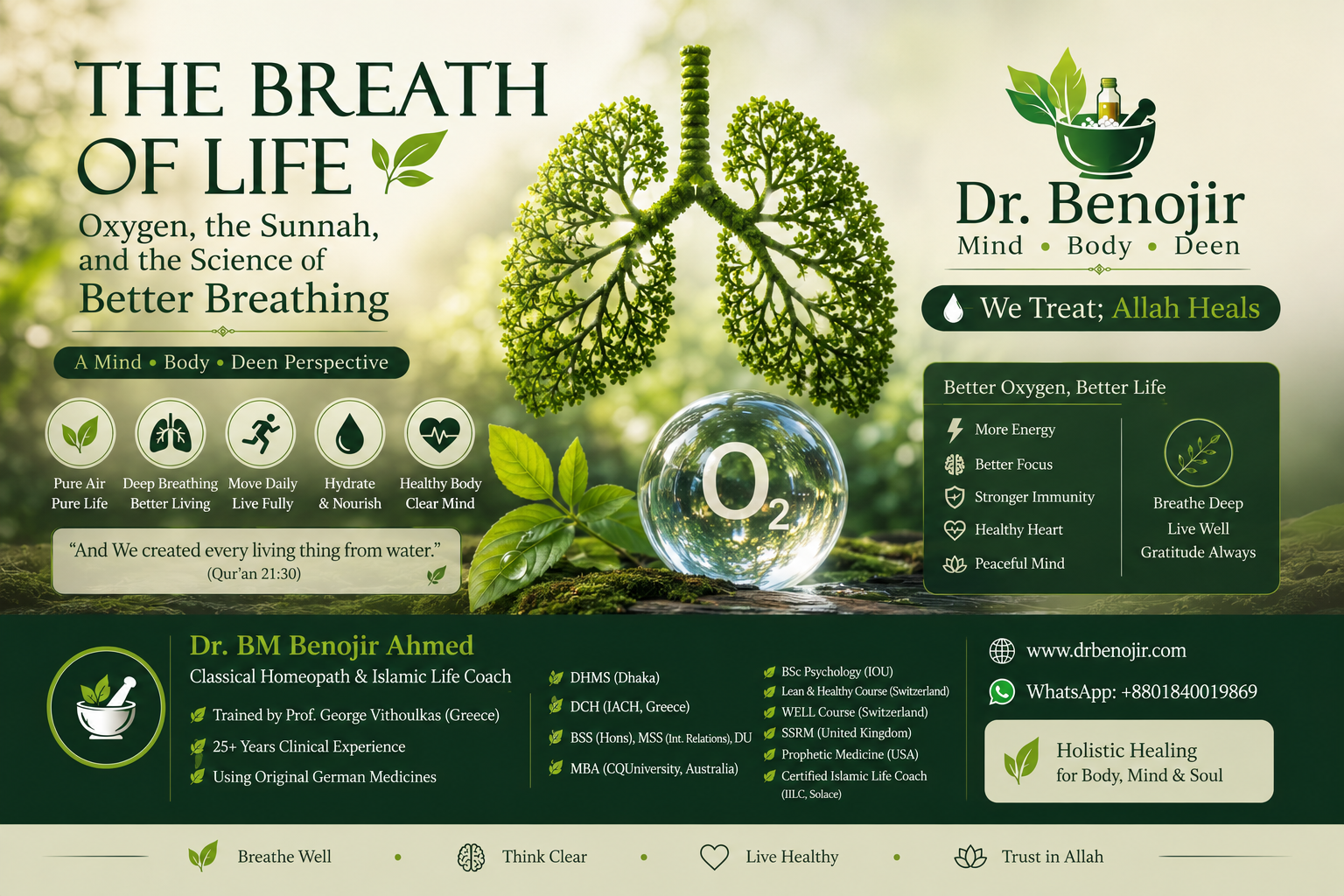
Oxygen, the Sunnah, and the Science of Better Breathing
A Mind • Body • Deen Perspective
Every breath a human being takes is, quite literally, a gift renewed sixteen to twenty times a minute. Oxygen fuels the mitochondria in every one of our cells, powers the beating of the heart, sharpens the mind, and keeps every organ alive. Yet most of us give this life-sustaining gas almost no conscious thought — until we are short of it. This article looks at oxygen from three angles at once: the biology of how much we need and where it truly comes from, the timeless wisdom of the Sunnah and Salah in optimising our breathing, and the gentle, individualised support that homeopathy offers when breathlessness or low-oxygen symptoms appear.
Why the Body Cannot Live Without Oxygen
Unlike food, which the body can store for weeks, or water, which can be rationed for days, oxygen cannot be stockpiled. Inside every cell, the mitochondria use oxygen to convert glucose into adenosine triphosphate (ATP), the energy currency that drives muscle contraction, nerve signalling, digestion, and cellular repair. The brain alone, though only about two percent of body weight, consumes a disproportionate share of the oxygen we breathe because neurons have almost no reserve capacity. This is why even a brief drop in oxygen supply causes light-headedness, poor concentration, or fainting, while a prolonged one can cause lasting cellular injury.
How Much Oxygen Do We Actually Need?
At rest, an average adult breathes in roughly 7–8 litres of air per minute — about 11,000 litres over a full day. Inhaled air is close to 21 percent oxygen, and exhaled air still carries around 15–16 percent, meaning the body typically extracts only about 5 percent of each breath. Worked out across a day, this comes to somewhere between 350 and 600 litres of pure oxygen actually consumed, depending on body size, age, and activity level — a figure that climbs sharply during exercise, fever, pregnancy, or illness.
A useful safety marker: workplace-safety bodies such as OSHA classify air with less than 19.5 percent oxygen as unsafe to breathe without protection, while normal blood-oxygen saturation in a healthy person sits between 95 and 100 percent. Even small, sustained dips below this range are a signal the body is under strain.
Where Does Our Oxygen Really Come From?
Most people picture rainforests when they think of the planet's oxygen supply, but the truth is more humbling: over half of the Earth's oxygen is produced by marine phytoplankton and algae in the oceans, with land plants and forests supplying the rest. A single mature tree may produce only enough oxygen to cover a small fraction of one person's daily requirement, which is why forests matter collectively, not individually. For the individual human being, however, the only source that matters minute to minute is the surrounding air — there is no dietary or liquid substitute for atmospheric oxygen, though good nutrition (particularly iron, which builds haemoglobin) determines how efficiently the oxygen we inhale is actually transported to our tissues.
Can We Meet 100% of Our Requirement? What Goes Wrong When We Don't
In theory, normal air at sea level supplies far more oxygen than the body needs. In practice, many people function on a chronic, partial oxygen deficit because of how and where they breathe rather than how much air is available. Common culprits include:
• Shallow chest breathing: most adults use only the top third of their lung capacity, engaging the diaphragm minimally and leaving the lower lung fields poorly ventilated.
• Polluted or stale indoor air: carbon dioxide build-up in closed rooms, dust, smoke, and poor ventilation all reduce the effective oxygen available with each breath.
• Sedentary living: reduced physical activity lowers lung capacity over time and slows circulation, so oxygen is delivered less efficiently even when it is inhaled.
• Poor posture: a slouched spine compresses the diaphragm and rib cage, mechanically limiting how much air the lungs can draw in.
• Mouth breathing and stress: rapid, shallow mouth breathing associated with anxiety triggers over-breathing, which paradoxically reduces the blood's ability to release oxygen to tissues.
When intake falls short over time, the body shows it: persistent fatigue, poor concentration, frequent headaches, disturbed sleep, low exercise tolerance, and in more marked cases, breathlessness (dyspnea) even at rest. These symptoms are the body's early-warning system, not something to dismiss.
Maximising Oxygen Intake Naturally
• Diaphragmatic (belly) breathing: consciously breathing from the abdomen rather than the chest can expand lung capacity considerably and is the single most effective free technique available.
• Regular movement and cardiovascular exercise: walking, swimming, and light aerobic activity increase both lung capacity and the efficiency of oxygen delivery to tissues.
• Good posture: sitting and standing upright keeps the diaphragm and rib cage free to expand fully.
• Fresh-air ventilation: regularly opening windows and spending time outdoors, especially around greenery, keeps ambient carbon dioxide low and oxygen levels higher.
• Hydration and iron-rich nutrition: adequate water keeps blood at the right viscosity for oxygen transport, while iron-rich foods support haemoglobin production.
• Avoiding smoke and pollutants: tobacco smoke and heavy air pollution both directly damage the lungs' capacity to absorb oxygen.
• Quality sleep: deep sleep restores normal breathing rhythm and allows the lungs and circulatory system to recover from the day's demands.
Why the Quality of Oxygen Matters as Much as the Quantity
Not all oxygen is equal in effect. Air in a forest, by the sea, or after rainfall tends to feel more refreshing than air in a congested city — and this is not merely psychological. Clean natural air carries fewer suspended particulates and pollutants that would otherwise compete for space in the airways and bloodstream, and it is often richer in negative ions, which some research links to improved mood and alertness. Polluted or recycled indoor air, by contrast, may still register a normal oxygen percentage on paper while carrying particulate matter, volatile compounds, and elevated carbon dioxide that blunt the practical benefit of every breath. This is precisely why the Sunnah's emphasis on fresh, open, well-ventilated environments has a physiological, and not only spiritual, benefit.
The Sunnah Lifestyle: A Blueprint for Better Breathing
Long before the mechanics of respiration were understood scientifically, the Sunnah of the Prophet Muhammad (peace be upon him) modelled a lifestyle that, examined today, supports optimal breathing and oxygenation in remarkably practical ways.
• Moderation in eating: the Prophet (peace be upon him) taught, “The son of Adam fills no vessel worse than his stomach... if he must fill it, then one third for food, one third for drink, and one third for air” (Sunan Ibn Majah 3349, graded authentic). A stomach that is not overfilled leaves the diaphragm free to descend fully with each breath — overeating is one of the most underestimated mechanical restrictors of healthy breathing.
• Walking to the mosque: regular, brisk walking five times a day was a built-in cardiovascular habit in the Sunnah lifestyle, gently building lung capacity over a lifetime.
• Early rising and fresh air: waking before dawn for Fajr exposes the body to the cleanest air of the day, before daytime pollution, heat, and dust accumulate.
• Sleeping on the right side: the recommended sleeping posture keeps the heart less compressed and can support easier breathing through the night compared to sleeping flat on the stomach.
• Fasting: periodic fasting in the Sunnah reduces the metabolic and digestive load on the body, which some physiological studies associate with improved respiratory efficiency and reduced inflammation.
• Cleanliness and fresh breath: practices such as using the miswak and regular ablution (wudu) keep the airways, mouth, and nasal passages clean, supporting easier nasal breathing over mouth breathing.
Salah and Qur'an Recitation: Worship That Oxygenates the Body
Salah is performed at least seventeen times a day across five prayers, and its physical structure is strikingly well suited to healthy breathing. The transitions between standing (qiyam), bowing (ruku), and prostration (sujood) function as a form of gentle, rhythmic movement — not unlike light isometric exercise — that encourages full, deliberate breaths rather than the shallow breathing common through a sedentary day.
Sujood in particular has drawn specific scientific attention. Because it is the only position in which the head is lower than the heart, prostration allows blood — and with it, oxygen — to flow toward the brain under the pull of gravity. A pilot study published in Basic and Clinical Neuroscience measured prefrontal brain activity during sajdah and found measurable changes consistent with increased cerebral blood flow and a calming, parasympathetic shift in the nervous system. Separate research on heart rate and blood pressure across different salah positions likewise found that the prostrate position produces the greatest venous return toward the head, plausibly raising oxygen delivery to brain cells and supporting concentration, memory, and mental clarity.
Recitation of the Qur'an adds a further respiratory dimension. The rules of tajweed require controlled, paced exhalation — sustaining certain letters, pausing at designated stops (waqf), and regulating breath before continuing a verse. This is, in effect, a disciplined breathing exercise, similar in principle to techniques used in singing or breath-training therapies, that encourages full use of lung capacity and slow, controlled exhalation rather than the rapid, shallow breathing associated with stress. The calm, meditative state that recitation and prayer cultivate also reduces the sympathetic “fight-or-flight” over-breathing pattern that wastes oxygen and increases heart rate without benefit.
Mind, Body, Deen: Breathing as Worship
Within a Mind–Body–Deen framework, breath is never merely mechanical. Each inhalation is a reminder of dependence on Allah, and the Sunnah habits woven through daily life — moderate eating, walking, fresh air, prayer, and recitation — form a coherent lifestyle in which spiritual discipline and physiological health reinforce one another. Optimizing the breath, in this view, is simultaneously an act of self-care and an act of worship: a body that breathes well concentrates better in prayer, and a mind stilled by prayer breathes more efficiently in return.
When Breathlessness Strikes: How Homeopathy Can Help
Breathlessness (dyspnea) always deserves careful attention. Sudden, severe, or worsening breathlessness — particularly with chest pain, blue lips, confusion, or fainting — is a medical emergency. For milder, recurrent, or constitutional patterns of breathlessness that a qualified homeopathic practitioner has assessed alongside conventional care, classical homeopathy offers individualised remedies chosen according to the precise character of the symptoms. A few of the most well-documented remedies in homeopathic materia medica include:
• Arsenicum Album — for breathlessness that is worse at night or on lying down, often with marked anxiety, restlessness, and a desire to sit up; the person is typically chilly and better for warmth.
• Antimonium Tartaricum — for breathing difficulty with a rattling, mucus-laden chest where little phlegm is actually brought up, accompanied by a sensation of suffocation and weakness.
• Carbo Vegetabilis — for breathlessness with a marked desire to be fanned, cold extremities, and a feeling of heaviness or burning in the chest — often indicated when vitality is generally low.
• Ipecacuanha — for sudden, intense breathlessness with a persistent cough, wheezing, and a clogged sensation in the chest, sometimes with nausea.
• Ammonium Carbonicum — for breathlessness brought on by even mild exertion, such as walking a short distance, with a sense of laboured, heavy breathing.
As with all homeopathic prescribing, remedy selection should be individualised to the complete symptom picture — not the name of a disease — and ideally guided by a qualified homeopath, alongside appropriate conventional evaluation of any underlying cause of breathlessness.
Conclusion
Oxygen is the one resource the human body cannot do without for even a few minutes, and yet how well we use the oxygen freely available to us depends heavily on daily choices: posture, movement, the air we choose to breathe, and even the rhythm of our worship. The Sunnah lifestyle, examined through a modern physiological lens, turns out to be a remarkably complete programme for better breathing — moderate eating that frees the diaphragm, brisk walking, fresh pre-dawn air, and a prayer built around movement and disciplined breath. When breathlessness does occur, timely medical assessment paired with thoughtful, individualised homeopathic support can offer gentle relief within a holistic Mind–Body–Deen approach to well-being.
References
1. HowStuffWorks / American Lung Association. “How Much Oxygen Does a Person Consume in a Day?” health.howstuffworks.com.
2. OSHA. Permissible oxygen concentration standards for confined spaces (19.5% minimum).
3. Red Health. “How Much Oxygen Does a Human Need?” — normal blood-oxygen saturation ranges (95–100%).
4. Greenline Print. “Is There Enough Oxygen for a Growing Population?” — oceanic phytoplankton as the majority source of atmospheric oxygen.
5. Hatef, B., et al. (2019). “The Effect of Prostration (Sajdah) on the Prefrontal Brain Activity: A Pilot Study.” Basic and Clinical Neuroscience, 10(3), 257–268. PMC6712630.
6. Doufesh, H., et al. “Assessment of Heart Rates and Blood Pressure in Different Salat Positions.” Journal of Physical Therapy Science, 25(2).
7. Sunan Ibn Majah 3349, Kitab al-At’ima (Chapters on Food), graded authentic (sahih); also narrated by Ahmad, al-Tirmidhi, and al-Nasa‧i. Sunnah.com.
8. DrHomeo.com. “Homeopathic Treatment for Dyspnea – Difficulty in Breathing.”
9. myUpchar. “Homeopathic Treatment for Shortness of Breath (Dyspnea).”
10. Boericke, W. Pocket Manual of Homeopathic Materia Medica — classical keynote references for Arsenicum Album, Antimonium Tartaricum, Carbo Vegetabilis, Ipecacuanha, and Ammonium Carbonicum.
Dr. Benojir
Trained By Prof. George Vithoulkas | Classical Homeopath & Islamic Life Coach
Mind | Body | Deen
“We Treat; Allah Heals”