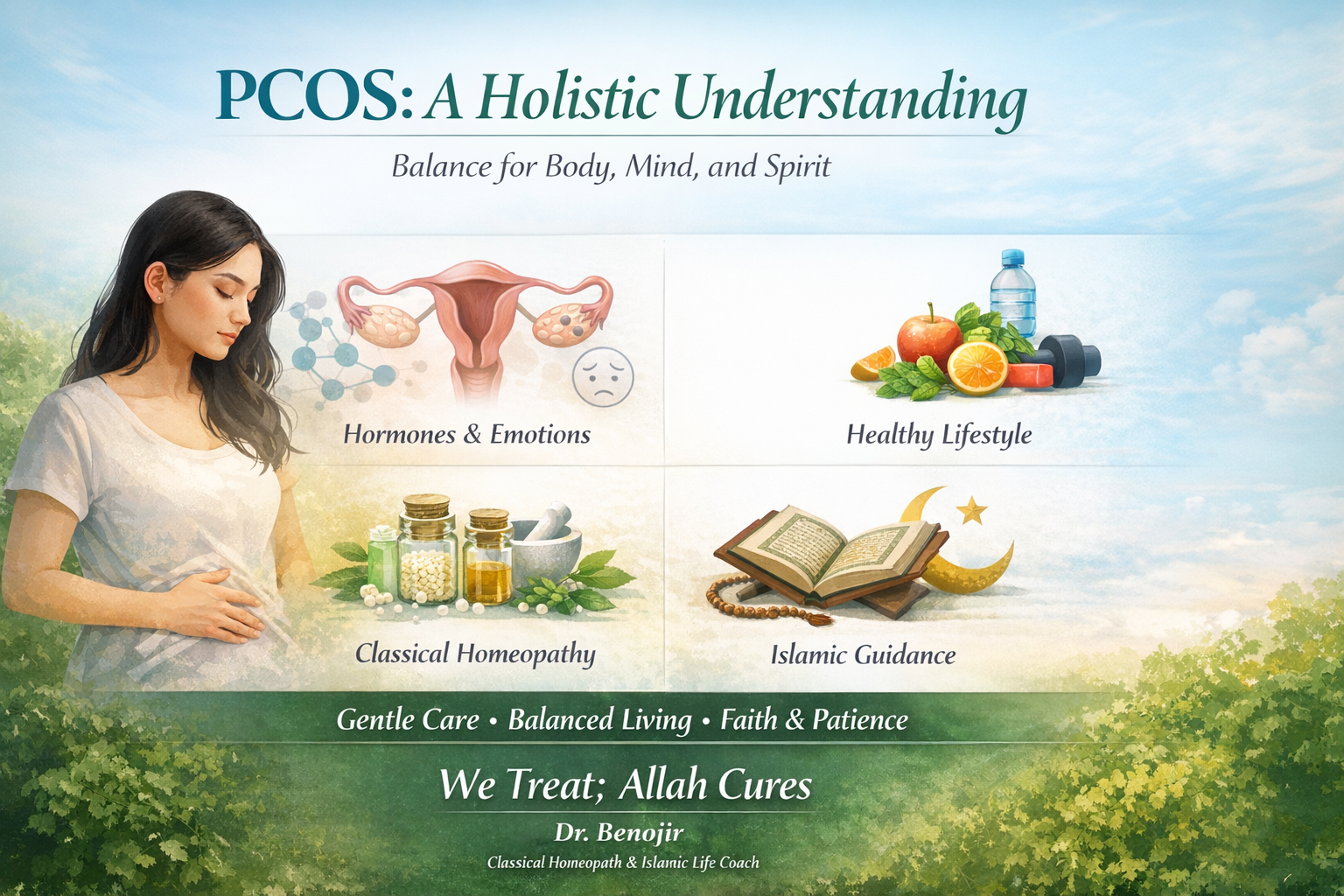
How Modern Medicine, Classical Homeopathy, Lifestyle Care, and Faith Support Lasting Hormonal Balance
Polycystic Ovary Syndrome, widely known as PCOS, has become one of the most talked-about women’s health conditions of our time, and for good reason. The World Health Organization estimates that 10 to 13 percent of women of reproductive age live with PCOS, and as many as 70 percent of affected women remain undiagnosed. Global research also shows the recorded burden of PCOS has risen sharply over the past three decades, particularly among adolescents and young women. Behind these numbers are real experiences: irregular cycles, visible skin and hair changes, fertility worries, and a quiet emotional weight that often goes unspoken.
PCOS is not simply a hormone report or an ultrasound finding. It is a whole-body pattern that touches metabolism, mood, self-image, and daily energy. This article looks at PCOS through four connected lenses: the established role of modern medicine, the individualized care of classical homeopathy, the steady support of lifestyle medicine, and the grounding strength of faith.
Understanding PCOS in Simple Terms
PCOS develops when the body’s hormonal signaling becomes imbalanced, most often involving higher-than-typical androgen levels and irregular ovulation. This can affect periods, skin, hair growth, weight regulation, and emotional wellbeing, though the pattern looks different from woman to woman. PCOS rarely appears overnight; it tends to build gradually through a combination of genetic tendency, insulin resistance, chronic stress, disrupted sleep, and lifestyle factors.
Common Symptoms and Risk Factors
Symptoms vary widely, but commonly reported experiences include:
• Irregular, delayed, or absent periods
• Difficulty managing weight, particularly around the abdomen
• Acne, oily skin, or unwanted facial and body hair growth
• Thinning hair on the scalp
• Fatigue or persistently low energy
• Mood changes, anxiety, or reduced self-confidence
• Difficulty conceiving when trying for pregnancy
Risk factors include a family history of PCOS or type 2 diabetes, insulin resistance, being overweight, sedentary habits, and chronic stress, although PCOS also affects women of average weight. Left unaddressed, PCOS can raise the long-term risk of type 2 diabetes, high blood pressure, sleep apnea, endometrial changes, and the psychological strain that research increasingly links to lower self-esteem and disordered eating patterns in some women with the condition.
Diagnosis: Looking at the Whole Picture
There is no single test for PCOS. Doctors typically combine menstrual history, blood tests for hormone levels, and an ultrasound scan, most often applying the Rotterdam criteria, which requires at least two of three features: irregular ovulation, signs of excess androgens, and a characteristic ovarian appearance on scan. A proper diagnosis matters because it shapes which treatments, lifestyle changes, and monitoring will genuinely help.
Modern Medicine: A Respected First Line of Care
Medical evaluation and monitoring remain essential, particularly for managing insulin resistance, fertility planning, and ruling out other hormonal conditions. Treatments such as prescribed medication, fertility support, or specialist referral should never be paused or replaced without a treating doctor’s guidance. For most women, the strongest results come from combining medical care with individualized homeopathic support and consistent lifestyle change.
Classical Homeopathy: Treating the Woman, Not the Label
Classical homeopathy does not treat “PCOS” as one uniform condition. It looks at how a particular woman experiences it: her cycle pattern, emotional state, body type, and what triggers or eases her symptoms. Two women with an identical ultrasound report may need entirely different remedies once their full picture is considered. A qualified homeopath takes a detailed case history before prescribing; the notes below are educational only and are not a substitute for individualized assessment.
Some remedies commonly studied in PCOS case-taking include:
• Apis mellifica — for right-sided ovarian pain that is stinging or burning, with sensitivity to touch and a tendency toward cystic swelling that is worse from heat.
• Conium maculatum — for hard, indurated breast or ovarian tissue, scanty or suppressed periods, a sedentary tendency, and vertigo brought on by turning the head.
• Lachesis — for left-sided ovarian symptoms that ease once the flow begins, a talkative and intense temperament, and marked discomfort from tight clothing around the waist.
• Lycopodium — for right-sided complaints with digestive bloating worse in the late afternoon, sugar cravings, low self-confidence hidden behind an assertive exterior, and metabolic sluggishness.
• Podophyllum peltatum — for PCOS linked with sluggish digestion and liver function, a sensation of pelvic heaviness or prolapse, and irregular, sometimes profuse, bleeding.
• Pulsatilla — for mild, gentle, changeable women whose periods are scanty, late, or absent, who feel better in open air and crave comfort and reassurance.
• Bufo rana — for ovarian cysts with burning pain, irregular or early menses, and a tendency toward weight gain, with symptoms most pronounced around the cycle.
• Colocynthis — for sharp, cramping pelvic pain that follows suppressed anger or frustration, relieved by bending double or firm pressure on the abdomen.
• Iodium — for PCOS overlapping with thyroid or metabolic imbalance, marked by restlessness, a strong appetite alongside weight changes, and intolerance of warm rooms.
• Palladium — for right-sided ovarian pain eased by pressure or rubbing, in women who value recognition and approval and feel drained after social effort.
• Platinum metallicum — for a sense of pride or looking down on others that masks deep insecurity, with early, heavy, dark menstrual flow and altered pelvic sensation.
• Thuja — for ovarian cysts in women with oily or blemished skin, skin tags or warts, fixed worries, and marked sensitivity to cold and dampness.
Lifestyle Modification: A Cornerstone of PCOS Care
Daily habits influence PCOS more than almost any single treatment. Several adjustable areas matter most.
Sleep. Irregular sleep disrupts the hormonal rhythm that governs ovulation and insulin sensitivity. Consistent sleep and wake times help regulate the body’s internal clock.
Diet. A balanced diet that avoids extremes, rich in fiber, protein, and steady meals rather than rigid restriction, supports more stable blood sugar and energy.
Movement. Exercise does not need to be intense to help. Regular, moderate movement such as walking or strength training improves insulin sensitivity and emotional wellbeing alike.
Stress management. Chronic stress quietly worsens hormonal imbalance. Slowing down, resting adequately, and setting emotional boundaries are genuine parts of PCOS care, not optional extras.
Daily habits. Small, sustainable choices, regular meal timing, limiting late-night screens, and consistent routines, compound over months into meaningful hormonal stability.
None of this requires perfection. Sustainability matters far more than intensity.
Mind | Body | Deen: A Complete View of PCOS
PCOS carries an emotional weight that is rarely discussed openly: worry about fertility, frustration with slow progress, and pressure to fix the body quickly. From an Islamic perspective, the body is an amanah, a trust from Allah, and caring for it is an act of responsibility rather than self-blame. The Prophet Muhammad (peace be upon him) reminded his companion that the body itself carries a right that must be honored through rest, balance, and care (Sahih al-Bukhari, 5199), a teaching that affirms self-care as a spiritual duty, not vanity.
The Qur’an also offers a steadying promise for conditions that take time to heal: that with hardship comes ease, repeated twice for emphasis (Qur’an 94:5–6). This is paired with a hopeful principle from the Prophet’s teaching that Allah has not sent down any illness without also sending down its cure, known to some and yet to be discovered by others (Sahih al-Bukhari, 5678). For a condition like PCOS, which often improves gradually rather than instantly, this framing offers real comfort without false promises.
Four practical concepts support this approach. Taqwa, mindful awareness, turns health choices into acts of intention rather than guilt. Sabr, patience, allows a woman to keep going through slow progress without despair. Shukr, gratitude, redirects attention toward small, real improvements rather than constant comparison. Tawakkul, trust in Allah, means giving genuine effort toward treatment while releasing anxious control over the outcome and its timing.
Common Questions Patients Ask
Can PCOS be fully cured?
PCOS is generally a long-term hormonal pattern rather than a condition with a single cure, but symptoms can be meaningfully managed and quality of life significantly improved through combined medical, homeopathic, and lifestyle care.
Will homeopathy interfere with my fertility treatment or medication?
Classical homeopathy can often be used alongside medical fertility care, but your doctor and homeopath should both be kept informed, and no prescribed treatment should be stopped without medical advice.
How soon will I notice improvement with homeopathic treatment?
This varies by individual. Some notice changes in energy or mood within weeks, while cycle regularity and deeper hormonal patterns generally take several months of consistent, individualized care.
Is weight loss necessary to manage PCOS?
Weight is one factor among many. Even modest, sustainable improvements in activity and diet can meaningfully help, and PCOS also affects women at a healthy weight, so care should never be reduced to weight alone.
A Balanced Path Forward
PCOS is not a life sentence, and it does not require choosing between medicine, homeopathy, lifestyle change, or faith. These approaches work best together: medical evaluation and monitoring where needed, individualized homeopathic care for whole-person balance, sustainable daily habits, and spiritual grounding for emotional resilience. Progress may be slow, and setbacks may occur, but healing is measured by direction and consistency, not speed. Women who approach PCOS with patience and informed, balanced effort often find not only symptom relief but a deeper understanding of their own body and strength.
Selected references
World Health Organization, Polycystic Ovary Syndrome Fact Sheet (2026). • Global Burden of Disease Study 2021, analyses published in Frontiers in Public Health and related journals (2025–2026). • Qur’an 94:5–6. • Sahih al-Bukhari, Hadith 5199 and 5678.
Dr. Benojir
Classical Homeopath & Islamic Life Coach
Mind | Body | Deen
“We Treat; Allah Heals”