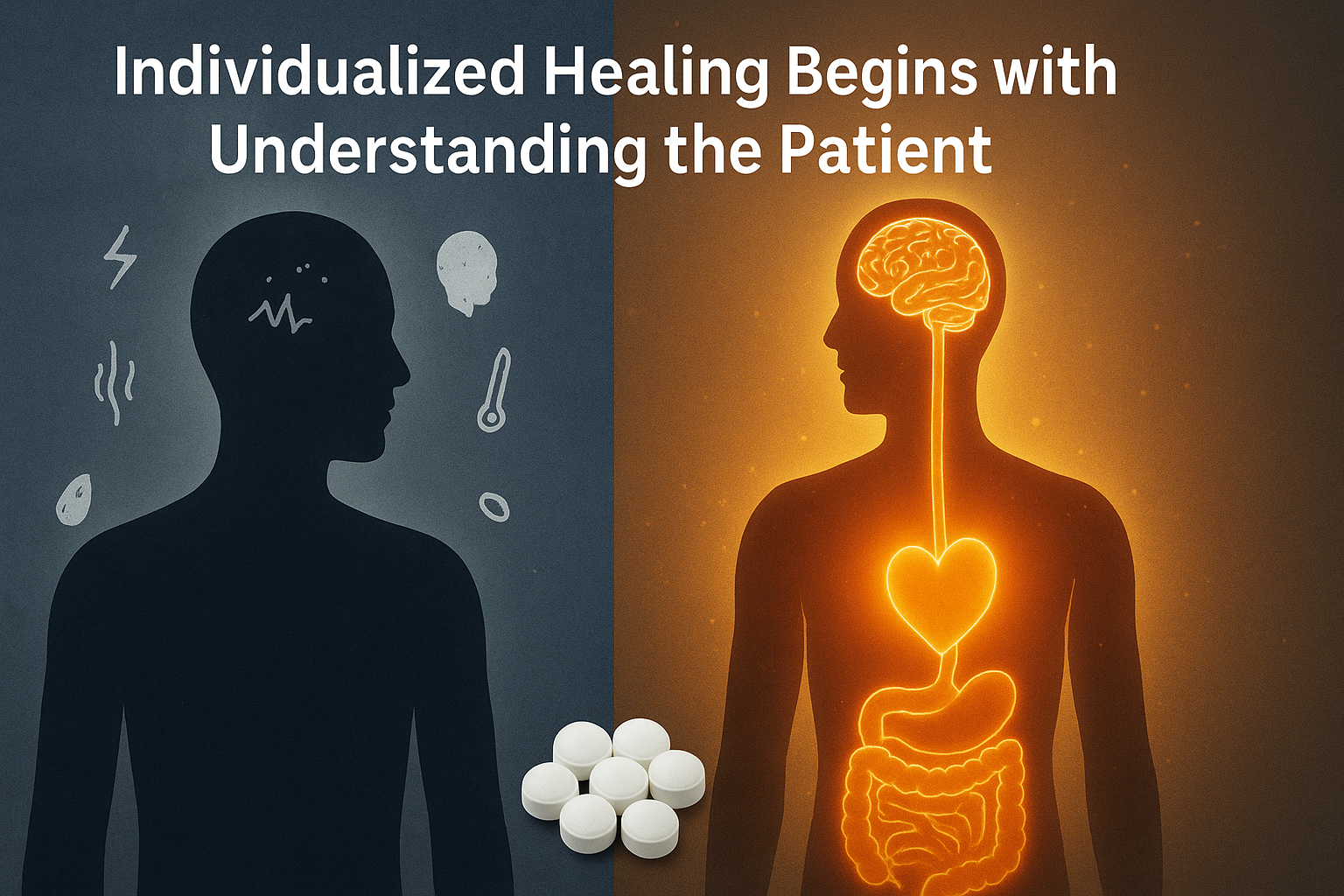
Why Homeopathy Treats the Patient, Not Just the Diagnosis
Two people can be told they have the same illness—say, migraine, arthritis, or anxiety—and yet need completely different treatment to truly recover. If you have ever wondered why a medicine that helped your friend did nothing for you, you are asking one of the most important questions in chronic-disease care: is disease just a label, or is it a personal experience that varies from person to person?
This article explores that question through the lens of individualized homeopathic treatment, alongside lifestyle medicine and the spiritual dimension of healing—an approach increasingly relevant for people managing chronic and lifestyle-related conditions today.
Understanding Disease as a Personal Experience
Modern medicine has transformed emergency care, surgery, and the treatment of infections. These are genuine triumphs. But for chronic illnesses—migraine, arthritis, irritable bowel syndrome, asthma, anxiety, and many lifestyle-related disorders—a different pattern often emerges in the clinic: the same diagnosis, given to ten different people, can produce ten different clinical pictures.
Why does this happen? Because a diagnosis describes a category of disease, but it does not describe the person living with it. Each individual brings a unique combination of genetics, emotional history, stress response, sleep pattern, diet, and even spiritual outlook to their illness. Modern research in psychoneuroimmunology and epigenetics increasingly supports this: chronic stress alters immune function, emotional trauma reshapes neuroendocrine pathways, and lifestyle factors can switch certain genes on or off.
This is precisely the gap that individualized, holistic approaches aim to fill—not by replacing conventional diagnosis, but by adding a layer of personal understanding that standardized protocols often cannot capture.
How Symptoms Tell a Personal Story
In classical homeopathy, founded by the German physician Samuel Hahnemann, the guiding principle is captured in his foundational text, the Organon of Medicine: the physician's task is to perceive clearly what is to be cured in the disease and what is curative in the remedy. In practice, this means looking far beyond the name of the disease.
A homeopathic practitioner pays close attention to details that conventional protocols often set aside, such as:
• What makes the symptom better or worse (heat, cold, rest, motion, pressure)
• The person's emotional state during illness—irritable, weepy, anxious, or withdrawn
• Thermal preferences—craving warmth or wanting cool, open air
• Sleep patterns, food cravings, and aversions
• How the person typically responds to stress or grief
Consider headache as an example. One person's throbbing headache is worse in the sun and eased by cold compresses, with a flushed face and a pounding sensation—quite different from another person's dull, bursting headache that worsens with mental effort and improves with firm pressure and quiet rest. Though both are “headaches,” the underlying pattern—and the most fitting remedy—can be entirely different. The same logic applies to arthritis: one patient's joint pain eases as they keep moving, while another's worsens with any movement at all and is relieved only by complete rest. Identical joints, opposite reactions.
This is the essence of individualization: matching the remedy to the person's unique pattern of reaction, not merely to the name of the disease.
Classical Homeopathy: Commonly Indicated Remedies
Below are examples of remedies frequently considered in classical homeopathic practice for headache-type complaints, shown here purely to illustrate how individualized symptom pictures guide remedy selection. Self-prescribing is not recommended; a qualified homeopath assesses the complete case before advising any remedy.
• Belladonna – throbbing pain, worse from heat and sun, flushed face, better with cold application
• Bryonia alba – dull, bursting pain, worse from motion or mental exertion, better with firm pressure and rest
• Silicea – pain beginning at the back of the head and spreading forward, worse in cold air, anxious and sensitive nature
• Ignatia amara – pain following emotional grief, sensation of a lump in the throat, frequent sighing
• Sepia – pain linked to hormonal changes, worse before menstruation, better in open air
• Natrum muriaticum – pain from suppressed emotions or grief, better with warmth, strong sense of duty
• Rhus toxicodendron – stiffness worse on first movement, improving with continued gentle motion
• Nux vomica – pain linked to overwork, stress, or excess stimulants, irritable disposition
This is why two people with the same diagnosis may need two different remedies—and why a careful case history, not the disease label alone, guides the homeopath's choice.
Lifestyle Modification: Healing Beyond Medicine
No remedy, conventional or homeopathic, can fully offset a lifestyle that continues to feed the illness. Sustainable recovery from chronic conditions usually depends on consistent, practical changes:
• Sleep: aim for a regular sleep-wake schedule and 7–8 hours of restful sleep; irregular sleep disrupts hormonal and immune balance
• Diet: favour whole, minimally processed foods; identify and reduce personal triggers such as excess caffeine, sugar, or skipped meals
• Exercise: regular, moderate movement—walking, stretching, or light strength training—supports circulation and mood
• Stress management: structured breathing exercises, short breaks during work, and realistic boundaries around daily demands
• Digital discipline: reducing late-night screen exposure, which is linked to poorer sleep quality and increased anxiety
• Emotional hygiene: acknowledging and expressing feelings rather than suppressing them, which research links to lower long-term stress burden
Patients often ask, “If I take my remedy, do I still need to change my lifestyle?” The honest answer is yes. Lifestyle correction does not replace treatment—it removes the ongoing triggers that keep undoing the body's healing efforts.
Mind | Body | Deen: The Spiritual Dimension of Healing
Chronic illness rarely stays confined to the body. Long-standing pain, fatigue, or uncertainty about recovery often brings worry, restlessness, or a quiet sense of being overwhelmed. Addressing this emotional and spiritual layer is not separate from treatment—it is part of it.
In the Islamic tradition, healing is understood as something sought through both effort and trust in Allah. The Quran reminds believers, in Surah Ash-Shu'ara (26:80), of the words of Prophet Ibrahim (peace be upon him) acknowledging Allah as the One who grants healing when he falls ill. This reflects a balanced outlook: the patient takes medicine and makes lifestyle changes, while placing ultimate trust in Allah's decree.
The Prophet Muhammad (peace be upon him) is reported to have said that Allah has not sent down any illness except that He has also sent down its cure, known to those who come to know it (recorded in the collection of Imam Ahmad, with a similar narration in Sunan Ibn Majah). This hadith encourages patients to seek treatment actively rather than abandon hope, while never losing sight of the spiritual source of healing.
Practically, this means:
• Tawakkul (trust in Allah) to ease anxiety about outcomes beyond one's control
• Sabr (patience) to endure the slower pace of chronic-illness recovery
• Shukr (gratitude) for small improvements, which research associates with better emotional resilience
• Regular prayer and remembrance (dhikr) as a structured way to calm the nervous system
Patients frequently ask whether faith and medical treatment can be combined. They not only can be—they support one another. Acting on the means available (treatment, lifestyle change) while trusting the outcome to Allah is itself a balanced, time-honoured approach to illness.
Common Questions Patients Ask
“If homeopathy treats the person, not the disease, how does the homeopath know which remedy to choose?”
Through a detailed case-taking process that records not only the main complaint but also its modalities, the patient's emotional state, general health, and lifestyle—building what homeopaths call the “totality of symptoms.”
“Can I continue my prescribed conventional medicine alongside homeopathic treatment?”
This should always be discussed with both treating physicians, since management plans must be coordinated and individualized rather than assumed.
“Will lifestyle changes alone cure a chronic illness?”
Lifestyle change is a powerful support, but it works best alongside individualized treatment rather than as a stand-alone substitute, especially in established chronic conditions.
Bringing It All Together
The recurring lesson across clinical experience, modern stress research, and spiritual tradition is the same: healing is rarely about silencing a symptom. It is about understanding the person behind it—their body, their emotional patterns, their daily habits, and their relationship with the One who ultimately grants recovery. When individualized treatment, sound lifestyle habits, and spiritual grounding are brought together, the result is not just symptom relief but a more complete and sustainable path back to health.
Dr. Benojir
Classical Homeopath & Islamic Life Coach
Mind | Body | Deen
“We Treat; Allah Heals”