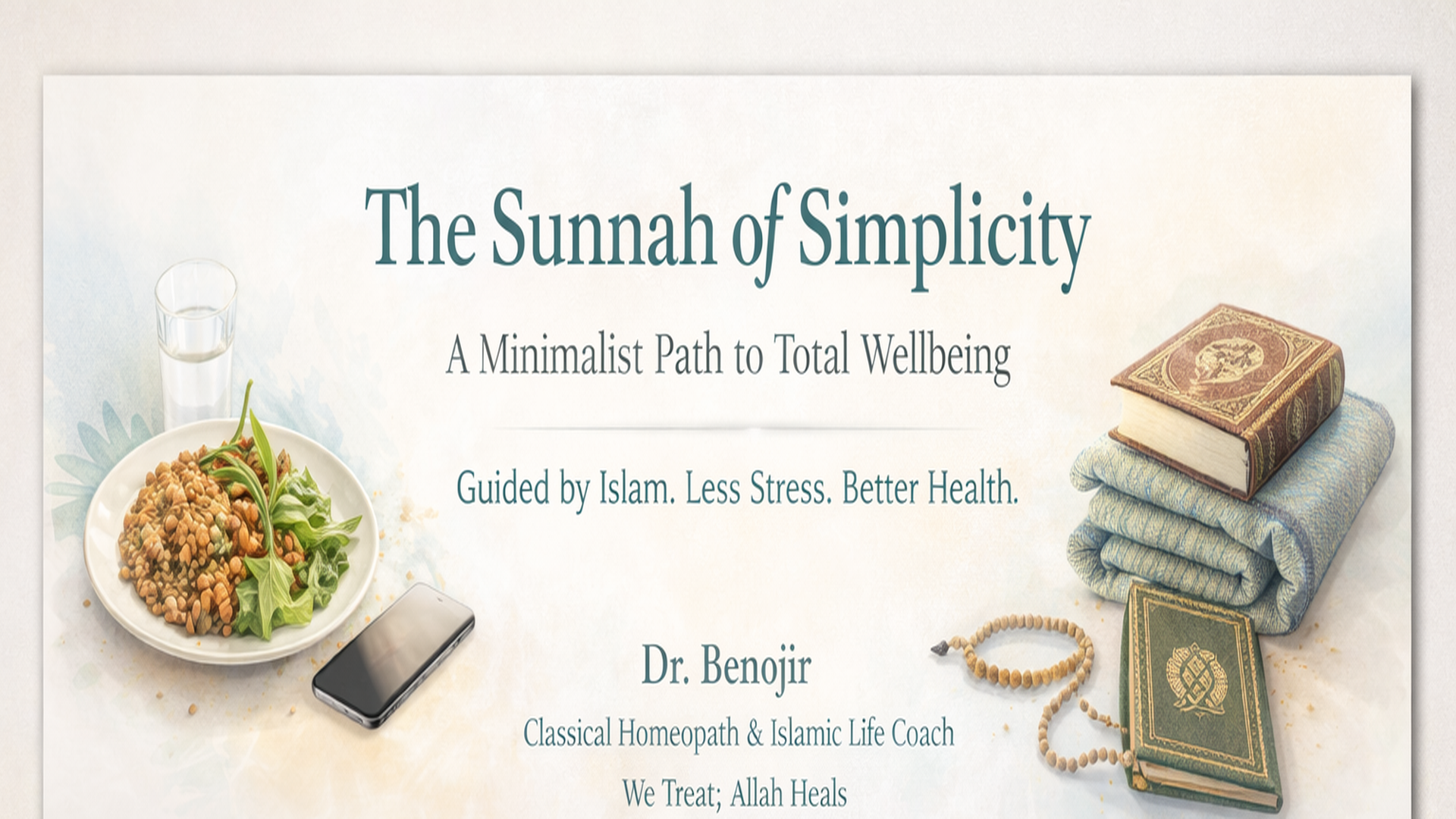
How the Sunnah of Less Unlocks Better Health, Deeper Peace, and Lasting Vitality
By Dr. Benojir | drbenojir.com
A patient once sat across from me and said: "Doctor, I earn three times what I did ten years ago. I have a better phone, a bigger home, and more food in my fridge than I can eat. But I am more tired, more anxious, and less at peace than I have ever been."
He is not alone. Across the world, clinics are filling with patients who are materially wealthy but physiologically and emotionally depleted. They suffer from what I call the diseases of excess: metabolic syndrome, chronic anxiety, insomnia, decision fatigue, and a deep spiritual restlessness that no supplement can fix.
The solution — counterintuitively — is not more. It is less.
Minimalism, when practised as a deliberate lifestyle rather than an aesthetic trend, is one of the most powerful preventive health interventions available. And remarkably, it is not a new idea. It is the living heart of Islamic tradition — what the scholars called Zuhd (detachment from excess) and Iktisad (principled moderation). What modern science is now validating through research in neuroscience, metabolic medicine, and psychology, the Prophet Muhammad (peace be upon him) modelled with his own hands fourteen centuries ago.
This article explores the science and spirituality of simplified living — how reducing excess in what we eat, consume, own, and do can produce measurable improvements in physical health, mental clarity, and emotional peace. It also examines how classical homeopathy — itself a system built on the principle of minimum dose for maximum effect — supports and accelerates this process.
What Is Minimalist Living — and Why Does It Heal?
Minimalism is not about empty rooms, white walls, or giving away everything you own. It is about the deliberate removal of excess — in possessions, commitments, stimulation, and consumption — so that what remains can be truly nourishing.
The health implications of this are significant and increasingly well-documented:
• A 2019 study in Environment and Behaviour found that cluttered home environments were associated with higher cortisol levels throughout the day, particularly in women — pointing to a direct link between physical disorder and hormonal stress.
• Research published in Psychological Science demonstrated that having too many choices (the 'paradox of choice') increases decision fatigue, lowers satisfaction, and elevates anxiety — the opposite of what we expect from having 'more options.'
• A landmark 2022 paper in JAMA Internal Medicine confirmed that dietary simplification — reducing variety in ultra-processed foods while increasing whole-food variety — significantly improved metabolic markers in just eight weeks.
Minimalism, in short, reduces the biological and psychological cost of living. It is preventive medicine — free, available to everyone, and immediately actionable.
Lifestyle Modification: Five Pillars of Simplified Wellness
1. Nutritional Simplicity — Less Noise, More Nourishment
The modern diet is characterised by what nutritional scientists call 'hyperpalatability' — foods engineered to overstimulate the brain's reward pathways through combinations of sugar, salt, fat, and artificial flavourings. The result is a perpetual cycle of craving, overconsumption, and inflammatory burden.
Simplifying your diet does not mean eating poorly. It means eating intentionally. Research consistently shows that diets built around a small number of whole, minimally processed ingredients outperform complicated 'clean eating' plans in terms of both adherence and health outcomes.
Practical principles for nutritional minimalism:
• Reduce the number of items per meal, not the quality. A bowl of lentil soup with wholegrain bread and a salad is more nourishing — and less metabolically taxing — than a spread of twelve dishes.
• Eliminate the concept of 'constant eating.' The digestive system needs rest between meals. Structured meal times with genuine fasting windows (even simply avoiding food after 8:00 PM) reduce insulin resistance and inflammatory markers.
• Choose foods with short ingredient lists. If a product has more than five ingredients — especially ones you cannot pronounce — it is probably ultra-processed.
• Embrace the prophetic pantry: dates, olive oil, honey, barley, and seasonal vegetables are not just spiritually significant — they are nutritionally validated by modern research. Extra virgin olive oil alone has over a hundred peer-reviewed studies confirming its anti-inflammatory, cardioprotective, and neuroprotective properties.
A specific practice worth highlighting is the Sunnah of intermittent fasting — fasting on Mondays and Thursdays. Research on time-restricted eating confirms what this practice has embodied for centuries: periodic fasting reduces visceral fat, improves insulin sensitivity, lowers inflammatory cytokines, and supports cellular autophagy — the body's own deep-cleaning mechanism.
2. Digital Minimalism — Reclaiming Your Nervous System
The average adult now spends over seven hours per day looking at screens. Each notification triggers a micro-cortisol spike. Each scroll through social media activates the same dopamine-reward pathway exploited by gambling and substance use. The cumulative neurological and hormonal cost is enormous.
Chronic screen exposure is now linked to disrupted circadian rhythms, elevated evening cortisol, delayed sleep onset, increased rates of anxiety and depression, and a reduced capacity for sustained attention — what psychologists call 'attentional fragmentation.'
Digital minimalism is not about eliminating technology — it is about choosing when and how you engage with it. Practical steps:
• Implement a 'digital sunset': no screens after the Maghrib prayer. This single habit, practised consistently, can restore natural melatonin rhythms within two to three weeks.
• Curate your consumption ruthlessly. Unfollow, mute, or remove anything that consistently triggers comparison, anxiety, or envy. Your social media feed is an environment — design it consciously.
• Create phone-free zones: the bedroom, the dining table, and any space designated for prayer or reflection. Physical distance from devices reduces the unconscious urge to check them.
• Replace passive consumption with active restoration: Dhikr, reading, walking, or simply sitting in silence. These are not empty activities — they are neurological repair.
3. Physical Simplicity — Movement Without Machinery
There is a pervasive belief that serious health requires expensive gym memberships, protein supplements, and complex training programmes. The evidence does not support this. In fact, research increasingly suggests that the most health-protective form of movement is also the simplest: walking.
A 2022 study in JAMA Internal Medicine found that walking approximately 7,000 to 8,000 steps per day was associated with a 50 to 70 percent reduction in all-cause mortality — regardless of exercise intensity. No equipment. No membership. No programme.
A minimalist approach to physical health:
• Walk wherever possible — to the masjid, to the market, to collect children from school. Each journey becomes both movement and mental decompression.
• Use your home as a gymnasium: floor stretches, bodyweight movements, and the physical postures of Salah itself — bowing, prostration, rising — provide compound movement patterns that benefit spinal flexibility, circulation, and core stability.
• Reduce sedentary time before adding exercise. Standing up every 30 to 45 minutes during desk work has measurable benefits on metabolic health that cannot be replicated by an hour in the gym if the remaining 23 hours are spent sitting.
• For those with lymphatic congestion or fatigue, rebounding on a small trampoline for 10 minutes daily is among the most efficient lymphatic stimulation exercises available.
4. Relational Simplicity — Depth Over Breadth
We live in an era of unprecedented social connectivity and unprecedented loneliness. The two are related. When relationships are spread thin across hundreds of digital acquaintances, the deep nourishment of genuine human intimacy becomes rare.
Research from Harvard's 85-year Study of Adult Development — one of the longest studies of human wellbeing ever conducted — found that the quality of close relationships was the single strongest predictor of health, happiness, and longevity in later life. Not wealth. Not status. Relationship quality.
Relational minimalism means consciously investing in fewer, deeper connections:
• Be fully present with the people in front of you. Put the phone away at meals, during conversations, and whenever a loved one needs your attention. Presence is the rarest gift in the modern world.
• Protect your energy for relationships that genuinely nourish. It is not selfish to decline invitations that consistently drain you — it is stewardship of a finite resource.
• Reconnect with family, neighbours, and community with the depth that Islamic teaching encourages: asking after wellbeing, checking in on the vulnerable, and being reliably present in difficult times.
5. Financial Simplicity — Owning Less, Living More
Lifestyle inflation — the tendency to upgrade spending as income rises — is one of the primary drivers of financial stress in modern households. We buy things we do not need, with money we have not yet earned, to impress people we do not particularly like.
The financial and psychological cost is compounded by what researchers call the 'hedonic treadmill': the rapid return of baseline happiness after any acquisition, which drives the next purchase in an endless cycle. More things do not produce more happiness beyond a certain threshold — a finding that has been replicated across cultures and income brackets.
Practical financial minimalism:
• Before purchasing anything non-essential, apply a 72-hour waiting period. Most impulse purchases are not made after three days of reflection.
• Redirect excess spending toward Sadaqah (voluntary charity). The psychological and spiritual benefits of giving are among the most consistently documented phenomena in the positive psychology literature — and its spiritual reward is explicitly promised in the Quran.
• Distinguish between assets (things that add genuine value to your life) and clutter (things that add only momentary stimulation). Invest in the former; reduce the latter.
Classical Homeopathy: Healing on the Principle of Less
There is a beautiful philosophical alignment between minimalism and classical homeopathy: both are built on the understanding that less, applied precisely and intelligently, achieves more than excess ever could.
Classical homeopathy uses highly diluted remedies — the minimum possible dose — to stimulate the body's own intelligent healing response rather than overriding it with suppressive measures. The selection is always individualised: not 'a remedy for stress,' but the specific remedy that matches this particular person's unique pattern of stress, their physical sensations, their emotional landscape, and their energy rhythms.
The following remedies are among those most commonly indicated in patients whose health has been affected by the excesses of modern life:
Nux Vomica — The Overstimulated Achiever
Keynote picture: The driven professional whose system has become toxic with stimulants, sedatives, and sensory overload. They wake around 3:00–4:00 AM with a churning mind, struggle with constipation and liver congestion, and are irritable at the slightest noise or interruption. This is the primary remedy for detoxifying the liver and nervous system in the context of a high-pressure, over-stimulated lifestyle.
Arsenicum Album — The Anxious Perfectionist
Keynote picture: Deep health anxiety and a compulsive need for order and control. Despite extreme fatigue, they cannot rest — restlessly rearranging, cleaning, or planning. Burning sensations relieved by warmth. A specific fear of being alone at night. These individuals often over-exercise and over-organise as anxiety management, eventually depleting their adrenal reserves.
Kali Phosphoricum — The Digitally Depleted
Keynote picture: Pure nervous exhaustion from information overload: the student who has over-studied, the remote worker overwhelmed by screens, the parent running on empty. A characteristic 'gone' or hollow feeling in the pit of the stomach — distinct from hunger. Extreme sensitivity to noise and a tendency to be startled. This biochemical tissue salt is the primary nerve-support remedy.
Lycopodium Clavatum — The Digestively Burdened
Keynote picture: Significant bloating and gas immediately after even modest meals, peaking between 4:00 and 8:00 PM. Intense cravings for sweets, especially in the late afternoon. Despite an intellectually capable exterior, there is a deep undercurrent of self-doubt and performance anxiety. Frequently indicated in fatty liver, irritable bowel syndrome, and metabolic sluggishness linked to dietary excess.
Natrum Muriaticum — The Bottled-Up Griever
Keynote picture: The person who has absorbed grief, disappointment, or emotional injury and learned to function through it rather than process it. Chronic hammering headaches, worsening in heat and sunlight, a craving for salt, and often a mapped tongue. Suppressed emotion creates physical holding patterns — particularly in the chest and solar plexus. Social media comparison and the pressure to 'seem fine' make this type increasingly common.
Calcarea Carbonica — The Overwhelmed and Overloaded
Keynote picture: A deep sense of being overwhelmed by accumulating responsibilities — too many tasks, too many decisions, too much information. Physical heaviness and sluggishness, extreme sensitivity to cold, and night sweats on the head. Frequently indicated in hypothyroidism, recurrent infections, and the particular kind of fatigue that arises not from physical exertion but from mental and emotional over-accumulation.
Sepia — The Depleted Caregiver
Keynote picture: Profound emotional flatness and withdrawal — the individual who has given endlessly and arrived at a state of indifference, even toward those they love. A dragging heaviness in the pelvis, hormonal dysregulation, and irritability that snaps at the closest people. Paradoxically, vigorous exercise improves their mood — one of Sepia's most distinctive and clinically useful features.
Phosphorus — The Empathetic Burnout
Keynote picture: A warm, open, socially attuned person who absorbs the emotional states of everyone around them and eventually becomes depleted by their own sensitivity. Intense and sudden hunger, thirst for cold drinks, easy bruising, and a fear of being alone or of thunderstorms. The 'social media empath' who feels exhausted after consuming others' emotional content.
Sulphur — The Chronic Accumulator Needing a Reset
Keynote picture: The person who has accumulated too much — toxins, habits, remedies, experiences — and whose system has become unable to clear itself. Burning sensations, offensive discharges, intense itching of the skin worse at night, and an aversion to bathing. Frequently used as an intercurrent or 'unlocking' remedy when other well-selected prescriptions have stalled.
Ignatia Amara — The Acute Grief Response
Keynote picture: The primary remedy for acute emotional shock, grief, and disappointment — particularly when the emotional event is recent and clearly identifiable. Rapid alternation between emotional states (laughing then crying), a sensation of a lump in the throat, sighing, and physical symptoms that are contradictory and changeable. Particularly indicated in the aftermath of loss, break-up, or sudden life disruption.
As always, these profiles are illustrative. Classical homeopathic prescribing requires a full consultation to assess the totality of symptoms. Self-prescribing can be helpful for minor acute conditions, but for chronic or constitutional issues, professional assessment yields significantly better results.
Mind | Body | Deen: The Islamic Architecture of Simplicity
What we call 'minimalist wellness' today, Islam has practised as a spiritual discipline for over fourteen centuries. The Quran and authentic Sunnah contain a remarkably complete framework for the simplified life — one that addresses the body, the mind, and the soul simultaneously.
The Body: Prophetic Guidance on Eating
The most celebrated prophetic teaching on health is also one of the most practically powerful:
"No human ever filled a vessel worse than the stomach. Sufficient for any son of Adam are some morsels to keep his back straight. But if it must be, then one third for his food, one third for his drink, and one third for his air." (Sunan Ibn Majah, 3349 — authenticated by Al-Albani)
This single hadith encapsulates what nutritional science now validates: caloric restriction and reduced meal volume lower inflammatory markers, support healthy insulin levels, reduce oxidative stress, and extend functional lifespan. The Prophet (peace be upon him) was not merely giving spiritual guidance — he was describing an optimal biological input protocol.
The Quran reinforces this with clarity:
"Eat and drink, but be not excessive. Indeed, He does not like those who commit excess." (Surah Al-A'raf, 7:31)
The Mind: Leaving What Does Not Concern You
Perhaps the most relevant prophetic teaching for our age of information overload is this:
"Part of the excellence of one's Islam is his leaving that which does not concern him." (Jami' al-Tirmidhi, 2317 — authenticated by Al-Albani)
This is a complete philosophy of attentional minimalism. Most of what floods our screens — breaking news, celebrity drama, political arguments, viral outrage — does not concern us. It neither improves our lives nor allows us to serve others better. Yet we consume it compulsively, at great neurological cost.
The spiritual practice of leaving what does not concern you is, in neurological terms, the deliberate reduction of attentional fragmentation. It protects the prefrontal cortex from decision fatigue and allows the mind to focus on what is genuinely meaningful.
The Soul: Zuhd — Detachment as Liberation
Zuhd is often mistranslated as 'asceticism' — a harsh withdrawal from worldly comfort. The classical scholars were precise: Zuhd does not mean owning nothing. It means that nothing you own, owns you.
Imam Ahmad ibn Hanbal defined Zuhd as having three levels: leaving the forbidden, leaving the excess of what is permitted, and leaving what distracts you from Allah. This final level is the spiritual goal of minimalism — not poverty, but clarity. Not deprivation, but freedom.
"Wealth is not in having many possessions, but rather true wealth is the richness of the soul." (Sahih al-Bukhari, 6446)
The clinical translation of Zuhd is striking. When patients reduce their attachment to outcomes, possessions, and social approval, their cortisol patterns stabilise, their sleep deepens, and their immune function improves. The soul's liberation has a direct biological signature.
The Heart: Moderation in Spending
"And those who, when they spend, are neither extravagant nor stingy, but hold a medium way between those extremes." (Surah Al-Furqan, 25:67)
This Quranic description of the 'servants of the Most Merciful' includes financial moderation as a mark of spiritual maturity. The research corroborates this: financial stress is one of the most consistent predictors of poor health outcomes, relationship breakdown, and chronic anxiety. Living within one's means — and below them, with savings and giving — creates a physiological state of security that no amount of spending can purchase.
Salah: The Built-In Minimalism Protocol
Five times daily, Muslims are called away from everything — business, screens, social interaction, food — and directed to stand before Allah. This forced simplification of attention, repeated throughout the day, is one of the most effective stress-regulation practices known.
Research on the physiology of Salah has documented: reduced cortisol after prayer, improved heart rate variability (a marker of nervous system resilience), enhanced mood through the physical postures of prostration (which activate the parasympathetic nervous system), and the social benefit of communal prayer in the masjid.
The ablution (Wudu) before each prayer adds a sensory-regulating layer: the sensation of water on the face, hands, and feet activates the vagus nerve and initiates a physiological 'reset' response. This is not metaphor — it is measurable neurobiology.
The Health Cost of Excess: What Happens When We Ignore Simplicity
The consequences of chronic excess are well-documented and increasingly common:
• Metabolic syndrome — the cluster of abdominal obesity, high blood pressure, elevated blood glucose, and abnormal cholesterol — now affects more than one in three adults globally and is directly driven by dietary excess and physical inactivity.
• Chronic insomnia, affecting an estimated 30% of adults, is primarily maintained by evening screen exposure, late eating, and an overstimulated nervous system that cannot downregulate.
• Burnout — recognised by the World Health Organization as an occupational syndrome characterised by exhaustion, cynicism, and reduced efficacy — is the direct physiological result of prolonged excess demand on human biological systems.
• Decision fatigue, well-documented in psychological research, reduces the quality of decisions across the day and is directly worsened by too many trivial choices — an inevitable feature of the hyper-consumer environment.
• Spiritual dryness — the feeling that life is full but meaningless — is not a diagnosis, but it is a clinical reality seen frequently in practice. It correlates with the busyness of a life so packed with consumption and stimulation that there is no space for depth, silence, or presence.
Common Questions from Patients
I want to simplify my life, but I have a family and a demanding job. Where do I even start?
Start with one domain, not all five. Most people who attempt a wholesale life overhaul abandon it within weeks. Instead, choose the area that is costing you the most — whether that is your diet, your screen time, your clutter, or your schedule — and apply one concrete change for thirty days. Once that becomes automatic, add another. Simplification is itself a skill, and like all skills, it is built incrementally.
Is homeopathic treatment compatible with a minimalist lifestyle?
Beautifully so. Classical homeopathy is, in a very real sense, the medicine of minimalism — the minimum dose, precisely chosen, to produce the maximum therapeutic effect. It asks nothing of the patient in terms of complex protocols or multiple medications. A single well-chosen remedy, combined with genuine lifestyle simplification, can produce shifts that neither alone achieves. The remedy removes the obstacles the lifestyle cannot reach; the lifestyle creates the conditions the remedy needs to hold.
Does simplicity mean I have to give up my comforts and pleasures?
No. Minimalism is not about deprivation — it is about discernment. The goal is not to remove everything, but to remove what costs more than it gives. A meal shared unhurriedly with family is a pleasure minimalism deepens. Mindless scrolling for two hours while eating alone is a 'comfort' that minimalism removes. The distinction is intentionality, not austerity.
I feel like I cannot stop — there is always more to do, buy, or consume. Is that a medical issue?
It may be, in part. Chronic overstimulation desensitises the brain's dopamine receptors, creating a compulsive need for novelty and consumption — a pattern that closely resembles addiction neurology. Classical homeopathy offers several remedies that specifically address this compulsive over-drive (particularly Nux Vomica, Arsenicum Album, and Sulphur in their respective types), and lifestyle restructuring is the necessary complement. If the pattern feels truly compulsive and unmanageable, a consultation is strongly advisable.
Conclusion: The Freedom Found in Less
The most radical act of self-care in the modern world is choosing less. Less stimulation, less consumption, less noise, less excess. Not because life should be joyless or bare, but because the human body, mind, and soul thrive in simplicity — and are crushed by endless accumulation.
The Prophet Muhammad (peace be upon him) owned almost nothing by the standards of his time and by any standard today. Yet by every measure that matters — the depth of his relationships, the clarity of his purpose, the peace of his inner life, and the health of his physical body — he was among the most complete human beings who ever lived. His simplicity was not a limitation. It was a liberation.
That same liberation is available to every one of us. It does not require a new purchase, a new programme, or a new plan. It requires only the willingness to let go.
Begin today. With one less thing. One cleaner meal. One quieter evening. One moment of genuine presence. The healing that follows will surprise you.
Dr. Benojir
Classical Homeopath & Islamic Life Coach
Mind | Body | Deen
“We Treat; Allah Heals”