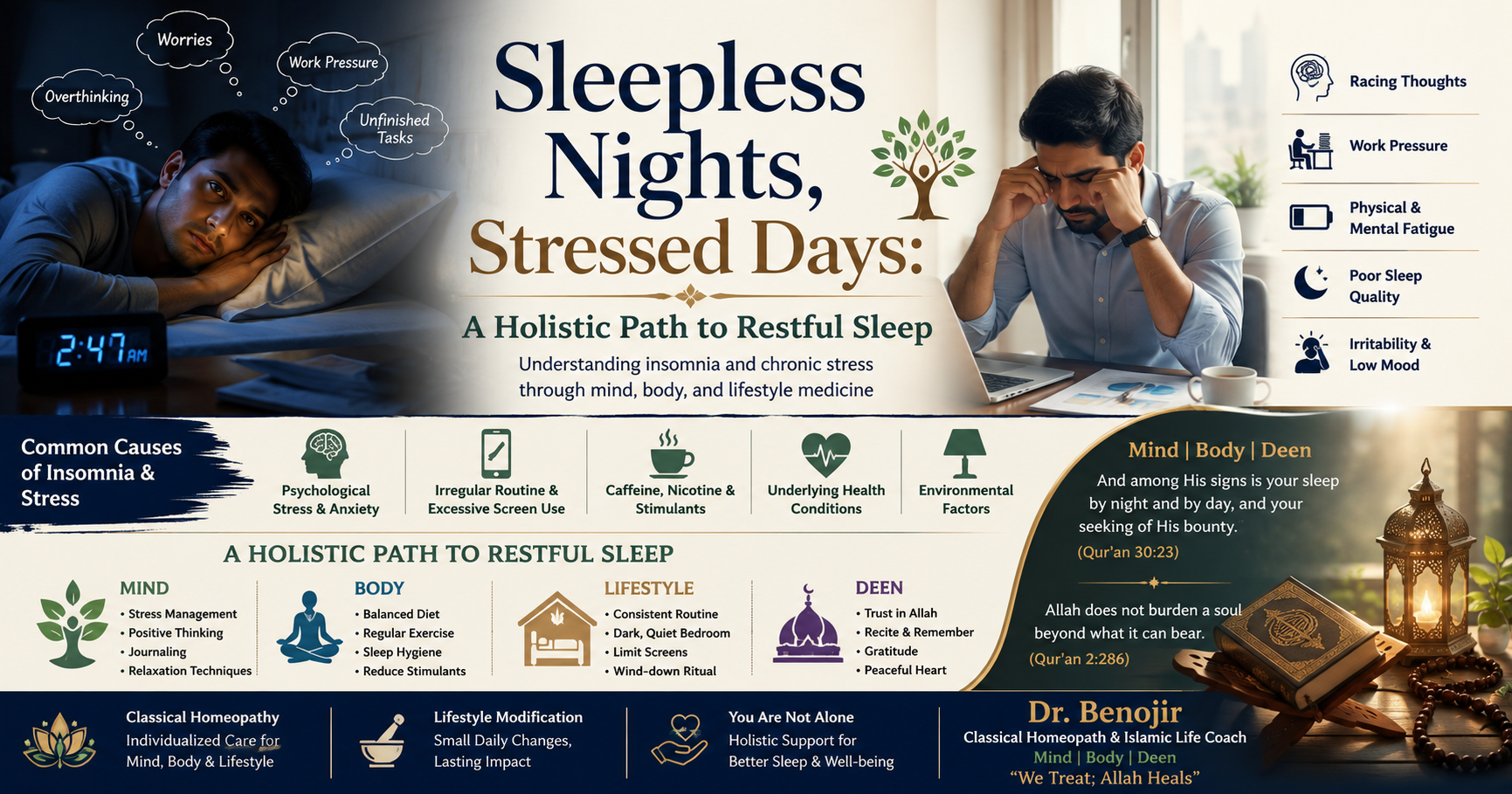
Sleepless Nights, Stressed Days: A Holistic Path to Restful Sleep
Understanding insomnia and chronic stress through mind, body, and lifestyle medicine
Sleep trouble is one of the most common complaints heard in clinics today. Many people lie awake replaying the day’s worries, wake repeatedly through the night, or rise feeling unrefreshed despite spending hours in bed. Often, this isn’t a stand-alone problem — it travels together with stress, anxiety, and the pressures of modern life.
This article looks at insomnia and stress-related sleep disturbance from several angles: what causes it, how it’s recognized, when it becomes a medical concern, and what a holistic approach — including classical homeopathy, lifestyle change, and spiritual grounding — can offer.
What Is Insomnia, and Why Does It Happen?
Insomnia is difficulty falling asleep, staying asleep, or waking too early, with daytime tiredness, irritability, or poor concentration as a result. Occasional poor sleep is normal; insomnia becomes clinically significant when it occurs at least three nights a week for three months or longer.
Common contributing factors include:
• Psychological stress — work pressure, financial worry, relationship conflict, grief, or unresolved fear
• Irregular routine — inconsistent bedtimes, excessive screen use at night, shift work
• Stimulants — caffeine, nicotine, and some medications taken too late in the day
• Underlying health conditions — thyroid disorders, chronic pain, acid reflux, hormonal changes (such as menopause), anxiety, or depression
• Environmental factors — noise, light, an uncomfortable bedroom temperature
Because sleep, mood, and physical health are closely linked, insomnia is rarely caused by just one factor — it usually reflects a combination of mind, body, and habit.
Recognizing the Pattern: Symptoms and Diagnosis
People with chronic insomnia often describe a racing mind at night, difficulty switching off, frequent waking, or early morning awakening they can’t get back to sleep from. Over time, this can bring fatigue, low mood, reduced concentration, and a lower tolerance for daily stress.
Diagnosis is mainly based on a careful history: sleep pattern, daily routine, stress levels, and any underlying medical or emotional triggers. A doctor may also check for treatable causes such as thyroid imbalance, anaemia, sleep apnoea, or medication side effects, since addressing these directly often improves sleep on its own.
Risk Factors and Possible Complications
Insomnia is more common in people with high occupational stress, irregular work shifts, chronic illness, anxiety disorders, or a family history of sleep difficulty. Left unaddressed for long periods, poor sleep has been associated with a higher risk of hypertension, weight gain, weakened immunity, and worsening mental health. This is why early attention to sleep — rather than waiting for it to “sort itself out” — is genuinely worthwhile.
Prevention and General Care
Good “sleep hygiene” remains one of the most evidence-supported ways to protect sleep quality: a consistent bedtime, a wind-down routine, limiting screens and caffeine in the evening, and keeping the bedroom dark, cool, and quiet. For persistent or severe insomnia, especially where mood, breathing problems, or other medical symptoms are present, conventional medical evaluation is important to rule out underlying conditions and to discuss options such as cognitive behavioral therapy for insomnia (CBT-I), which has strong evidence behind it.
Classical Homeopathy: An Individualized Approach to Sleep and Stress
In classical homeopathy, insomnia is never treated as a single, generic condition. Two people who “can’t sleep” may need entirely different remedies, because the homeopath looks at the whole picture — the nature of the person’s worry, their emotional temperament, what makes their sleep better or worse, and accompanying physical symptoms. This individualization is the foundation of the homeopathic method founded by Dr. Samuel Hahnemann over two centuries ago, and it remains one of the more widely used complementary approaches worldwide; surveys suggest an estimated 193 million people have used homeopathy in the US at some point, with the large majority of users in some surveys reporting satisfaction with treatment.
A classical homeopath takes a detailed case history before selecting a remedy. Some commonly considered remedies for sleep and stress-related complaints — always selected according to the individual’s full symptom picture, not self-prescribed for a diagnosis alone — include:
• Coffea cruda — for a mind that is over-stimulated and racing with thoughts, often after good or exciting news, with great difficulty switching off
• Nux vomica — for the overworked, irritable person who falls asleep but wakes around 3–4 a.m., mind full of business or responsibilities
• Ignatia amara — for insomnia following grief, emotional shock, or suppressed sadness, with sighing and a sensitive, introspective nature
• Arsenicum album — for anxious, restless sleep with fear and a need for reassurance, often waking around 1–2 a.m.
• Kali phosphoricum — for sleeplessness from nervous exhaustion and overwork, with a generally depleted, “burnt out” feeling
• Passiflora incarnata — for simple restlessness and difficulty settling the mind, without strong emotional disturbance
• Natrum muriaticum — for sleep disturbed by old grief or emotional reserve, in someone who tends to keep feelings private
• Aconitum napellus — for sudden insomnia from fright, panic, or acute anxiety, often with a racing heart
A qualified classical homeopath matches the remedy to the person’s complete constitutional picture rather than to the label “insomnia” alone, which is why self-treatment from a list like this is discouraged — it is intended here to illustrate the principle of individualization, not as a prescribing guide.
Lifestyle Modification: Daily Habits That Support Sleep
Alongside any treatment approach, lifestyle adjustments make a real difference:
• Diet — a light evening meal, reduced caffeine after midday, and avoiding heavy or spicy food close to bedtime
• Sleep routine — a fixed bedtime and wake time, even on weekends, helps regulate the body’s internal clock
• Physical activity — regular daytime exercise improves sleep depth, though vigorous exercise should be avoided right before bed
• Stress management — breathing exercises, gentle stretching, journaling worries earlier in the evening, or a short walk to “close” the day
• Screen habits — reducing phone and bright-screen exposure for at least 30–60 minutes before bed
• Moderation — limiting alcohol, which disrupts sleep architecture even though it may feel initially sedating
Small, consistent changes in these areas often improve sleep more reliably than any single remedy or medication alone.
Mind | Body | Deen: Finding Inner Stillness
Sleeplessness is frequently a mirror of an unsettled heart. The Qur’an describes sleep itself as a sign of Allah’s mercy and a means of rest: “And among His signs is your sleep by night and by day, and your seeking of His bounty” (Qur’an 30:23). This frames sleep not merely as a biological necessity but as a gift requiring gratitude and right living to receive fully.
The Prophet Muhammad (peace be upon him) taught simple practices before sleep — remembrance of Allah, seeking His protection, and reflecting on the day with a settled heart — as a means of calming the mind before rest. Many scholars note that anxiety and sleeplessness often ease when a person entrusts their unresolved worries to Allah rather than carrying them alone through the night. The Qur’an reassures: “Allah does not burden a soul beyond what it can bear” (Qur’an 2:286) — a reminder that can genuinely soften the mental load that keeps people awake.
Combining physical care, emotional processing, and spiritual trust reflects the Mind | Body | Deen approach: the sleepless mind is calmed not only through remedy and routine, but through surrender, gratitude, and trust in Allah’s wisdom.
Common Questions Patients Ask
Is it safe to use homeopathy alongside my regular sleep medication? Homeopathic remedies are generally gentle and are commonly used as a complementary approach. However, never stop or adjust prescribed medication without speaking to your treating doctor first.
How long does it take to see improvement? This varies by individual, the chronicity of the problem, and how well lifestyle changes are followed alongside any treatment. A homeopath will usually review progress over a period of weeks.
Should I see a doctor first? Yes — particularly if sleeplessness is new, severe, associated with breathing pauses, chest symptoms, mood changes, or has lasted more than a few weeks, a medical check-up helps rule out an underlying condition that needs direct attention.
Conclusion
Insomnia and stress-related sleep disturbance rarely have a single cause, and they rarely respond to a single fix. A holistic view — one that respects the body’s medical needs, the mind’s emotional load, the value of steady daily habits, and the heart’s need for spiritual stillness — offers the most complete path back to restful sleep. Classical homeopathy’s individualized approach, combined with sound lifestyle practice and sincere spiritual grounding, can work together with conventional medical care rather than in place of it, supporting a person’s return to genuine, sustainable rest.
Dr. Benojir
Classical Homeopath & Islamic Life Coach
Mind | Body | Deen
“We Treat; Allah Heals”