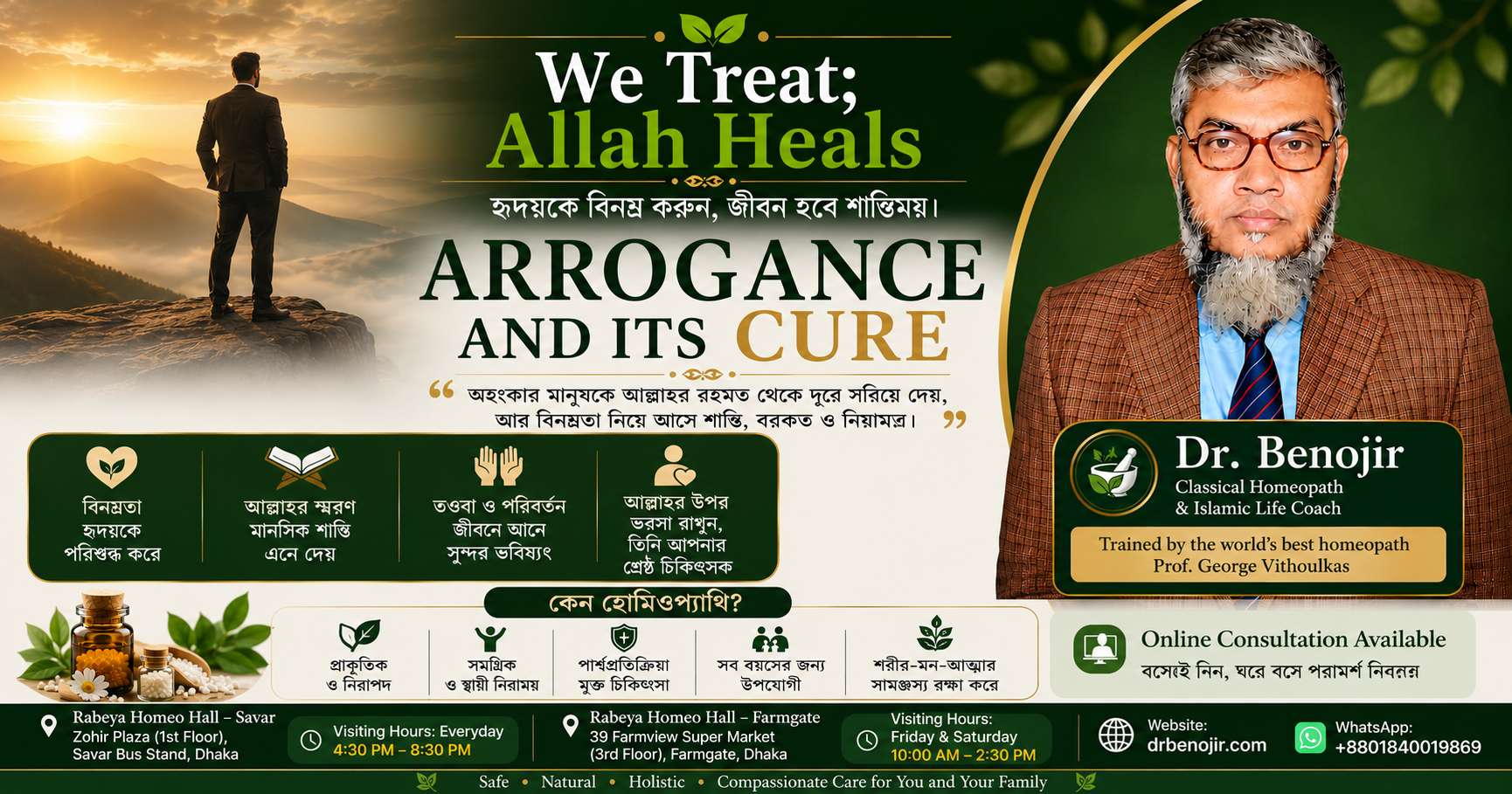
The Hidden Disease of the Heart (Arrogance) & its Healing
Understanding Arrogance (Kibr), Its Roots in the Human Psyche, and the Path to Lasting Humility
By Dr. Benojir Ahmed | Classical Homeopath & Islamic Life Coach
There is a disease that has no fever, no visible swelling, and no laboratory test that can detect it. It does not keep you awake at night with physical pain. And yet, according to Islamic tradition, it is one of the most destructive afflictions a human being can carry — because it attacks not the body, but the heart.
That disease is arrogance. In Arabic, it is called Kibr.
Human beings naturally seek recognition, pursue excellence, and desire a dignified place in society. These are not flaws. When grounded in gratitude and balanced by humility, they can drive extraordinarily good. But when self-worth curdles into superiority — when a person begins to view others as beneath them, refuse correction, or seek glory for its own sake — something spiritually dangerous has taken root.
This article explores what arrogance truly is, how psychology and Islamic scholarship both illuminate its origins, how it manifests in modern life, and what it genuinely takes to heal it — drawing on Qur'anic guidance, authentic Hadith, contemporary psychological research, and the lens of classical homeopathy.
Defining Kibr: What Does Islam Actually Say?
The Prophet Muhammad (peace be upon him) offered one of the most precise and psychologically astute definitions of arrogance found in any tradition. He said:
“Arrogance is rejecting the truth and looking down upon people.” — Sahih Muslim, 91
This definition is remarkable for its precision. It identifies two distinct expressions of arrogance: an epistemological one — the refusal to accept truth when it conflicts with the ego — and a social one — contempt for other human beings.
Rejecting the truth is perhaps the more insidious form. A person may receive sound advice, accurate correction, or important feedback — and dismiss it entirely, not because the evidence is lacking, but because accepting it would require acknowledging that they were wrong. This pattern is as recognizable in the boardroom and the family home as it is in the theological texts.
Looking down on others, the second element, can be rooted in wealth, education, profession, lineage, nationality, religious practice, or physical appearance. The object of comparison matters less than the underlying posture: the belief that one's blessings make one intrinsically more valuable as a human being.
The Prophet (peace be upon him) also said:
“No one who has an atom's weight of arrogance in his heart will enter Paradise.” — Sahih Muslim, 91
A companion asked: “But a man loves for his clothing to be beautiful and his shoes to be fine?” The Prophet replied: “Allah is beautiful and loves beauty. Arrogance is rejecting the truth and looking down upon people.” This is a crucial clarification: caring about appearance, seeking excellence, and taking pride in one's work are not arrogance. Kibr is specifically a posture of the heart toward truth and toward others.
The First Sin: The Story of Iblis
To understand why Islam treats arrogance with such gravity, we must understand its origin in the Qur'anic narrative.
When Allah created Adam (peace be upon him), He commanded the angels to prostrate before him as a sign of honor. All obeyed. All except Iblis.
“What prevented you from prostrating when I commanded you?” He said: “I am better than him. You created me from fire and created him from clay.” — Surah Al-A’raf (7:12)
This is the prototype of arrogance in the Islamic worldview. Iblis did not lack knowledge — he was among the most knowledgeable of creation. He did not deny Allah's existence. His catastrophic error was rooted in comparative superiority: he measured himself against another and concluded he ranked higher, and then — critically — he allowed that conclusion to override a direct divine command.
The lesson is sobering: arrogance does not require ignorance. It can coexist with intelligence, religious knowledge, and even sincere worship. What it cannot coexist with is submission — and submission is the very essence of Islam.
The Qur'an also presents the historical archetypes of Fir'awn, who declared “I am your highest lord” (Surah An-Nazi'at, 79:24) despite witnessing clear miracles; Qarun, who attributed his immense wealth entirely to his own skill (Surah Al-Qasas, 28:78); and the people of 'Ad, who boasted of their physical strength and civilizational achievement until they were destroyed (Surah Fussilat, 41:15). Each story follows the same arc: blessing leads to pride, pride leads to blindness, and blindness leads to ruin.
The Psychology of Pride: What Modern Research Tells Us
Contemporary psychology offers a complementary — and in many ways confirming — perspective on arrogance. Research distinguishes between two forms of pride that have very different psychological profiles.
Authentic pride arises from genuine effort and achievement. It is associated with conscientiousness, agreeableness, and psychological well-being. Hubristic pride — the kind that most closely maps to Kibr — is defined by an inflated global sense of superiority that is trait-like and relatively stable. Research by psychologist Jessica Tracy at the University of British Columbia has found that hubristic pride predicts narcissism, aggression, disagreeableness, and poor interpersonal relationships.
Importantly, arrogance and genuine self-confidence are not the same thing. A growing body of psychological research identifies what is known as the “arrogance-insecurity link”: many individuals who display arrogant behavior are not, at their core, secure in their self-worth. Rather, arrogance functions as a defensive structure — a way of pre-emptively avoiding the vulnerability of being seen as inadequate. This is precisely why arrogant individuals so often react with disproportionate anger or withdrawal when corrected or criticized: the correction threatens the very scaffolding of the self.
A 2021 study in the Journal of Personality found that individuals high in hubristic pride were significantly less likely to seek help when needed, less able to form trusting relationships, and more likely to experience loneliness and emotional dysregulation over time. The disease, it turns out, is self-defeating even by worldly standards.
How Arrogance Hides in Modern Life
In classical Islamic scholarship, arrogance was discussed primarily in its more visible forms: open contempt, public boasting, and outright refusal to submit to religious authority. These remain relevant today. But arrogance in the modern world has become more sophisticated — and harder to recognize.
Social media has created an entirely new arena for subtle pride. The curated presentation of achievements, the careful management of personal image, the craving for validation through likes and followers — these are new manifestations of an ancient disease. A person can spend their day in the remembrance of Allah and still spend their evening unconsciously measuring their worth against others on a screen.
Other modern expressions include: the professional who cannot receive feedback without becoming defensive; the educated person who subtly condescends to those with less formal learning; the religiously observant person who quietly judges others for their spiritual shortcomings; the parent who cannot acknowledge a child's valid point; the spouse who has not apologized in years because doing so would feel like defeat.
Perhaps the subtlest sign of arrogance is the inability to say three simple words sincerely: “I was wrong.” When that phrase becomes psychologically impossible, the ego has grown too large for the heart.
Mind | Body | Deen: Understanding the Roots of Pride
Mind — When Arrogance Is a Mask for Pain
Arrogance is not always — or even usually — born of genuine confidence. Clinical psychologists increasingly recognize it as a compensatory mechanism: a way of managing deep-seated feelings of inadequacy, shame, or fear of failure. The person who cannot tolerate being average may construct a persona of superiority as protection.
Common psychological underpinnings include perfectionism, hypersensitivity to criticism, a fragile sense of self-worth, unresolved childhood wounds, and a deep fear of being seen as ordinary or unworthy. Understanding this does not excuse arrogant behavior — but it does help explain why a purely moralistic approach to self-improvement often fails. If the arrogance is rooted in pain, addressing only the surface behavior leaves the wound untouched.
Body — The Physical Dimension of Emotional Patterns
Physical well-being has a direct bearing on patience, empathy, and emotional regulation — the very capacities that humility requires. Chronic sleep deprivation reduces prefrontal cortex activity, impairing impulse control and increasing emotional reactivity. Chronic stress elevates cortisol, which narrows cognitive flexibility and amplifies defensive responses to perceived threat. Poor nutrition and physical inactivity compound these effects.
A person who is chronically exhausted, undernourished, or in physical pain has genuinely diminished capacity for the kind of generous, other-centered attention that humility requires. This does not mean physical health determines character. But it does mean that caring for the body is part of the work of the heart.
Deen — The Spiritual Cure
Islam does not merely prohibit arrogance — it provides a comprehensive counter-architecture for the soul. The entire structure of Islamic worship is designed to cultivate the opposite of pride.
Salah, performed five times a day, places the forehead on the ground before the Creator. This is not incidental — it is a physical enactment of the truth that no human being, regardless of status or achievement, stands above the One who created them. The Prophet (peace be upon him) said:
“Whoever humbles himself for the sake of Allah, Allah will raise him.” — Sahih Muslim, 2588
Dhikr — the remembrance of Allah — continually reorients the heart toward its dependence on a power infinitely greater than itself. Zakat and charity require a person to acknowledge that their wealth is a trust, not a proof of superiority. Fasting strips away the markers of status and places the wealthy and the poor in the same physical condition before Allah.
Reflection on death — a practice the Prophet (peace be upon him) explicitly recommended — is perhaps the most effective antidote to arrogance. The grave does not distinguish between the rich and the poor, the powerful and the weak, the famous and the forgotten.
Allah says in the Qur'an:
“And do not turn your cheek in scorn toward people, and do not walk through the earth exultantly. Indeed, Allah does not like everyone self-deluded and boastful.” — Surah Luqman (31:18)
Lifestyle Modifications That Support Humility
Humility is not only a spiritual aspiration — it is a practice. And like all practices, it is supported or undermined by daily habits.
Guard Your Consumption of Social Media
Social media is perhaps the single greatest environmental driver of comparative pride and envy in modern life. Limiting exposure — particularly passive scrolling — reduces the number of opportunities for unconscious social comparison. Intentional use, such as sharing knowledge or maintaining relationships, is qualitatively different from competitive image management.
Cultivate Genuine Listening
Arrogance speaks; humility listens. A practical discipline is to enter conversations with the explicit intention of understanding rather than winning. This requires slowing down, tolerating the discomfort of not having the last word, and practicing what psychologists call “active listening” — attending fully to what the other person is saying rather than formulating a response while they are still speaking.
Seek and Accept Feedback
A powerful counter-practice to arrogance is actively inviting honest feedback — from a spouse, a trusted colleague, or a friend — and receiving it without defensiveness. This is uncomfortable. It is also profoundly effective at keeping the ego calibrated.
Sleep, Exercise, and Emotional Regulation
Prioritize adequate sleep (seven to nine hours for most adults), regular physical movement, and balanced nutrition. These are not peripheral to the work of character development — they are foundational. An emotionally depleted, sleep-deprived person is physiologically compromised in their capacity for empathy, patience, and perspective-taking.
Serve Others, Especially the Vulnerable
Voluntary service — whether within the family, the community, or a charitable context — is one of the most effective practical antidotes to pride. It is difficult to maintain a posture of superiority while washing dishes for others, caring for the sick, or sitting with the lonely. The Prophet (peace be upon him) set the example: despite his immense spiritual and worldly rank, he mended his own clothes, milked his own goats, and treated the most ordinary members of his community with full dignity and warmth.
Practice Gratitude Daily
Gratitude and arrogance cannot occupy the same heart simultaneously. A regular practice of acknowledging the sources of one's blessings — beginning with Allah, and extending to parents, teachers, community, and circumstance — fundamentally reframes achievement. Success becomes something received rather than something deserved.
Classical Homeopathy and Emotional Constitutional Types
Classical Homeopathy does not diagnose spiritual diseases, nor does it claim to treat arrogance as a condition. However, it does recognize that individuals differ in their constitutional emotional tendencies — including patterns of pride, insecurity, defensiveness, and hypersensitivity — and that these patterns respond to carefully individualized homeopathic treatment.
The goal of homeopathic constitutional treatment is not to change a person's character, but to restore emotional balance and reduce the intensity of patterns that cause suffering to the individual and those around them. The remedies listed below address constitutional emotional tendencies — not moral failings.
Lycopodium Clavatum
A leading remedy for hidden insecurity behind an authoritative exterior. The Lycopodium constitution often presents as confident and even domineering in social settings but is privately plagued by self-doubt and fear of failure. Sensitive to criticism; prefers to control situations rather than risk being found inadequate. Great intellectual capacity, often used defensively.
Platina (Platinum Metallicum)
Characterized by an exaggerated sense of superiority, often accompanied by emotional coldness and disdain toward others. The Platina patient tends to feel that others are beneath them in intelligence, taste, or status. Pride in physical appearance is often marked. Can present alongside a deep sense of isolation — the very superiority they project creates distance from genuine connection.
Sulphur
The constitutional type associated with intellectual pride and strong opinions. The Sulphur patient loves to discuss, debate, and defend their views at length. Often dismissive of conventional thinking, they can become argumentative when challenged. Generous and enthusiastic in many respects, but their self-centered tendency can alienate others. Frequently indicated when philosophical pride or spiritual self-satisfaction is prominent.
Veratrum Album
For individuals with grandiose self-importance and an intense need for recognition and admiration. The Veratrum constitution tends toward dramatic self-presentation, extravagant claims, and a craving for status. Can become manic when their sense of importance is threatened. One of the primary remedies in homeopathy when the presenting picture resembles narcissistic personality features.
Staphysagria
The remedy of wounded pride and suppressed indignation. The Staphysagria constitution often presents not as openly arrogant but as hypersensitive to any perceived slight or humiliation. Holds resentments silently; deeply affected by criticism or disrespect. Outbursts of anger may eventually follow prolonged suppression. Frequently indicated after experiences of humiliation, powerlessness, or injustice.
Nux Vomica
The driven, ambitious, type-A constitution. Impatient, competitive, and easily irritated when others do not meet their exacting standards. Often found in high-achieving professionals who struggle to delegate, apologise, or relax. Their irritability and perfectionism alienate those around them, though the Nux Vomica patient is often genuinely hard-working and effective.
Palladium Metallicum
A less commonly discussed but important constitutional type for arrogance: the person who craves public admiration and validation but feels deeply wounded when it is withheld. Frequently found in individuals whose identity is strongly tied to their professional status, social standing, or reputation. The remedy is particularly indicated when there is a marked fluctuation between elation (when praised) and collapse (when ignored).
As always, effective homeopathic prescribing requires a full case analysis by a qualified classical homeopath. The remedies above represent tendencies, not diagnoses, and self-prescribing for complex constitutional patterns is not recommended.
Common Questions
“Is having pride in my achievements a sin in Islam?”
No. The Prophet (peace be upon him) explicitly clarified this when asked. Caring about the quality of one's work, taking pleasure in genuine achievement, and presenting oneself well are not arrogance. Kibr is specifically defined as rejecting the truth and looking down upon others. The issue is the posture of the heart — not the achievement itself.
“How can I tell if I am arrogant if arrogance is hidden from itself?”
This is one of the most important questions in Islamic self-development. The scholars recommended three reflective tests: Do I feel uncomfortable when others are praised and I am not? Can I sincerely accept correction from someone younger, less educated, or of lower social status? Can I apologize genuinely and without resentment? Difficulty in any of these areas warrants honest self-examination.
“Can psychological therapy help with arrogance?”
Yes — particularly where arrogance is rooted in insecurity, trauma, or narcissistic personality patterns. Modalities such as schema therapy, compassion-focused therapy, and psychodynamic approaches can be effective in helping individuals understand and work through the deeper emotional structures that sustain arrogant behavior. Spiritual growth and psychological healing are not in competition — for many people, they reinforce each other.
The Model of Humility: Prophet Muhammad (Peace Be Upon Him)
No discussion of arrogance and humility in an Islamic context is complete without reflecting on the supreme example of the Prophet Muhammad (peace be upon him). He was, by any measure, the most significant human being in history: the final Messenger, statesman, teacher, husband, father, and judge. And yet the accounts of his behavior consistently describe a man of extraordinary ordinariness in his personal conduct.
He sat on the floor with the poor. He greeted children and adults alike with warmth and full attention. He repaired his own shoes and helped with household work. A'ishah (may Allah be pleased with her) reported that in his home, he was at the service of his family. He was the first to offer the greeting of peace. He listened without interrupting.
The Prophet (peace be upon him) said:
“Allah has revealed to me that you should humble yourselves, so that no one transgresses against or boasts to another.” — Sahih Muslim, 2865
His greatness did not diminish his humility. It deepened it. This is the mark of true spiritual maturity: the more a person genuinely knows and understands, the more aware they become of how much they do not know — and of how little any worldly distinction means in the presence of the One who created all things.
The Path to Healing
Arrogance is one of the most dangerous diseases of the heart precisely because it is self-concealing. The arrogant person rarely sees themselves as arrogant. They see themselves as honest, discerning, high-standards, realistic. The very cognitive distortion that arrogance produces — that one's own judgements are more reliable and one's own worth is greater — prevents the kind of clear-eyed self-examination that healing requires.
This is why the path to humility is not simply a matter of trying harder. It requires a multi-dimensional approach: spiritual practices that structurally reorient the heart toward its true place before Allah; psychological self-awareness that can identify and compassionately work with the insecurities that drive pride; relational practices that keep us accountable and grounded; and physical self-care that maintains the emotional capacity for generosity and openness.
The good news — and it is genuinely good news — is that humility is not a diminishment. It is a liberation. When a person no longer needs to protect a constructed image of superiority, they become free to learn, to connect, to admit mistakes, to grow, and to experience the deep dignity that comes from sincerity rather than performance.
May Allah purify our hearts from pride, self-deception, envy, and arrogance. May He grant us sincerity, gentleness, beautiful character, and closeness to Him. May He make us of those who hear the truth and follow it, regardless of who speaks it.
Ameen.
References
Tracy, J. L., & Robins, R. W. (2007). The psychological structure of pride: A tale of two facets. Journal of Personality and Social Psychology, 92(3), 506–525.
Tangney, J. P. (2002). Humility. In C. R. Snyder & S. J. Lopez (Eds.), Handbook of Positive Psychology (pp. 411–419). Oxford University Press.
Means, J. R., et al. (1990). Humility as a psychotherapeutic virtue: Therapist appreciation of the patient’s insight. Psychotherapy, 27(3), 369–375.
Exline, J. J., & Geyer, A. L. (2004). Perceptions of humility: A preliminary study. Self and Identity, 3(2), 95–114.
Twenge, J. M., & Campbell, W. K. (2009). The Narcissism Epidemic: Living in the Age of Entitlement. Free Press.
Al-Ghazali, A. H. (Trans. W. J. Skellie, 2010). The Book of Destructive Evils: Kitab Muhlakat (Book of the Ihya). Fons Vitae.
Ibn Qayyim al-Jawziyyah. (Trans. Umar Faruq Abd-Allah, 2003). The Purification of the Soul. Al-Firdous.
Luchies, L. B., et al. (2012). The doormat effect: When forgiving erodes self-respect and self-concept clarity. Journal of Personality and Social Psychology, 98(5), 734–749.
Sahih Muslim, Hadith 91 (Kitab al-Iman). Narrated by 'Abdullah ibn Mas'ud.
Sahih Muslim, Hadith 2588 (Kitab al-Birr). Narrated by Abu Hurayrah.
Dr. Benojir Ahmed
Classical Homeopath & Islamic Life Coach
Mind | Body | Deen
“We Treat; Allah Heals”