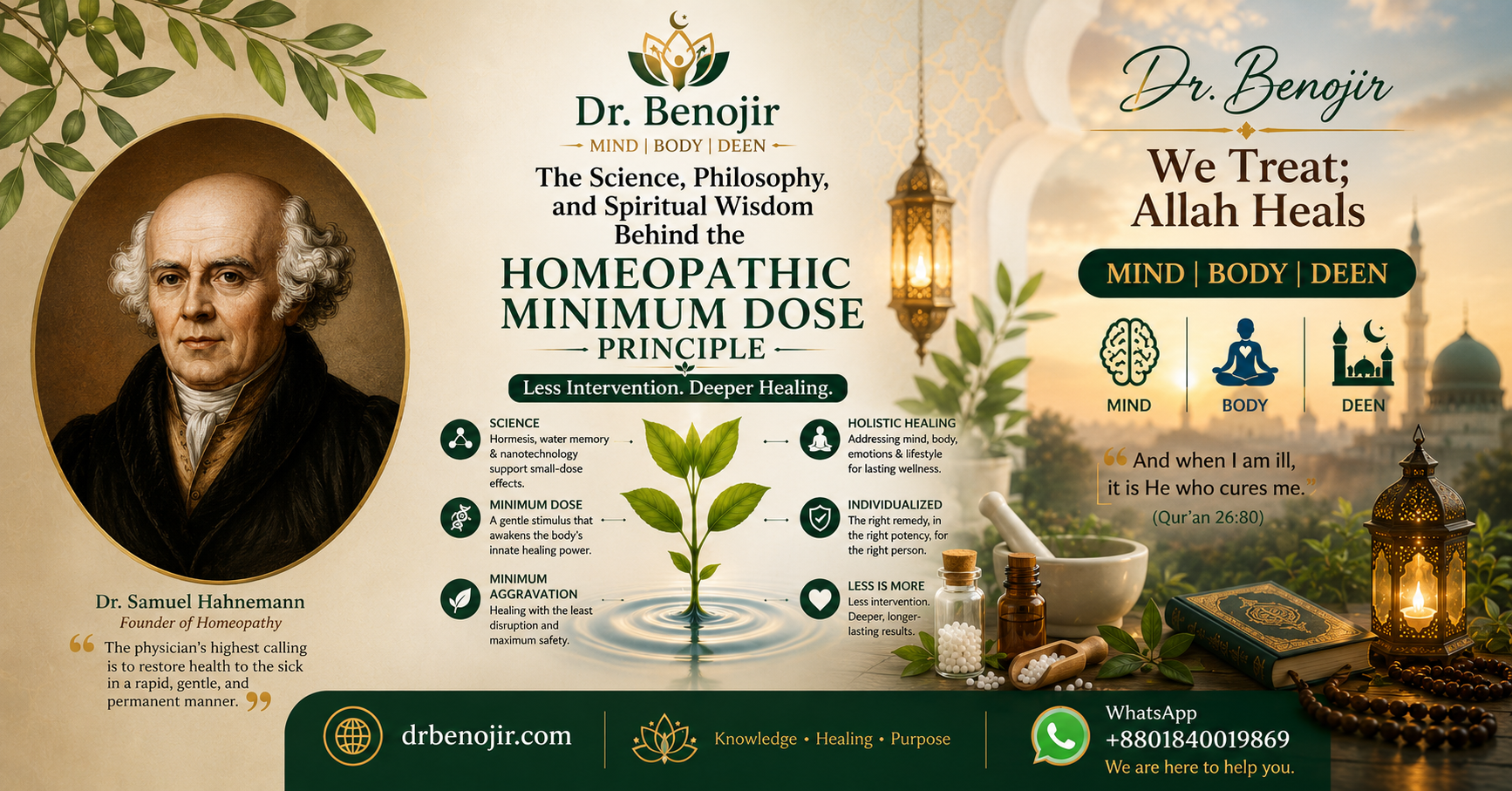
The Science, Philosophy, and Spiritual Wisdom Behind the Homeopathic Minimum Dose Principle
In an age of over-medication, side-effect-laden drugs, and complex treatment protocols, a quiet but profound principle stands apart: the minimum dose produces the maximum healing. This is not a fringe idea or a poetic metaphor — it is the foundational philosophy of classical homeopathy, a system of medicine that has been practiced for over two centuries and continues to attract both patients and researchers worldwide.
But what does the minimum dose actually mean? Why does less intervention sometimes produce deeper results than more? And what does Islamic wisdom have to say about restraint, sufficiency, and the body's innate capacity to heal?
This article explores the minimum dose principle from scientific, clinical, philosophical, and spiritual perspectives — in plain language that anyone can understand and benefit from.
What Is the Minimum Dose Principle?
The minimum dose is one of the core tenets of homeopathy, first articulated by Dr. Samuel Hahnemann (1755–1843), the German physician who founded the homeopathic system. Hahnemann observed something remarkable in his clinical practice: the smallest possible amount of a correctly chosen remedy could trigger the body’s own healing response — often more powerfully and safely than larger, cruder doses.
In homeopathy, remedies are prepared through a process called potentization — a systematic series of dilutions combined with vigorous succussion (shaking). The result is a preparation that contains the energetic or informational imprint of the original substance, rather than its chemical mass. The higher the potency, the more diluted the substance — and paradoxically, in homeopathic experience, often the more deeply it acts.
This stands in contrast to the conventional pharmacological model, which generally assumes that greater doses produce stronger effects. The homeopathic model inverts this assumption: the body does not need to be overwhelmed by a substance; it needs only to be gently stimulated toward its own innate capacity for self-correction.
“The physician’s highest calling is to restore health to the sick in a rapid, gentle, and permanent manner.” — Dr. Samuel Hahnemann, Organon of Medicine
The Science Behind Small Doses: What Research Suggests
Sceptics often ask: if a remedy is so diluted that no molecules of the original substance remain, how can it possibly work? This is a fair and important question. The honest answer is that the exact mechanism is still a subject of ongoing scientific investigation. However, several areas of research offer intriguing insights.
Hormesis: When Less Produces More
One of the most relevant scientific concepts is hormesis — a well-documented biological phenomenon in which low doses of a substance produce stimulatory or beneficial effects, while high doses of the same substance produce inhibitory or toxic effects. The hormetic dose-response curve has been observed across thousands of studies in pharmacology, toxicology, and biology.
For example, low-dose aspirin reduces blood clotting risk, while high doses can cause bleeding. Low-dose radiation has been studied for potential stimulatory immune effects, while high-dose radiation is clearly harmful. This principle of biphasic dose response — which has been published in journals such as Toxicological Sciences and Critical Reviews in Toxicology — lends a credible scientific framework to the idea that small signals can trigger significant biological responses.
The homeopathic minimum dose may be understood, at least in part, as an application of this same principle: providing the body with a precise, micro-signal that stimulates healing without overwhelming the system.
Water Memory and Nanoparticle Research
More recently, researchers including Nobel Prize laureate Professor Luc Montagnier have explored the possibility that water can retain and transmit molecular information — a concept sometimes called water memory. While this remains controversial and requires further rigorous investigation, it raises important questions about the informational properties of biological systems and the limits of our current measurement tools.
A 2010 study published in Langmuir (the journal of the American Chemical Society) by researchers at the Indian Institute of Technology found that homeopathic preparations, even at high dilutions, contained nanoparticles of the original substance — suggesting that potentization may produce physical changes in the solution beyond what simple dilution would predict.
These findings are preliminary and the field requires more high-quality research. However, they illustrate an important point: the absence of a fully understood mechanism does not mean an effect does not exist. Two hundred years ago, we had no understanding of how aspirin worked — yet it worked.
Why ‘Minimum Aggravation’ Matters in Healing
In classical homeopathy, an aggravation refers to a temporary intensification of existing symptoms that can sometimes occur after a well-chosen remedy. Hahnemann viewed a mild, brief aggravation as a positive sign — evidence that the remedy had found its target and the body’s vital force was responding.
However, a key advantage of the minimum dose is that when the potency and remedy selection are correct, aggravation is minimal — or absent altogether. The goal is not to shock the body into a reaction, but to guide it gently. This is why homeopathy is particularly valued for sensitive patients: infants and young children, pregnant women, the elderly, and those with multiple chronic conditions who may already be struggling with the side effects of conventional medications.
This principle resonates deeply with a broader truth: healing should not in itself cause harm. The ideal intervention does the most good with the least disruption — a standard that all therapeutic systems, conventional and complementary alike, should aspire to.
The Minimum Dose in Classical Homeopathic Practice
How does this principle actually translate into clinical practice? A classical homeopath applying the minimum dose principle will typically follow several specific disciplines.
Single Remedy Prescribing
Rather than prescribing multiple remedies simultaneously, the classical homeopath selects the single remedy that most closely matches the patient’s complete symptom picture — physical, mental, and emotional. This prevents the confusion of multiple simultaneous interventions and allows the practitioner to clearly observe the body’s response.
Appropriate Potency Selection
The choice of potency — how highly diluted the remedy is — is tailored to the patient. More sensitive individuals, or those with deeper constitutional issues, may require higher potencies. Acute conditions may call for lower potencies repeated more frequently. The art of potency selection is one of the most nuanced aspects of classical homeopathic training.
Watchful Waiting
After administering a remedy, the classical homeopath waits and observes. There is no immediate repetition — no adding of additional remedies while the body is still responding to the first. This patience is itself a clinical discipline. It honors the body’s own pace of healing and avoids the common mistake of confusing ‘more treatment’ with ‘better treatment.’
Avoiding Suppression
Suppression — the driving of symptoms inward rather than true resolution — is considered one of the most harmful outcomes in homeopathic thinking. A minimum dose applied with the correct remedy aims to resolve the underlying disturbance, not merely silence its outward expression. This is why two patients with the same diagnosed condition may receive entirely different remedies based on their individual symptom totality.
Patients treated with this approach often report not just relief of the presenting complaint, but broader improvements: better sleep, greater emotional stability, improved energy levels, and a general sense of wellbeing. This is the hallmark of deep, constitutional healing versus symptomatic suppression.
A Philosophy for Life: The Wisdom of ‘Less Is More’
The minimum dose is not only a clinical principle — it is a philosophy that extends well beyond the consulting room. In an era of excess — excess information, excess stimulation, excess consumption, excess medication — the wisdom of restraint and precision is more needed than ever.
Consider these parallels. A seed does not need an ocean to germinate — it needs precisely the right amount of water and warmth. An archer does not need the most powerful bow — they need the most accurate aim. A word spoken with sincerity and care heals more deeply than a thousand words spoken carelessly. In each case, the quality of the intervention, its precision and appropriateness, matters infinitely more than its quantity.
In medicine, the overuse of antibiotics has produced drug-resistant bacteria. The over-prescription of sedatives has created dependency crises. The over-treatment of early-stage conditions has sometimes caused more harm than watchful waiting. These are not failures of medicine itself — they are failures of the principle of proportionality. They are the consequence of ignoring the minimum dose lesson on a systemic scale.
The minimum dose philosophy invites us to ask, in medicine and in life: What is the smallest intervention that will produce the best outcome? What is sufficient? What is necessary? What can the body — or the situation — resolve on its own if given the right conditions and a gentle nudge in the right direction?
Where Homeopathy Fits in Modern Healthcare
It is important to be clear: the minimum dose principle and classical homeopathy are not positioned here as replacements for evidence-based conventional medicine. For acute infections, surgical emergencies, hormonal deficiencies, and many other conditions, modern medicine offers indispensable, life-saving interventions.
What classical homeopathy offers is a complementary approach — one particularly suited to chronic conditions, constitutional health, emotional wellbeing, and situations where conventional medicine has reached its limits or where patients wish to minimise their medication burden. The two systems can work together, with each contributing what it does best.
The future of healthcare is increasingly integrative — a recognition that no single system holds all the answers, and that the patient is best served by a practitioner who can draw thoughtfully from multiple traditions while remaining grounded in evidence, humility, and genuine concern for the person in front of them.
Mind | Body | Deen: The Spiritual Dimension of Restraint and Healing
Islam has always understood what modern science is only beginning to articulate: that the body is a trust, that excess is harmful, and that sufficiency — the precise and balanced — is the path of wisdom and health.
The Body as Amanah
The Prophet Muhammad (peace be upon him) taught us to care for the body as a trust from Allah. He said:
إنّ لجسدك عليك حقّاً
"Your body has a right over you."
— Sahih al-Bukhari, 1975
This hadith is a call to mindful stewardship of the physical self. Overloading the body with unnecessary substances — whether food, medication, or toxic habits — is a violation of this trust. The minimum dose principle echoes this teaching precisely: do not give the body more than it needs. Give it what is sufficient, precise, and purposeful.
The Sunnah of Moderation
The Prophet (peace be upon him) was described as never eating to excess, always stopping before fullness, sleeping with moderation, speaking with precision, and living with elegant simplicity. This way of life — al-wasatiyyah, the middle path — is not mere asceticism. It is a recognition that excess, in any form, disrupts balance, and that balance is the precondition for health.
Allah says in the Quran:
وكلوا واشربوا ولا تسرفوا
"Eat and drink, but do not be excessive. Indeed, He does not like those who are excessive."
— Surah Al-A'raf, 7:31
This verse is commonly applied to food and drink, but its wisdom extends to all forms of consumption, including medical intervention. The prohibition of excess is not a limitation — it is a gift. It points us toward sufficiency, which is where health, clarity, and gratitude reside.
Illness as Purification, Treatment as a Sunnah
Islam does not ask us to simply accept illness without seeking help. On the contrary, seeking treatment is a Sunnah — a recommended practice. The Prophet (peace be upon him) said:
تداووا عباد الله، فإنّ الله لم يضع داءً إلّا وضع له شفاءً
"Seek treatment, O servants of Allah, for Allah has not created a disease without creating a cure for it." — Sunan Abu Dawud, 3855
This hadith establishes a beautiful framework: disease and cure exist in balance, as part of divine design. The physician’s role is not to overpower nature but to discover and apply the precise remedy — the cure Allah has already placed in creation. The minimum dose practitioner is, in a sense, engaged in exactly this search: finding the most precise, least intrusive, most harmonious intervention for each individual patient.
The Mind: Healing the Inner World
Emotional and mental wellbeing are inseparable from physical health in Islamic teaching. The Prophet (peace be upon him) recognized that grief, worry, and emotional pain have physical consequences. Homeopathy shares this understanding — many classical remedies are prescribed based primarily on emotional states: grief after loss, anxiety from chronic stress, depression following illness. The minimum dose acts not just on the body but on the whole person.
Allah reminds us of the ultimate source of peace and healing:
ألا بِذِكْرِ اللّهِ تَطْمَئِنُّ الْقُلُوبُ
"Verily, in the remembrance of Allah do hearts find rest." — Surah Ar-Ra'd, 13:28
The healer who tends to the body while neglecting the heart is only doing half the work. True healing — the kind that lasts — addresses the person in their entirety: mind, body, and soul.
Conclusion: The Most Powerful Medicine Is Precise, Not Excessive
The minimum dose principle is one of homeopathy’s greatest gifts to medicine and to human thinking. It teaches us that healing is not about overpowering the body — it is about informing, guiding, and stimulating the body’s own extraordinary capacity to restore itself. It teaches restraint in an age of excess, precision in an age of overload, and patience in an age of instant results.
Whether you are a patient curious about complementary medicine, a healthcare professional exploring integrative approaches, or a person simply seeking to live and heal more wisely — this principle has something to offer you. Give the body what it needs. No more, no less. Trust the process. Seek the right guidance. And remember that the One who created the disease has already created its cure.
References & Further Reading
1. Hahnemann S. Organon of Medicine. 6th ed. New Delhi: B. Jain Publishers; 2002.
2. Calabrese EJ, Baldwin LA. Hormesis: the dose-response revolution. Annual Review of Pharmacology and Toxicology. 2003;43:175–197.
3. Chikramane PS, Suresh AK, Bellare JR, Kane SG. Extreme homeopathic dilutions retain starting materials: a nanoparticulate perspective. Langmuir. 2010;26(21):17175–17182.
4. Montagnier L, et al. Electromagnetic signals are produced by aqueous nanostructures derived from bacterial DNA sequences. Interdisciplinary Sciences: Computational Life Sciences. 2009;1(2):81–90.
5. Bell IR, Schwartz GE. Adaptive network nanomedicine: an integrated model for homeopathic medicine. Frontiers in Bioscience. 2013;5:685–708.
6. Sahih al-Bukhari, Hadith 1975 — On the rights of the body.
7. Sunan Abu Dawud, Hadith 3855 — On seeking medical treatment.
8. Holy Quran, Surah Al-A’raf (7:31) — On moderation.
9. Holy Quran, Surah Ar-Ra’d (13:28) — On tranquillity through remembrance of Allah.
10. Boericke W. Pocket Manual of Homeopathic Materia Medica. 9th ed. New Delhi: B. Jain Publishers; 2002.
Dr. Benojir
Classical Homeopath & Islamic Life Coach
Mind | Body | Deen
“We Treat; Allah Heals”