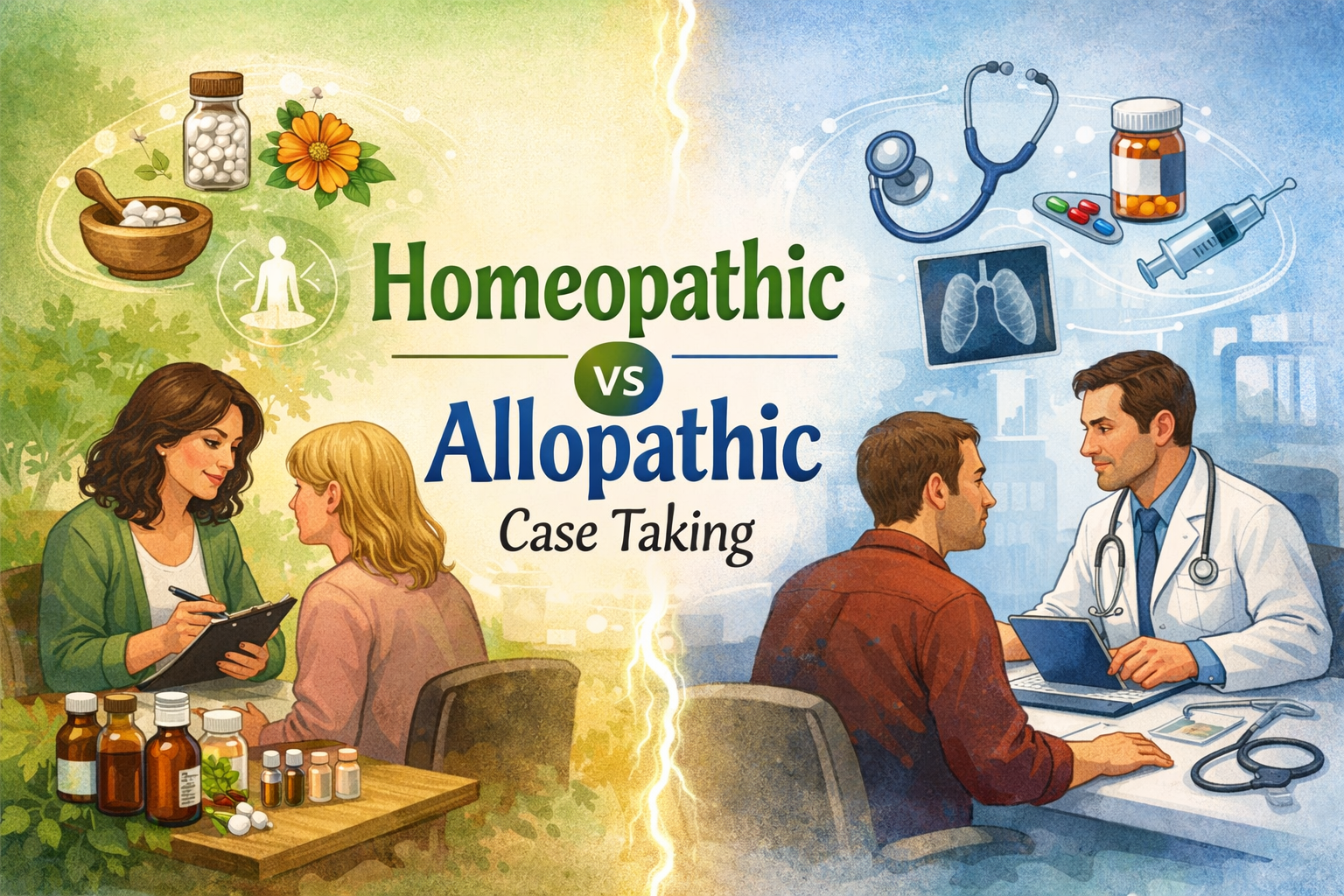
Understanding the Profound Difference Between Homeopathic and Conventional Case Taking — and Why Being Truly Listened to May Be the Most Powerful Medicine of All
"Doctor, everyone asks about my reports. Nobody asks about how I feel."
This sentence, spoken quietly in clinic rooms across the world, carries one of the most important truths in medicine. Healing does not begin with a prescription. It begins the moment a patient feels genuinely heard — understood as a whole human being, not simply catalogued as a diagnosis.
Case taking — the structured, compassionate process of gathering a patient's full health story — is the foundation upon which every effective treatment is built. Whether a clinician works within conventional medicine or classical homeopathy, the quality of the case taken will determine the quality of the cure. This article explores why case taking matters so profoundly, how it differs between the two traditions, and what patients can do to support the process.
What Is Case Taking — And Why Does It Matter?
In medicine, case taking refers to the systematic collection of a patient's medical history, symptoms, lifestyle, emotional state, and personal background. It is the conversation that precedes diagnosis and treatment — and in both conventional and homeopathic practice, it is considered foundational to clinical excellence.
Research confirms that the quality of the clinical consultation directly affects health outcomes. A landmark study published in the British Medical Journal (2002) found that patients who felt their doctors listened to them were significantly more likely to adhere to treatment, report better outcomes, and experience lower anxiety about their condition. The act of being heard is not merely comforting — it is clinically meaningful.
Yet in many healthcare settings, time pressure has shrunk the consultation window. A 2017 global study published in the Journal of General Internal Medicine found that the average time before a doctor interrupted a patient's opening statement was just 11 seconds. In chronic illness especially, this is insufficient to capture the full picture of a person's suffering.
Conventional Case Taking: Strengths and Limitations
Modern medicine has developed a rigorous, structured approach to clinical history taking. The standard framework includes the presenting complaint, history of current illness, past medical and surgical history, drug history, family history, and a systematic review of body systems. This is an excellent tool — particularly for identifying acute, life-threatening, or organ-specific disease that requires urgent investigation and intervention.
Conventional case taking is precise, efficient, and well-suited to objective measurement. Blood tests, imaging, and physical examination findings give it diagnostic power that should not be underestimated.
Its relative limitation, however, lies in the domain of chronic, functional, stress-related, and emotionally intertwined conditions — where the numbers may be broadly normal, yet the patient continues to suffer. In these cases, the individual experience of illness — what it feels like to be this particular person with this particular problem — can hold more diagnostic value than any scan.
Homeopathic Case Taking: A Deeper Conversation
Classical homeopathic case taking, rooted in the work of Samuel Hahnemann and developed over two centuries of clinical practice, takes a fundamentally different approach. Rather than cataloguing symptoms by body system, it seeks to understand the totality of the individual — their physical complaints, mental and emotional patterns, sleep, appetite, thermal preferences, reactions to weather, fears, dreams, relationships, and life history.
The core distinction in homeopathy is between signs and symptoms. Signs are what the doctor can observe and measure. Symptoms are what the patient experiences — and it is the patient's unique, subjective experience of illness that guides the homeopathic prescription.
Two patients may present with the same diagnosis — say, recurring migraine — yet require entirely different remedies. One becomes intensely irritable and cannot bear light or noise. The other withdraws quietly, weeps without knowing why, and is soothed by gentle company. Homeopathy treats the person experiencing the migraine, not the migraine as an abstract category. This is the principle of individualisation, and it begins with case taking.
Hahnemann's Disease Classification — A Framework Often Overlooked
One of the most practically important aspects of homeopathic case taking is understanding the type of disease being treated. Hahnemann categorised illness not simply as "short-term" or "long-term" but according to how the vital force — the body's inherent self-healing intelligence — is disturbed.
Acute Disease
Acute diseases have a sudden onset, a rapid evolution of symptoms, and are typically self-limiting — the body will either recover or deteriorate within a defined period. In acute case taking, only the recent deviations from the person's normal baseline are relevant. For example: if a person is ordinarily thirstless, but develops a strong thirst during fever, only this new change matters — not the person's general lifelong tendencies.
Acute case taking requires fewer questions, faster assessment, and a narrower symptom focus. Moving too deeply into constitutional territory during an acute illness leads to confusion and incorrect prescribing.
Chronic Disease
Chronic diseases develop gradually — across months or years — and reflect a deeper disturbance in the individual's constitution. Chronic case taking is therefore longitudinal, patient, and comprehensive. The physician must enquire into the full arc of the illness, emotional and mental patterns, family history, significant life events, lifestyle habits, and recurring physical tendencies.
This depth is not optional — it is the diagnostic backbone of a well-indicated constitutional remedy. Rushing chronic case taking produces a shallow symptom picture that yields shallow, temporary results.
Acute on Chronic — Where Most Confusion Occurs
A critical clinical distinction — and the site of most prescribing errors — is the category of acute recurrent illness. Conditions such as asthma attacks, seasonal allergies, recurring migraines, menstrual colic, and recurrent respiratory infections appear acute, yet are in fact repeated expressions of one underlying chronic disorder.
During the acute phase, treatment addresses only the acute symptoms. Once the acute episode resolves, constitutional treatment is resumed during the symptom-free interval. Blending these two stages — as frequently happens when a single case format is used for all conditions — produces mixed totalities, unnecessary aggravations, and ultimately, frustrated patients and practitioners.
When Case Taking Is Incomplete: The Silent Cost
The consequences of superficial or incomplete case taking are rarely dramatic — but they are cumulative and demoralising. Symptoms may reduce temporarily, only to return in the same or a different form. Chronic illness continues beneath the surface. The patient loses trust. The practitioner loses confidence. And an entire healing relationship is undermined — not by failure of medicine, but by failure of method.
In my clinical experience, when homeopathic treatment appears to fail, the cause is rarely a flaw in the system. The most common reasons are incomplete case taking, incorrect disease classification, failure to track symptom evolution, and consultations that were too brief to capture the individual picture. The principles remain sound; it is the application that requires refinement.
This is not unique to homeopathy. The rise of "diagnosis shopping" — patients moving from doctor to doctor seeking answers — is largely a symptom of consultations in which people did not feel adequately heard. A 2019 survey published in Patient Experience Journal found that 62% of patients who sought second or third opinions did so primarily because they felt their concerns had not been taken seriously, not because they doubted the initial diagnosis.
Classical Homeopathy and the Art of Individualised Healing
To illustrate how case taking directly shapes the prescription, consider the following remedies — each suitable for chronic, stress-related, or emotionally complex presentations, and each selected only through careful, individualised case taking:
• Natrum Muriaticum — Chronic illness rooted in suppressed grief, emotional self-containment, and a history of long-term stress. Strong salt craving, dryness, and a characteristic tendency to withdraw when hurt.
• Lycopodium Clavatum — Chronic digestive and liver complaints with underlying performance anxiety, a strong need for control, and symptoms worsening between 4 and 8 pm. Often prescribed in intellectually active individuals who appear confident externally but experience deep insecurity.
• Nux Vomica — The remedy of chronic overload: excessive caffeine, late nights, sedentary professional work, and emotional irritability. Digestive dysfunction, sleep disturbance, and hypersensitivity to external stimuli are hallmarks.
• Ignatia Amara — Acute or chronic grief, emotional shock, and the physical illness that follows profound loss or disappointment. Characterised by contradictory symptoms, sighing, and emotional lability.
• Sepia Officinalis — Chronic fatigue, hormonal imbalance, and emotional detachment — particularly in women carrying heavy domestic and professional burdens. Paradoxically improved by vigorous physical activity.
• Phosphorus — Highly sensitive, empathetic individuals with a tendency toward anxiety, bleeding tendencies, burning sensations, and a profound need for reassurance and connection.
• Pulsatilla Nigricans — Shifting, changeable complaints with emotional dependence, intolerance to fatty food, and a constitutional type that craves reassurance and is strongly improved by open air and gentle movement.
• Arsenicum Album — Chronic anxiety, perfectionism, restlessness after midnight, and a deep fear of illness and death. Acute presentations include burning pains relieved by warmth.
• Sulphur — The philosophical, intellectually inclined constitutional type prone to skin conditions, burning sensations, and metabolic sluggishness. Often indicated where previous treatments have suppressed symptoms without resolution.
• Staphysagria — Chronic illness arising from suppressed anger, humiliation, or violation of personal dignity. Indicated where emotional suppression has translated into recurring physical symptoms — urinary complaints, skin issues, or post-surgical grief.
Each of these remedies can only be identified through a case taking process that goes beyond symptom checklists and into the patient's lived experience. This is the irreplaceable art at the heart of classical homeopathy.
Lifestyle Modification: What Patients Can Actively Do
Case taking is a collaborative process. The quality of information a patient brings to the consultation directly determines the quality of the prescription. Beyond the consultation room, certain lifestyle habits significantly improve both the accuracy of case taking and the effectiveness of any treatment.
Observe and Record Your Symptoms
Keep a brief symptom diary for one to two weeks before your consultation. Note when symptoms appear, what makes them better or worse, how they affect your mood, sleep, and energy, and whether they have any pattern across the day, week, or menstrual cycle. This kind of self-observation is genuinely valuable — in homeopathy, the modalities (the conditions that modify a symptom) are often the key to the correct remedy.
Sleep and Rest
Chronic sleep deprivation suppresses the immune system, exacerbates mental health conditions, and makes both the experience and the reporting of illness less accurate. Aim for 7 to 8 hours of consistent, good-quality sleep. The body's deepest repair work — physical and neurological — occurs during the late-night hours of undisturbed sleep.
Dietary Awareness
Note your food cravings, aversions, and sensitivities — these are diagnostically meaningful in homeopathy and often overlooked in the general medical history. Beyond homeopathic case taking, a whole-food, low-processed diet reduces systemic inflammation and provides the biological environment in which healing is most effective.
Stress Reduction
Chronic stress is both a cause and a complicating factor in most chronic illness. Simple daily practices — diaphragmatic breathing, nature walks, journaling, regular prayer and remembrance — reduce cortisol levels, improve immune function, and make the body more responsive to treatment. Evidence from the journal Psychoneuroendocrinology (2013) confirms that mindfulness-based practices produce measurable reductions in inflammatory biomarkers within eight weeks.
Honest Communication
The most important thing a patient can do in any consultation — homeopathic or conventional — is to speak honestly. Do not minimise your emotional symptoms. Do not omit experiences that feel embarrassing or unrelated. The symptoms you consider unimportant are often the ones that point most precisely to the correct remedy or the root cause of your illness.
Mind | Body | Deen — The Integrated Perspective on Illness and Healing
The Mind
The mind is not separate from the body — it is the body's most influential regulator. Research in psychoneuroimmunology over the past three decades has confirmed what traditional medicine has long recognised: chronic emotional states — sustained anxiety, unresolved grief, suppressed anger, loneliness — alter immune function, hormonal balance, and susceptibility to disease. Case taking that ignores the mental and emotional dimension is, by definition, incomplete.
Homeopathic case taking places the mental and emotional level at the top of its hierarchy of symptoms. This is not mysticism — it is recognition that mind and body speak one language, and that chronic illness is often the body's way of expressing what the mind has not been permitted to say.
The Body
The body has a remarkable intelligence — what homeopathy calls the vital force, what physiology describes as homeostasis, and what Islamic medicine recognises as the natural disposition (fitrah) toward health. Given the right conditions — accurate medicine, appropriate nutrition, adequate rest, and removal of the obstacles to recovery — the body moves toward healing with a persistence that should inspire confidence rather than despair.
No treatment, however correct, can override a lifestyle that continuously undermines recovery. This is why lifestyle modification and case taking must walk together.
The Deen — Spiritual Dimension
Islam teaches that the human being is not a body that happens to have a soul — but a soul that has been given a body as a trust. This perspective transforms the entire relationship between patient, physician, and the healing process.
The Prophet Muhammad (peace be upon him) said:
"Verily, your body has a right over you." (Sahih al-Bukhari, 1975)
This hadith establishes the body's claims upon us — the obligation to care for it, to seek treatment when ill, and to pursue healing with intention and gratitude. The act of attending a consultation and engaging honestly in case taking is itself a form of ibadah (worship) when undertaken with sincere intention.
The Quran reminds us of the Divine dimension of healing:
"And when I am sick, it is He who cures me." (Surah Ash-Shu'ara, 26:80)
This verse, attributed to the Prophet Ibrahim (peace be upon him), does not discourage medicine — it contextualises it. We seek, we treat, we adopt every means within our reach; and we recognise that ultimate healing belongs to Allah alone. This is the model of tawakkul (reliance on Allah) combined with asbab (the adoption of means) — a balance that Islamic scholars have articulated for centuries and that produces a unique quality of trust and patience in the healing journey.
The Prophet (peace be upon him) also said:
"Make use of medical treatment, for Allah has not made a disease without appointing a remedy for it." (Sunan Abu Dawud, 3855)
In this light, the consultation room becomes more than a clinical encounter. When a physician listens deeply and a patient speaks truthfully, something sacred occurs — a meeting of trust, intention, and the search for balance that Islam places at the centre of all human endeavour.
Chronic illness is frequently accompanied by a quiet spiritual unrest — a sense of disconnection, purposelessness, or loss of meaning. Islamic practice — regular prayer (salah), supplication (du'a), gratitude (shukr), fasting, and community — addresses this dimension directly. These are not alternative therapies; they are integral to the holistic healing that mind, body, and deen together make possible.
Common Questions Patients Ask
"Why does my homeopath ask about my dreams and fears — what does that have to do with my illness?"
In classical homeopathy, mental and emotional symptoms are diagnostically significant — often more so than physical symptoms alone. Dreams, fears, and emotional patterns reveal the constitutional type, which guides the selection of the most precisely indicated remedy. These questions are not curiosities; they are clinical tools.
"My condition keeps returning despite treatment. Is something wrong with me?"
Recurring illness is rarely a sign of a weak body. It is most often a signal that the underlying imbalance has not yet been fully addressed — and that the case taking may need to go deeper, or that the disease has been classified incorrectly (for example, treating an acute episode of a chronic condition without subsequently returning to constitutional treatment). It is an invitation to look further, not a reason to lose hope.
"How is homeopathic case taking different from what my GP does?"
Both approaches take a medical history — but the scope and focus differ. Conventional case taking prioritises objective findings, test results, and body-system review. Homeopathic case taking places equal or greater emphasis on subjective experience, emotional and mental patterns, and the individual's unique response to illness. They are complementary rather than competing lenses on the same patient.
"Can I use homeopathy alongside my current medication?"
Classical homeopathy uses highly diluted remedies that do not interact pharmacologically with conventional drugs. It is safe to use alongside conventional treatment. Always inform both your GP and your homeopath about all treatments you are receiving so that each can support the other's work.
Being Understood Is the Beginning of Being Healed
There is a quiet but profound difference between being treated and being understood. Treatment addresses the symptom. Understanding addresses the person who is experiencing it.
When case taking is done with skill, patience, and genuine curiosity, something shifts in the patient before a single remedy is administered. Clarity replaces confusion. Trust replaces anxiety. The healing process begins not in the prescription but in the conversation — and in the experience of being seen, fully, as a human being rather than a set of test results.
Whether you are seeking treatment for the first time, or returning after years of unsatisfying consultations elsewhere, know this: your experience of illness matters. The nuances of how you suffer, when, under what circumstances, and what brings you relief — these are not irrelevant details. They are the map. And in the hands of a careful clinician, they are the path to lasting healing.
References
1. Stewart M et al. (2002). The impact of patient-centred care on patient outcomes. BMJ, 326(7381).
2. Ospina NS et al. (2017). Eliciting the patient's agenda — secondary analysis of recorded clinical encounters. Journal of General Internal Medicine, 34(1).
3. Hahnemann S. Organon of Medicine, 6th Edition. Translated by W. Boericke.
4. Materia Medica — Kent JT. Lectures on Homoeopathic Materia Medica. (1904).
5. Epel ES et al. (2013). Meditation and vacation effects on disease-associated molecular phenotypes. Psychoneuroendocrinology, 38(3).
6. Patient Experience Journal (2019). Why patients seek second opinions: a survey-based analysis. Vol. 6, Issue 1.
7. Sahih al-Bukhari, Hadith 1975 — The right of the body.
8. Sunan Abu Dawud, Hadith 3855 — Seek medical treatment.
9. Surah Ash-Shu'ara (26:80), The Holy Quran.
Dr. Benojir
Classical Homeopath & Islamic Life Coach
Mind | Body | Deen
“We Treat; Allah Heals”