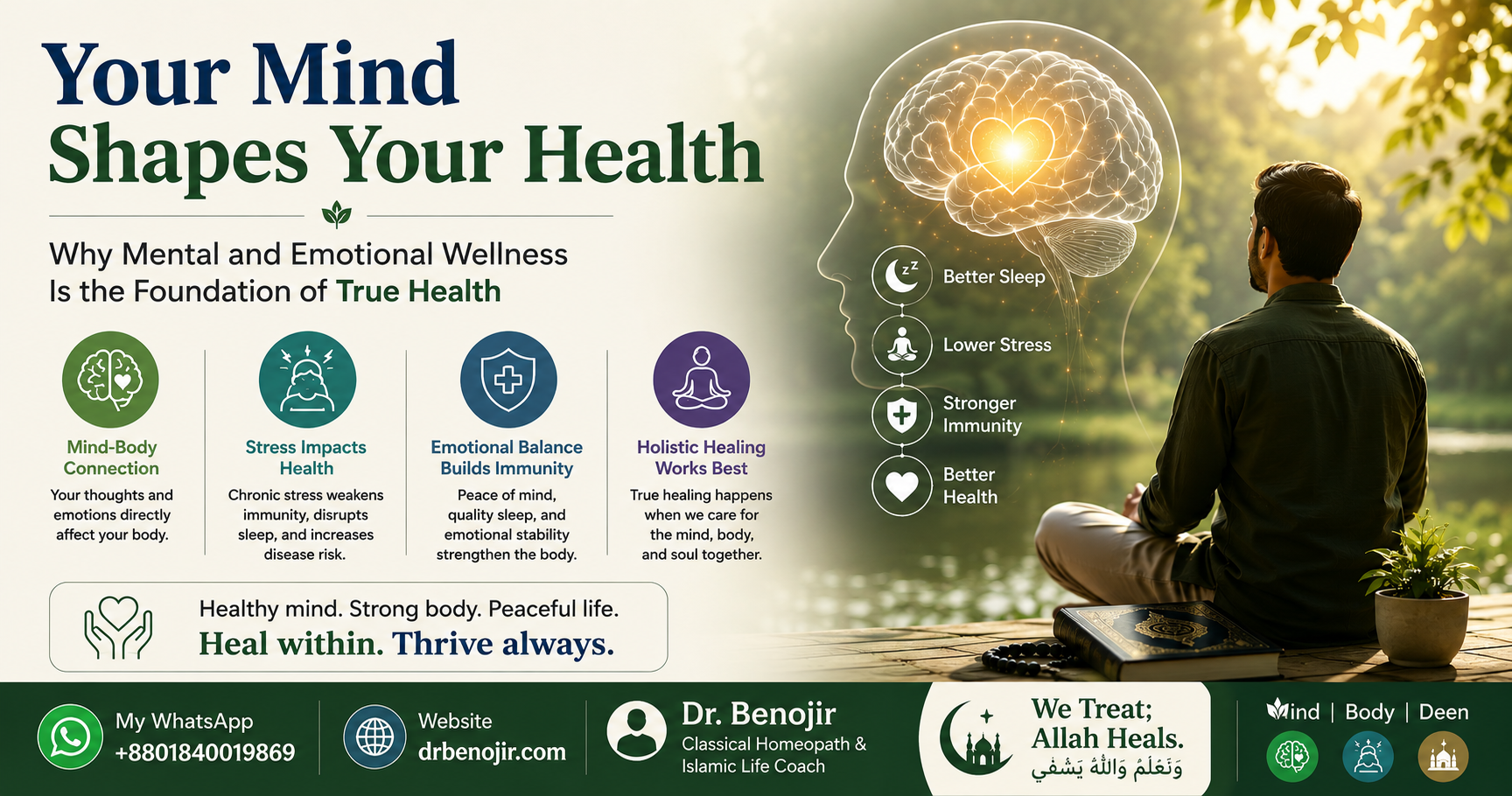
Why Mental and Emotional Wellness Is the Foundation of True Health
By Dr. Benojir | Classical Homeopath & Islamic Life Coach
When most people think about health, they think about the body — blood tests, diet plans, and medications. Yet research increasingly confirms what holistic practitioners have long understood: the mind is not separate from the body. Mental and emotional health are not secondary concerns to be addressed only when physical treatments fail. They are, in fact, the foundation upon which physical wellness either stands or crumbles. Understanding this connection is one of the most powerful steps anyone can take toward living a healthier, more balanced life.
The Mind-Body Connection: What Modern Science Confirms
The field of psychoneuroimmunology — the study of how psychological factors influence the nervous system and immune response — has produced compelling evidence over the past two decades. Chronic stress triggers the release of cortisol and adrenaline, hormones that, when elevated over long periods, suppress immune function, disrupt sleep cycles, impair digestion, and raise blood pressure. The World Health Organization (WHO) now recognizes that mental health is an integral component of overall health, defining health as "a state of complete physical, mental and social well-being."
A landmark 2023 study published in JAMA Psychiatry found that individuals with untreated anxiety disorders were significantly more likely to develop cardiovascular disease within a ten-year period. Similarly, research from Harvard Medical School has linked depression to a measurably weakened immune response, slower wound healing, and increased inflammation — a driving factor behind conditions ranging from arthritis to type 2 diabetes. These are not coincidences. They are biological cause and effect.
How Emotional Distress Becomes Physical Disease
Emotional distress does not stay neatly confined to the mind. It follows a predictable pathway into the body, often in stages that are easy to overlook until symptoms become severe.
In the early stage, unresolved mental stress — whether from grief, fear, financial pressure, relationship conflict, or workplace burnout — activates the body's stress response system. The hypothalamic-pituitary-adrenal (HPA) axis becomes overactive, flooding the body with stress hormones. Sleep becomes disrupted. Appetite changes. Energy drops.
As this continues, the body begins showing tangible signs of imbalance. Headaches become frequent. Digestion falters, often manifesting as irritable bowel syndrome (IBS). Skin conditions such as eczema or psoriasis flare up. Fatigue becomes chronic. At this stage, many people visit their doctor for physical complaints without ever connecting these symptoms to their emotional state.
Left unaddressed, the progression continues to more serious disease. Hypertension develops. Migraines intensify. The immune system — worn down by constant cortisol exposure — loses its ability to defend effectively, making the individual more susceptible to infections and inflammatory conditions. This is why treating only the physical symptom, while ignoring the mental root, so often yields disappointing long-term results.
Common Conditions with Deep Emotional Roots
A growing body of clinical evidence connects specific emotional patterns to particular health conditions. Among the most well-documented are:
• Anxiety disorders — affecting over 284 million people globally, are now a leading cause of workplace absenteeism and are strongly associated with gastrointestinal disorders, chest pain, and chronic muscle tension.
• Insomnia — which affects roughly one-third of adults worldwide, is both caused by and a cause of mental health decline. Poor sleep quality accelerates cognitive aging, increases emotional reactivity, and weakens immune defenses.
• IBS and functional digestive disorders — are now understood to be closely tied to the gut-brain axis — the bidirectional communication network between the central nervous system and the enteric nervous system in the gut. Anxiety and depression are present in up to 60% of IBS patients.
• Hypertension (high blood pressure) — has a well-established link to chronic stress and suppressed anger. Studies consistently show that emotional regulation strategies — including mindfulness and therapy — produce measurable reductions in blood pressure.
• Chronic fatigue and burnout — are increasingly recognized by clinicians as conditions rooted in psychological exhaustion, not simply physical overexertion. They are more prevalent in individuals who experience prolonged emotional suppression or a lack of autonomy in their personal or professional lives.
• Skin conditions such as eczema, psoriasis, and acne — have long been known to worsen under psychological stress. The skin has its own stress-response system that reacts to emotional triggers, producing inflammation and disrupting the skin barrier.
Addressing Mental and Emotional Health: A Holistic Approach
Genuine wellness requires attending to the mind as attentively as the body. This does not necessarily mean years of psychotherapy, though that can be profoundly valuable for many people. It means developing daily habits and practices that support emotional regulation, mental clarity, and psychological resilience.
Consistent, restorative sleep is one of the most powerful and underestimated interventions available. Research from the National Sleep Foundation confirms that adults who sleep seven to nine hours nightly show markedly lower cortisol levels, better emotional regulation, and stronger immune function than those who are chronically sleep-deprived.
Regular physical movement is equally essential. A 2024 meta-analysis in The Lancet Psychiatry reviewed data from over 1.2 million participants and found that individuals who engaged in regular exercise reported 43% fewer days of poor mental health per month compared to those who were sedentary. Exercise does not need to be intense — brisk walking for thirty minutes, five times a week, produces clinically meaningful improvements in anxiety and depression.
Mindfulness and contemplative practices — including meditation, prayer, and structured breathing exercises — have been shown in numerous randomized controlled trials to reduce cortisol, lower inflammatory markers, and improve both mood and cognitive function. For individuals of faith, spiritual practice provides an additional layer of psychological grounding that research consistently associates with greater emotional resilience and life satisfaction.
Expressing rather than suppressing emotion is another critical factor. A 2022 study published in Frontiers in Psychology found that individuals who habitually suppressed their emotions showed significantly higher levels of inflammatory biomarkers than those who expressed and processed their feelings in healthy ways. Talking to a trusted friend, journaling, or working with a counsellor can all serve this function.
Nutrition, too, plays a significant role in mental health. The gut microbiome — the complex ecosystem of bacteria residing in the digestive tract — produces approximately 95% of the body's serotonin, a neurotransmitter central to mood regulation. Diets rich in fiber, fermented foods, omega-3 fatty acids, and diverse plant matter support a healthy microbiome and, by extension, a more stable emotional state. Ultra-processed foods, sugar, and alcohol, conversely, have been linked to increased risk of depression and anxiety.
The Role of Classical Homeopathy in Whole-Person Wellness
Classical homeopathy is one of several integrative health approaches that explicitly treats the whole person — mind, emotion, and body — rather than isolating physical symptoms. In a classical homeopathic assessment, the practitioner seeks to understand not only the patient's physical complaints but also their emotional patterns, mental state, sensitivity, and life circumstances. This comprehensive picture allows for a remedy selection that addresses the root disturbance rather than merely managing surface-level symptoms.
For example, a patient presenting with IBS might receive a remedy chosen not simply for digestive distress, but for the underlying anxiety, the tendency to overthink, and the physical constitution that together characterize that individual's experience. This is a fundamentally different paradigm from symptom suppression — one that recognizes the inseparable relationship between inner life and outer health.
When integrated with appropriate lifestyle changes — sleep hygiene, movement, emotional expression, mindful eating, and meaningful social connection — this whole-person approach creates the conditions in which lasting wellness becomes genuinely possible.
Recognizing the Warning Signs: When to Seek Help
It is important to recognize when mental and emotional distress has reached a point where professional support is needed. Warning signs that merit attention include:
• Persistent low mood, hopelessness, or loss of interest in activities previously enjoyed
• Anxiety that feels uncontrollable or interferes with daily functioning
• Sleep disturbance lasting more than a few weeks
• Physical symptoms with no clear medical explanation
• Emotional numbness, detachment, or difficulty connecting with others
• Increased use of alcohol, substances, or other avoidance behaviors
Seeking help — whether from a qualified homeopath, counsellor, psychologist, or general practitioner — is not a sign of weakness. It is an act of wisdom and self-care. No one would hesitate to consult a doctor for a broken bone; the same urgency and openness should apply to the health of the mind.
Conclusion: True Wellness Begins Within
Mental and emotional health are not luxuries or afterthoughts. They are the bedrock of physical wellness, productive relationships, and a meaningful life. Every system in the human body is influenced by psychological state — the cardiovascular system, the immune system, the digestive system, the endocrine system, and more. To neglect the mind is, ultimately, to neglect the body.
The encouraging truth is that the mind is also where change begins. By cultivating emotional awareness, prioritizing mental wellness, seeking appropriate support, and making consistent lifestyle choices that nourish both mind and body, every individual has the capacity to move toward deeper, more sustained health.
We try. Healing comes from Allah alone.
Dr. Benojir
Classical Homeopath & Islamic Life Coach